
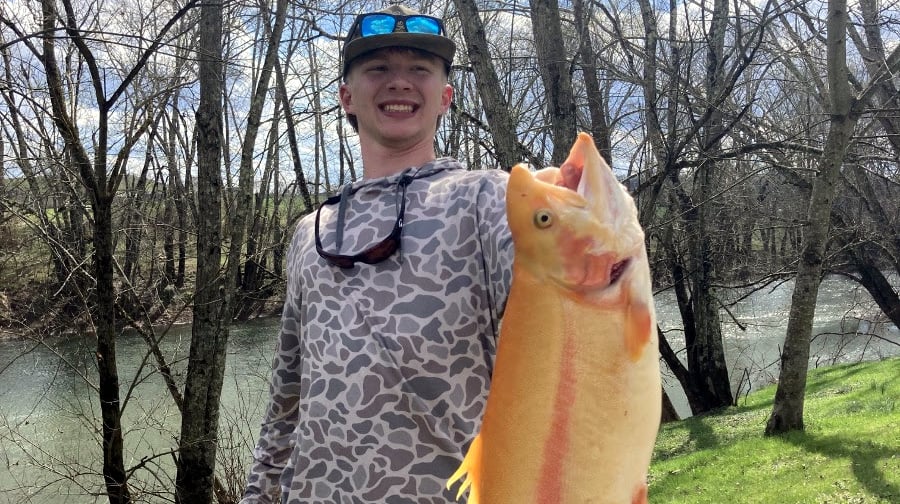
SMOKE HOLE, W.Va. — Hunter Rohr, 15, of Buckhannon, West Virginia, has caught a golden rainbow trout that set state records for length and weight, according to biologists with the W.Va. Division of Natural Resources.

Rohr caught the 28-inch, 11.84-pound trout in the Smoke Hole section of the South Branch of the Potomac River in Pendleton County using an egg sack on a four-pound test line. The new state record was confirmed by biologist Jim Walker.
Gerald Estep held the previous length record when he caught a record 27.5-inch golden rainbow trout in 1987 at Stonecoal Lake in Lewis County. Charles Lilly, Jr., held the previous weight record with a 9.72-pound golden rainbow trout caught during the Gold Rush trout fishing event in 2023 at Little Beaver Lake in Raleigh County.
Rohr’s catch came during the annual West Virginia Gold Rush event, a statewide spring fishing program run by the division that stocks lakes and streams with thousands of bright golden rainbow trout.
Designed to boost participation, the rush gives anglers—especially beginners and families—a better chance to catch fish while kicking off the state’s peak fishing season.
Brett McMillion, director of the division, said Hunter’s trophy catch exemplifies West Virginia’s growing capacity as a national fishing destination.
“We are proud to recognize Hunter’s accomplishment,” McMillion said. “His record-setting golden rainbow trout showcases the many fishing opportunities here in West Virginia and demonstrates the passion anglers of all ages bring to the sport.”
The U.S. all-tackle rainbow trout record, 28 pounds, 8 ounces, was caught by Sean Konrad in Lake Taneycomo in Missouri. Konrad is also notable for catching the world-record rainbow trout, weighing 48 pounds, in Canada, making him one of the most prominent anglers in the International Game Fish Association’s record books.
To learn more about state fish record categories, check page 24 of the West Virginia Fishing Regulations Summary, available to download at WVdnr.gov/fishing-regulations. Information pertaining to the Trophy Fish Citation and Master Angler programs can be found on page 27.
All anglers 15 and older must have a West Virginia fishing license, which can be purchased online at WVFish.com. Anglers are reminded that a trout stamp is required when fishing for trout.
About Rainbow Trout in West Virginia
The rainbow trout (Oncorhynchus mykiss) is a species of freshwater fish native to the cold-water tributaries of the Pacific Ocean in Asia and North America. A member of the salmon family, it’s widely identified by a pink-to-red lateral stripe running along its sides and a speckled pattern of black spots across its body and fins. The species exhibits considerable variation in size, coloration, and life history depending on the environment.
Rainbow trout occur in resident (freshwater) and anadromous (migratory) forms. The migratory form, commonly known as “steelhead,” migrates to the ocean before returning to freshwater to spawn.
Resident populations, such as those native to West Virginia, remain in rivers, streams, and lakes throughout their lives. Spawning typically occurs in spring, when females excavate gravel nests, or “redds,” in well-oxygenated streambeds where eggs are deposited and fertilized.
Highly adaptable, rainbow trout have been introduced to every continent, except Antarctica, for recreational fishing and aquaculture. They prefer clear, cool water with abundant oxygen and are sensitive to pollution and habitat degradation, making them important indicators of aquatic ecosystem health. Their diet includes aquatic insects, crustaceans, and smaller fish, with feeding behavior varying by habitat and life stage.
Rainbow trout are among the most economically and culturally significant sport fish in the world. They are managed extensively by agencies such as the International Game Fish Association and numerous regional wildlife departments, which regulate stocking, harvest, and habitat conservation. In addition to their recreational value, rainbow trout are widely farmed for food, contributing to global aquaculture production.
The species’ broad distribution, ecological flexibility, and popularity among anglers have made it one of the most studied and recognized freshwater fishes worldwide.