
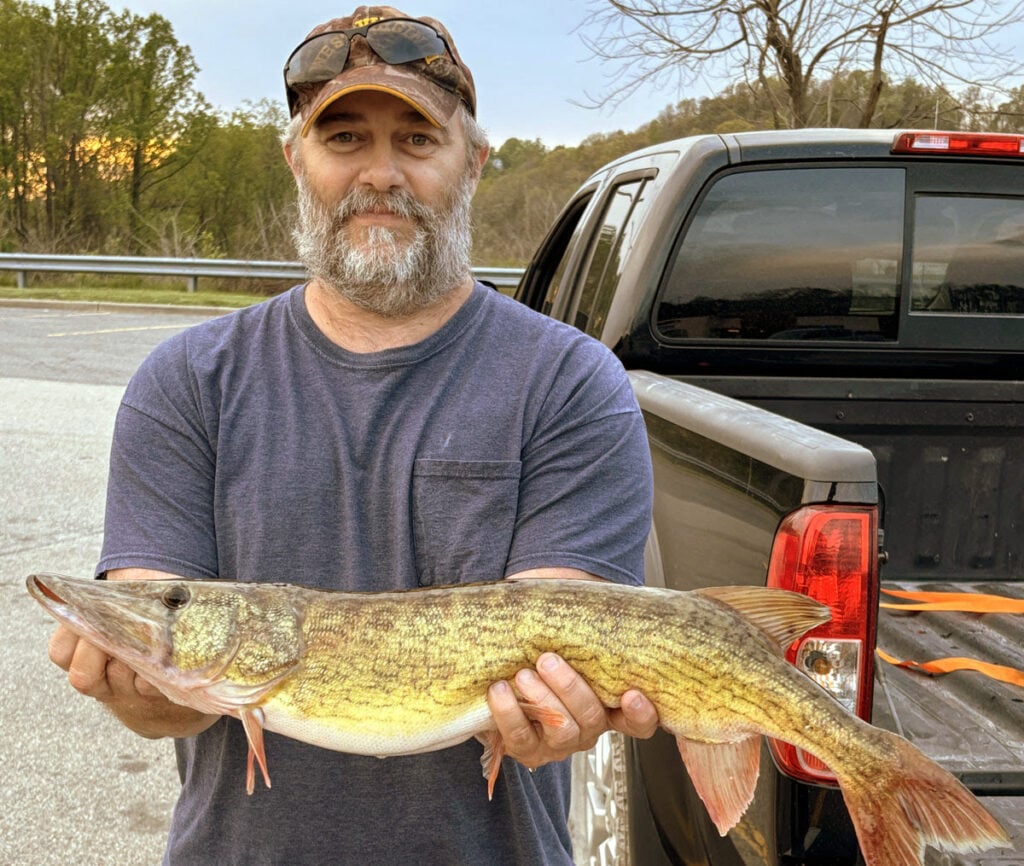
REEDSVILLE, W.Va. — Matt Born, of Reedsville, in Preston County, West Virginia, has caught a new state-record chain pickerel at a pond in the county.

He landed the 27.95-inch, 5.65-pound fish on April 21 using a homemade spinner on a four-pound test line, according to biologists with the W.Va. Division of Natural Resources.
Born broke his own length record from 2019, when he caught a 27.87-inch chain pickerel from Upper Deckers Lake in Preston County.
The popular sport fish, the chain pickerel is an energetic fighter when hooked. A distinctive, dark, chain-like pattern extends across its greenish sides. However, it is most common in lowland states along the Gulf and East coasts. Its nicknames include the “southern pike,” “grass pike,” “jack,” “jackfish,” “gunny,” and “eastern pickerel.” In central Florida, it’s known as “Gatorfish.”
Steven Demma holds the state weight record for a chain pickerel—taken with a 6.19-pound fish in 2001 at Tuckahoe Lake in Greenbrier County.
The new record was confirmed by division fisheries biologists Dustin Smith and E.M. Dean.
The world record chain pickerel is a 9.4-pound fish caught in Homerville, Ga., on February 17, 1961, by Baxley McQuaig, Jr. The world record for length is 26 inches, set in Lake Ontario in 2019 by Burnie Haney.
To learn more about state record fish categories, visit wvdnr.gov/fishing/state-records or consult page 24 of the W.Va. Fishing Regulations Summary.
Anglers 15 and older must have a West Virginia fishing license, which can be purchased at WVFish.com. Anglers are reminded that a trout stamp is required when fishing for trout.
Chain Pickerel Spreads Across Eastern Waters, Raising Ecological Concerns
The chain pickerel (Esox niger) is drawing increasing attention from anglers and conservationists due to its expanding range and aggressive feeding habits.
First identified in 1818 by French naturalist Charles Alexandre Lesueur, the species is now widely distributed from southern Canada to Florida and as far west as Texas.
Easily recognized by its green body and distinctive chain-like markings, it’s a stealthy predator commonly found in lakes, rivers, wetlands, and even brackish waters. While capable of growing more than 30 inches long, most are smaller, and anglers typically catch fish under two pounds.
The species’ adaptability has contributed to its spread, but in some regions it has become a serious ecological concern. In parts of Atlantic Canada, including Kejimkujik National Park, it’s considered invasive, and its introduction has disrupted native fish populations. The fish is a voracious predator that feeds on smaller fish, amphibians, and even small mammals.
Chain pickerel reproduce in late winter and early spring, depositing up to 50,000 eggs in shallow, vegetated waters. With no parental care required, the young quickly become active hunters, contributing to rapid population growth in favorable habitats.
Despite ecological concerns, the fish remains popular among anglers for its aggressive strikes and energetic fight when hooked.
Experts note that while the chain pickerel plays a natural role within its native range, its continued spread into new waterways could pose challenges for fisheries management.