
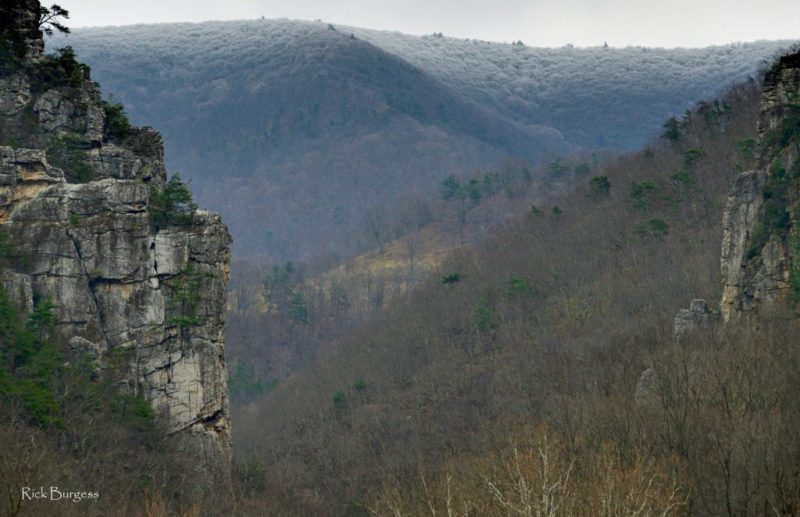
THOMAS, W.Va. — The Allegheny Mountains in eastern West Virginia grow treacherous in winter—and hardly more so than along the western front of that range, which bears the brunt of blizzards coming off the Monongahela Valley.

In 1885, twenty-year-old James B. Helmick came face-to-face with the savagery of the Alleghenies while hunting on Backbone Mountain. His harrowing tale, which was recounted in the W.Va. Heritage Encyclopedia, captures the essence of life on the edge of a hostile wilderness haunted by panthers and other relentless foes.
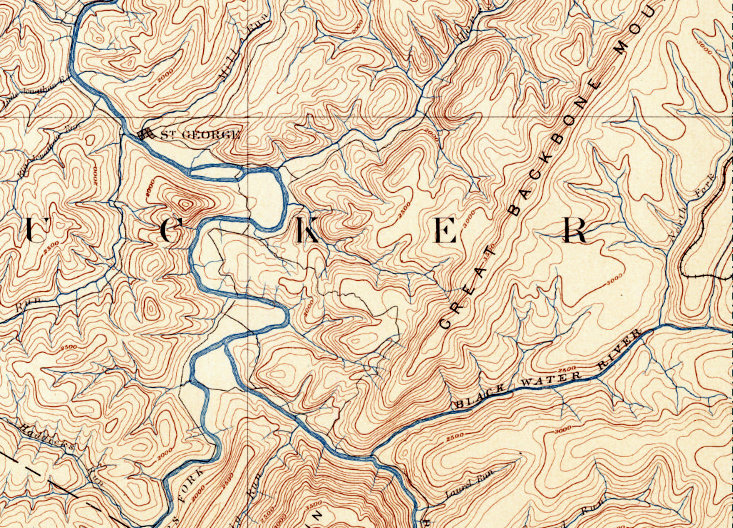
On November 22, 1885, I left home before breakfast to go to Abe Helmick’s to kill a beef. This was on Monday. In a little while, after I reached Abe Helmick’s, Abe Dawson came along with his gun, saying that he was going across the Backbone Mountain hunting, and he wanted me to go with him. I felt tired after having walked from 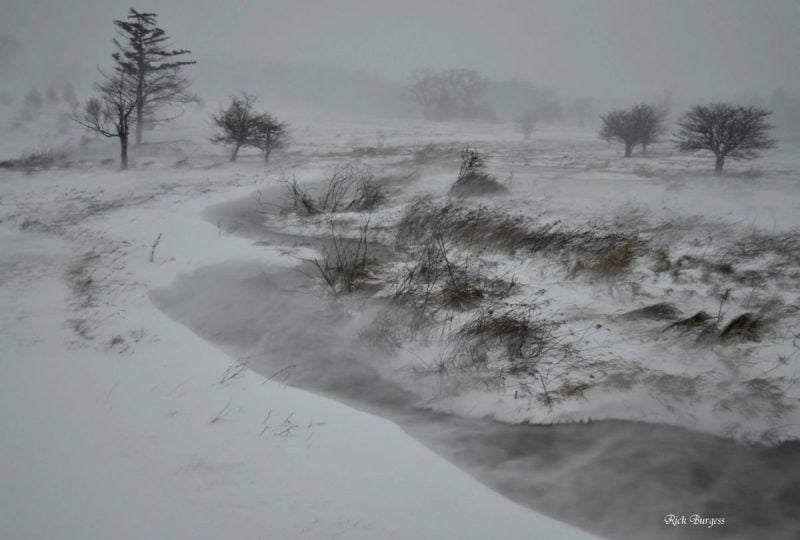 Driven Snow, Canaan Valley[/caption]
I could see plainly that night was coming fast, and I had been traveling through snow and 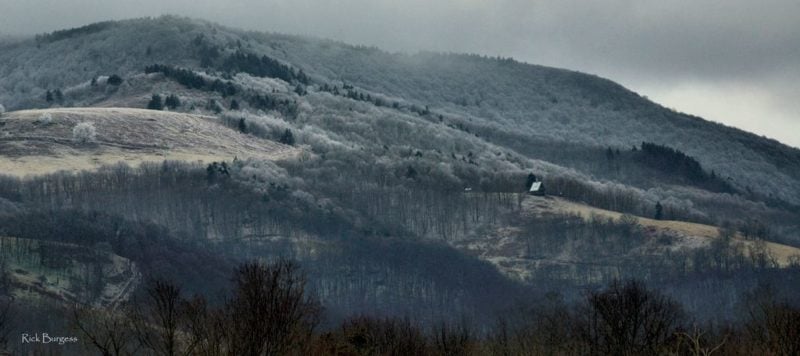 Snow in the Alleghenies in Tucker County, West Virginia. Photo courtesy Rick Burgess.[/caption]
When it began to break day, I came out of the den and intended to try again to get to the Black Fork in the same direction that I had gone the day before. I could not walk without holding on to something and of course could not move from where I was. I thought when the day grew warmer my feet would become all right and I could get out. I did not feel cold but was numb and weak. Since the first day, I was not particularly hungry, but now the feeling of hunger began to return. I felt like I could eat anything, no matter what it might be.
While I was standing there undecided what to do, a large hawk lit on a tree just across from me. I was determined I would shoot it and eat it, and as carefully as possible I raised the gun, but it failed to fire.
After the hawk escaped, I set myself to work the best I could with my frozen fingers, to get the damp load out of the gun and to get ready to shoot anything else that might come along. After several failures, the load went off. It now occurred to me that by discharging my gun I might let those who were hunting for me know where I was. I felt certain that they were in the woods searching for me and might not be far off. I loaded my gun as heavily as I thought it would stand and discharged it. The report was loud, but it didn’t seem to go any distance and died away among the thick forest trees or was drowned in the desolate and roaring wind among the tops of the pines.
No answer came. I loaded the gun still heavier and fired again and again. Still, no definite answer came. Two or three times it seemed to me that I heard the report of a gun and someone calling, but as the day wore away even this ceased to reach me. Still, I fired away until late in the afternoon when I accidentally spilled my gun caps, and my hands were so numb that I could not pick them up.
This was about the most unfortunate thing that could have happened to me, for I depended on my gun to help furnish me something to eat as well as a weapon to defend myself against the wild beasts. I felt certain that they were constantly prowling around in the laurel near me. I could not pick up my gun caps, and with an empty gun I settled down to spend another night in the wilderness.
I crawled back under the tree to go to sleep. Once or twice I thought of my gun not loaded and what would happen if some wild animal should come. Knowing that I was powerless to defend myself I lay down and thought as little of it as I could and soon fell asleep and dreamed that George Jennings and Raymond Phillips came to me. They talked awhile and then went off and left me. Sometime during the night I awoke and found myself unable to turn over or scarcely move. I had become wedged in under some roots in such a manner that I was powerless to extricate myself. My feet had no feeling. To be lost in the woods was bad enough, and it was still worse to suffer with hunger, thirst and cold, but altogether they were not so terrible as the thought of having to die wedged in that tree, unable to help myself.
I knew not at what moment some bear or panther would find me, and I could not in any manner defend myself. The thought of this caused me to put forth greater exertions and struggle still more desperately to get free. The little strength that was left in me was nearly exhausted in my efforts, and it seemed to do no good, and so I resigned myself to my fate.
I don’t know whether I fell asleep or became unconscious from some other cause, but when I awoke again to a realization of my condition, I still was pressed under the roots and fearfully cramped. Recovering myself as much as possible, I made one more desperate effort and freed myself. I immediately fell asleep and lay in a half-conscious stupor until daylight Thursday morning.
I now had no settled plan. I did not intend to do anything more. I thought people might find me and take me out, but if they did not, I never would get out. I crept out of the den and found myself unable to stand unless I could hold something. I did not feel hungry as on Tuesday before but still could have eaten almost anything.
Late in the morning, the sun became visible through the pines, but it never occurred to me that I could guide myself out by it. Such a thought never entered my head anytime during the five days that I was in the woods. I stood around, leaning against the laurel and the trees for an hour or two, then crawled back in the hole and lay down. I had heard the reports of guns the day before in the distance. I knew that people were hunting for me, and I had some hope that they would find me. The more I thought of it, the more certain I felt that they would reach me that day, and at last I decided to come out where I could see and hear better, if they should come near and fire any guns.
Scarcely had I gotten into the open air when I distinctly heard the heavy boom of a gun far off, but could not tell the direction. After a while, I heard it again. Toward noon I heard it again. I afterward ascertained that these reports were from William Channel’s musket. He must have loaded it with four charges of powder. The first reports were heard for miles.
I expected every hour to see them come in view, but hour after hour passed, and still, they did not come. During the afternoon several times I thought I could hear people yell, but as evening came the sound died away, and all became still—except the eternal roaring of the winds through the timber. The day had been a long one, the longest of all since I had gotten lost. The sun went down, and night settled on the forest, and still, no one came.
There was no choice with me but to crawl again back into the den under the tree and run the risk of becoming wedged in there and nearly dying as I had nearly done the night before. So I crawled into the den. This was Thursday night, and I had eaten nothing of account since Monday morning. I had partly gotten over my ravenous hunger of the day before and now could hardly tell whether I was hungry or not. I had a peculiar feeling, which may have been one form of hunger. I was weak and nervous, and all my courage and ambition seemed to have left me. I cannot say that I cared much whether I lived or died.
I had not taken a drink of water since Monday. I now felt that I must have a drink of water. Up to this time I had refrained through fear that the water would make me sick or probably kill me. I felt now that I must have a drink or die. The creek was in five feet of me, but the bank was steep, and in the dark I was afraid that I might fall in the water and drown. I decided to wait until morning, but in the meantime I ate snow to help my thirst and froze my mouth in a fearful manner.
When I settled down for the night, it was quite dark, and I was so drowsy that I almost ceased to think, and I was beginning to dream. I suddenly aroused. It seemed as though someone had actually called me, but whether I had actually heard it or not or whether it was only a dream I could not tell. I listened intently, and in about a minute I plainly heard a voice. It was the direction I thought was home. I thought that they were coming at last, having followed my tracks in the dark, and, thinking I could not be far off, were calling me. I answered and heard the voice again immediately. I kept answering, and it came nearer. I did not intend to leave the den where I lay but intended to do so in a moment or two, as soon as the persons should come up. Within ten steps of me it uttered a terrific cry, and at once I recognized it was not a person but a panther.
It was on the opposite bank of the creek, not ten steps from me. As soon as I discovered what it was, I lay quiet, expecting that it would find me and drag me out. I was not afraid. l did not fear anything then. The beast stayed there on the bank for some time and yelled and then moved off through the laurel, screaming as it passed out of hearing. After a while I heard it coming back, screaming still, but it did not come so near, and again went off. I think the wind was blowing from it to me, and not being able to scent me, the panther did not know where I was. After that, I fell asleep and don’t know whether it came again or not, but when I awoke again towards morning I heard it again still yelling. But then it was far away in the direction of Black Fork.
I now began to think about my condition—where I was and what would become of me. I knew to remain in that place I would die, for the hunger, cold, and thirst had already almost worn me out. I felt thirst more than anything else then, and there was water nearby. I was determined to drink even if it killed me. It would only be death. Certainly no worse than to die of thirst.
I began to study whether I could get down the creek to the Black Fork and thence make my way out. When I crawled I found my feet were the hardest to get along, and I thought it was because of the weight of my shoes, but it was not. The only way possible for me to get along was to crawl, and that would be slow work, dragging myself along with my hands through the laurel and snow. It was the only way possible, and I made up my mind to try it. I first tried to take my shoes off, but my feet were swollen until my shoes were so tight that I could not remove them, not even untie the strings. My hands were numb and useless.
I managed to get my knife from my pocket and commenced cutting my shoes off. In doing this I cut my foot from the instep to the toes and laid open an ugly gash, but I did not feel it. I did not know that I had cut myself until I saw the wound. The other shoe was cut off without hurting the other foot, and then I found myself ready to travel with only my socks on my feet.
It did not help the matter, now that my shoes were off. I could not take a step. My feet refused to be lifted from the ground and had no more feeling in them than if they had been blocks of wood. I hardly knew what to do next, but I thought that in the course of a few hours my feet would recover their feeling, and I could then travel. But by this time my thirst returned, and I crawled down to the water and drank, and my cut foot dragged along on the ground and left a trail of blood. Returning to my place, I leaned against a tree for my feet to recover their feeling so I could walk. I intended to crawl, provided I could not walk in an hour or so.
About nine o’clock I heard a gun fired seemingly much nearer than the one I heard the day before and as near as I could hear in the same direction. Later I heard another shot, and I began to hope that those men were hunting for me and would soon reach me. I had been disappointed so often that I was almost unwilling to hope anything of the kind, for I find it better not to expect luck than to expect it and not get it.
At about 10 o’clock I heard more firing of guns, still nearer and, almost immediately, I plainly heard someone shouting and another person in a different direction answering. I replied at the top of my voice, and they at once answered me. I expected every minute to see them come up. An hour passed, and they did not come, although I could still hear them calling one another and calling to me. At noon they came in sight.
S. E. Parsons and A. L. Helmick were the first persons who reached me. In a few minutes the rest of them came up, and I found myself among friends at last, after more than one hundred hours in the woods without fire or a bite of food to eat.
Note from the Editor:
Mr. Helmick was carried out of the forest on a rude stretcher manufactured of poles, coats, and sacks. So thick was the laurel that a road had to be cut with an ax, and it was nearly dark before the top of the mountain was reached, just back of Little Sugarlands. A horse was brought to the top of the mountain, and from there Mr. Helmick rode home. Dr. A. E. Calvart was called that night, and Mr. Helmick’s feet were found to be still frozen solid, and his hands and face were frozen. His feet were thawed in cold water and were painfully swollen. He was thought to be getting along in a fair way until two weeks later when it was found that gangrene had set in, and Dr. Baker found it necessary to amputate the toes of both feet and a few days later remove part of the right foot.
Sign up for a FREE copy of West Virginia Explorer Magazine in your weekly email. Sign me up!