





Communities
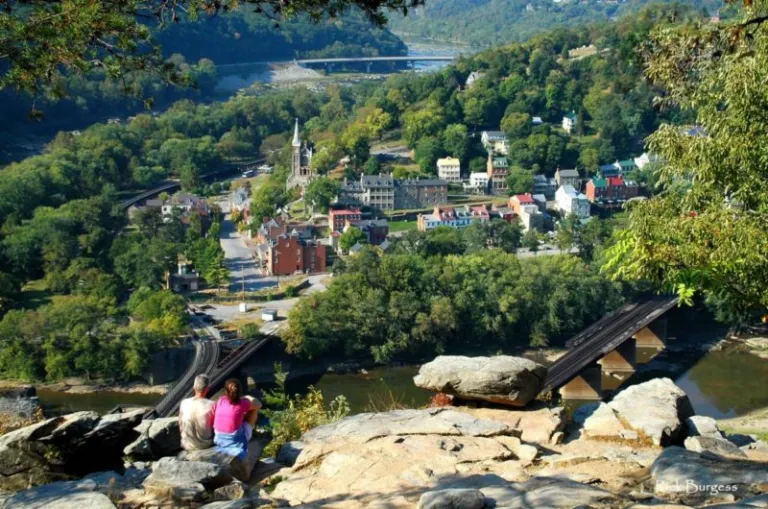
Hikers take in the view of historic Harpers Ferry, one of the oldest communities in West Virginia, from Maryland Heights.
West Virginia law recognizes four principal forms of government—counties, regions, and incorporated cities and towns. Many small unincorporated towns and villages pepper the state. The following is a guide to more than 350 West Virginia communities.
West Virginia Communities
West Virginia communities are listed here in order of size, from smallest to largest.

West Virginia is unique among the U.S. states and commonwealths in its community development patterns, which are largely determined by its terrain. In the early 1900s, railroads penetrated deep into its interior in search of extractable wealth, though by the turn of the 21st century, the tide of industrialism had ebbed, leaving behind a landscape of small communities in a singular rural environment.
- Cities & Towns: The smallest unit of local government recognized in West Virginia is the incorporated community or "municipality," also known as a town or city. Towns and cities operate independently of the counties in which they are located and maintain their own governments.
- Counties: West Virginia is divided into 55 counties, most of which were established before West Virginia was created in 1863. Most county bounds encircle a territory principally defined by ridges and river drainage areas. Most counties in West Virginia are relatively rural.
- Regions. West Virginia has been divided into many complex regions over time and by different agencies. Our editorial department has arranged the state into 12 regions based on cultural patterns and geographic determinants. These are cultural boundaries and do not overlap with state travel bureau boundaries.
- West Virginia. Though diverse, the State of West Virginia itself may be approached as a distinct community due to its controversial creation during a period of political upheaval and its condition as the only state located wholly within the Appalachian region of the eastern U.S.
Convention & Visitors Bureaus (CVBs)

Are you searching for travel information specific to a West Virginia region? The friendly folks at West Virginia's convention and visitors bureaus are available to help arrange vacations specific to our various communities, whether you're planning a short trip for yourself or an extended stay for a large group. Find a CVB now to help you plan your trip.
Patterns of Community Growth in West Virginia
As might be expected, the most populous communities in West Virginia -- Wheeling, Charleston, Huntington, Parkersburg, and Morgantown -- developed along rivers, accommodating transportation and water power. Extractive industries, such as mining and timbering, saw the birth of communities that quickly waxed and waned, most notably in rugged mountain regions. Many of these latter communities are now ghost towns, and others have entirely disappeared.
Two official forms of community recognized by West Virginia law are counties, school districts, and municipalities, also known as towns or cities.
Advertisement
Ethnic Communities in West Virginia

The first European settlers in West Virginia were most usually of Scots, English, and Scots-Irish descent. Many retreated far back into the highland forest and became mountain people, braving harsh conditions in virtual isolation. Others farmed the fertile valleys. During the American Industrial Revolution, African-Americans and European-Americans of many ethnic origins arrived to work in mines and factories in and near its northern and southern coalfields and in forests throughout the state. In the late 1900s, many International residents moved to the state, settling primarily in its largest cities. As a result, West Virginia is home to many diverse ethnic communities.

Stay Connected
Subscribe to our Newsletter
Latest Articles
Nightfall’s Value: Light pollution can diminish real estate worth in W.Va.
WINFIELD, W.Va. — An increasing number of new West Virginia residents are being drawn to its rolling hills and quiet valleys to escape brightly lit cities and reclaim the enchantment of pitch‑dark night skies. But while the dark skies represent a precious amenity, the...
Inside Appalachian Escapes: Themed rentals, escape rooms, and a love letter to West Virginia
FAYETTEVILLE, W.Va. — What began as a search for an affordable retirement option has turned into one of southern West Virginia’s most imaginative tourism ventures. Nate Adams and his wife, Rachel Adkins, are the founders of Appalachian Escapes , a growing collection...
West Virginia bottler wins silver award at international water competition
BERKELEY SPRINGS, W.Va. — Le Sage Natural Water, of Lesage, has been awarded a silver medal for its purified water at the 36th annual Berkeley Springs International Water Tasting competition in the eastern panhandle of the Mountain State. The world’s most prestigious...
West Virginia uniquely prepared to dominate 21st-century outdoor economy
CHARLESTON, W.Va. — West Virginia is uniquely prepared to dominate in the 21st-century outdoor economy of the U.S., thanks to its unmatched potential for outdoor recreation, says a spokesman for The Nature Conservancy. The state is attracting new residents in record...
Flood risk outpaces warnings, advocates say, as W.Va. considers changes to resiliency fund
CHARLESTON, W.Va. — As the W.Va. House of Delegates considers changes to Senate Bill 390, the West Virginia Rivers Coalition warns that the state risks narrowing its flood strategy at a time when disasters are becoming more frequent, more costly, and more destructive....