





Prehistoric West Virginia was never a so-called “uninhabited” hunting ground
CHARLESTON, W.Va. — When I moved to West Virginia in 2013, just out of grad school and anxious to learn more about the local archaeology, it didn’t take long to be introduced to the idea that West Virginia was too rugged and remote for Native Americans to live here permanently.

I was told that the state was a “hunting ground” for tribes in surrounding states. While the hunting ground concept isn’t entirely wrong, the reality of Native American life in West Virginia is more vibrant and complex.
West Virginia was an interaction zone for many people
Archaeologists refer to this time period as the “Protohistoric,” which spans the arrival of the first European-American explorers around 1550 AD through the region’s colonization, from approximately 1700 to 1800 AD. We generally assign Protohistoric archaeological sites to the Monongahela or Fort Ancient cultures, which aren’t easily matched to named tribes of later periods.
According to a cultural affiliation statement authored by archaeologist Bob Maslowski, protohistoric West Virginia encompassed a diverse range of Siouan-, Algonquin-, and Iroquoian-speaking groups. These, respectively, include the Osage and Omaha, the Shawnee and Delaware, and the Seneca and Cherokee, among others.
Artifacts such as corncob-impressed pottery and “weeping eye” shell masks, both of which are considered Siouan, found in Fort Ancient villages, which are often associated with Algonquin culture, suggest communication, trade, and intermarriage.
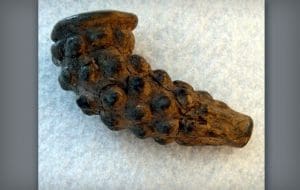
Iroquoian-style pipe was discovered at the Marmet archaeological site (46-KA-9). (Provided by Darla Spencer)
The Marmet village site, located near present-day Charleston, for example, features these intermingled artifacts, in addition to animal effigies and a “noded” pipe, both of which are Iroquoian, as well as European trade goods.
According to a book by archaeologist Darla Spencer, the Marmet archaeological site, named 46-KA-9, was occupied as late as 1700, while another Fort Ancient village site in Logan, named 46-LG-4, yielded a date of 1770.
Spencer summarizes that “West Virginia was an interface between Fort Ancient people to the west and Siouan-speaking people to the east” and that people of the Fort Ancient culture were “more likely a regional cultural tradition that includes more than one ethnic or linguistic group of people.”
Primary sources from European-American explorers also support the idea of extensive protohistoric trade and interaction. For example, the 1671 journal of Robert Fallow describes a tribe of “Salt Indians” near Charleston who traded the area’s natural salt deposits and were feared by their neighbors. This chapter of Native Americans in West Virginia’s salt industry is often overlooked.
Old Fields and Villages
First-hand accounts describe early explorers, such as Gabriel Arthur, visiting these villages, and land speculators, including George Washington, describing their recent remains in advertisements.
It’s even possible that these speculators created the hunting ground myth because abandoned lands would be more attractive to settlers who were worried about Native American violence.
In cases where Native American villages and fields were found empty by settlers, this period of “abandonment” was often very short, likely less than a generation in many cases.
A U.S. Forest Service report lists accounts from the 1670s to the 1770s that describe fields only recently gone fallow and covered by white clover, broom grass, and even visible corn stalks. Similar overgrowth can be observed on modern farms when a pasture or hayfield is even briefly left unused.
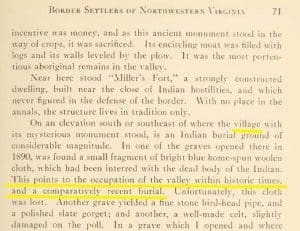
Excerpt from McWhorter (1915), Border Settlements of Northwestern Virginia
A historic text by amateur archaeologist Lucullus McWhorter describes the burial cloth from the protohistoric period recovered in 1890 and the remains of a village along Hackers Creek that had been reforested by trees, then a mere 12 inches in diameter, as of 1821.
Other science-based research also supports the idea that recent reforestation occurred between periods of occupation by Native American and European-American peoples. Dr. Kristen de Graauw of Historic Timbers Dendroarchaeology uses tree rings to date log buildings and other timbers.
She says that her research cannot alone provide “explicit proof against the hunting myth, but what it demonstrates is that synchronous forest alternation occurred around 1650-1670, i.e., regrowth of trees on land that was likely previously cleared.” She plans to continue exploring this rapidly growing, second-growth forest, and her research is further described in the West Virginia Explorer Magazine article.
Not Truly Abandoned
If we assume there were some uninhabited lands, it’s important to note that they were not necessarily empty because Native Americans didn’t want to live there. It was a side effect of European-American expansion elsewhere, possibly exacerbated by drought and other factors.
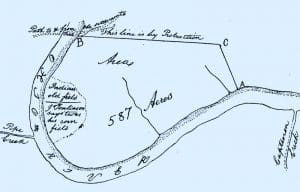
Old fields depicted by George Washington south of Moundsville (Provided by Grave Creek Mound Archaeological Complex, WVDACH)
Historical sources describe how the original native groups were driven out or “conquered” by the Iroquois, who were experiencing their own pressures from the fur trade, as well as conflicts between Britain and France, and diseases introduced from Europe. Events like Lord Dunmore’s War in 1774 show direct attempts by settlers to drive out Native Americans.
We must also recognize that native use of a hunting ground was different than recreational hunting today. While protohistoric Native Americans did live in permanent settlements, they would have traveled far from their villages for seasonal hunting that was a crucial part of their diet. Visits from Ohio or Pennsylvania tribes were not day-trips or even long weekend trips. Their temporary hunting camps were important and likely involved repeated use of specific locations.
All of these discoveries alter our perspective from a narrative of unwanted or unclaimed West Virginia lands ready for the taking to one of colonialization and sometimes violent conquest.
It’s easy to think about Native Americans as a generic whole and make broad statements about their settlements, diet, beliefs, stone tools, and other indigenous technology. However, understanding the reality of their displacement creates a personal and empathic connection with the past.
West Virginia folklore offers us stories of indigenous heroes, such as “Princess” Aracoma, who may be buried at the Logan village site; Chief Cornstalk; Buckongahelas; and Tecumseh, whose histories blend into the very Appalachian struggle for freedom and love of the same wild and wonderful lands we enjoy today.
Charity Moore is a director and social-media manager with the Council for West Virginia Archaeology. A Pennsylvania native who received her graduate degree in England, she is employed by an environmental consulting firm in West Virginia. She is passionate about researching the archaeology of her new home state. Message her at facebook.com/CWVArchaeology
Sign up to receive a FREE copy of West Virginia Explorer Magazine in your email twice weekly. Sign me up!

Inside Appalachian Escapes: Themed rentals, escape rooms, and a love letter to West Virginia
West Virginia bottler wins silver award at international water competition
BERKELEY SPRINGS, W.Va. — Le Sage Natural Water, of Lesage, has been awarded a silver medal for its purified water at the 36th annual Berkeley...
West Virginia uniquely prepared to dominate 21st-century outdoor economy
CHARLESTON, W.Va. — West Virginia is uniquely prepared to dominate in the 21st-century outdoor economy of the U.S., thanks to its unmatched...
Flood risk outpaces warnings, advocates say, as W.Va. considers changes to resiliency fund
CHARLESTON, W.Va. — As the W.Va. House of Delegates considers changes to Senate Bill 390, the West Virginia Rivers Coalition warns that the state...
We asked AI how its own data centers could pollute West Virginia. Here’s what it had to say
(The following article was generated partly by ChatGPT in response to a prompt about how data centers pollute. As ChatGPT is powered by data...
Inaugural W.Va. Outdoor Economy Summit to unite leaders around $2.1 billion growth
CHARLESTON, W.Va. — West Virginia’s outdoors are more than a scenic backdrop. They’re a strategic economic asset. That message will take...
West Virginia State Parks Foundation launches online merchandise store
HURRICANE, W.Va. — The West Virginia State Parks Foundation has launched an official online merchandise store, offering supporters a new way to...
West Virginia Travel Safety: What it means for residents and visitors in 2026
CHARLESTON, W.Va. — Travel safety in West Virginia is shaped less by headline-grabbing crime and more by geography, weather, and the realities of...
Did Abraham Lincoln and Jefferson Davis secretly meet in West Virginia?
PHILIPPI, W.Va. — Did Abraham Lincoln and Jefferson Davis secretly meet in what is now West Virginia just days after the first land battle of the...
Study finds WVU and its health system account for 17% of West Virginia’s economy
MORGANTOWN, W.Va. — West Virginia University and the WVU Health System together generate $14.3 billion in annual economic impact in West Virginia,...