








Kanawha Valley in W.Va. had highest concentration of burial mounds
SOUTH CHARLESTON, W.Va. — The Kanawha Valley in western West Virginia once had the highest concentration of burial mounds in North America, though most were destroyed.
According to the late archaeologist Darla Spencer, author of Woodland Mounds of West Virginia, more than 400 mounds have been recorded in West Virginia, and their presence was once so extensive that explorers couldn’t believe they were of Native American origin.

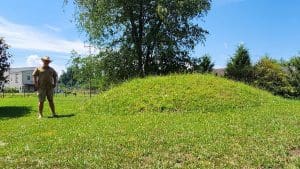
David Sibray visits the site of a potential prehistoric burial mound at Pinch, West Virginia.
Scholars long ago proved that indigenous peoples had raised the mounds, though Spencer and other archaeologists have worked to oppose a popular myth that an “ancient white race” had built them.
During the nineteenth century, widespread belief in North America of a prehistoric lost race existed, though modern science has long since disproved the idea.
“Early Europeans coming to the Ohio Valley, including West Virginia, thought the mounds must have been built by some earlier race of people and not the ancestors of living Native Americans,” Spencer said.
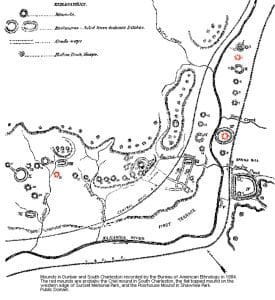
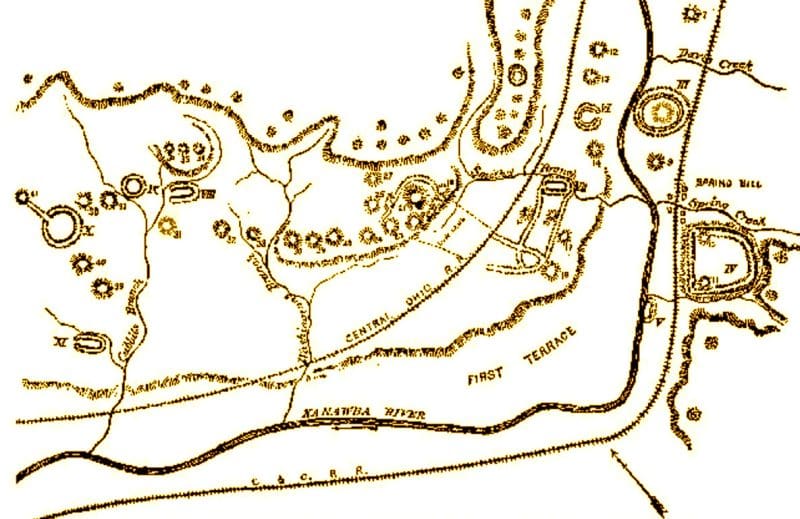
A full-scale map of prehistoric mounds appears to include existing mounds at Shawnee Park and South Charleston, which are highlighted in red.
To determine whose hands had raised them, the Division of Mound Exploration of the Smithsonian Institution’s Bureau of Ethnology performed its first systematic exploration in the valley in the 1880s.
“The conclusion was that the ancestors of Native Americans had built the mounds,” says Spencer, though non-archaeologists occasionally propose stories of non-American, supernatural, or even extra-planetary origins.
Spencer said she’d confronted legends that a race of giants above seven feet tall built the mounds. In 2014, an Internet story that claimed that the Smithsonian Institution had custody of giant skeletons began circulating.
Spencer also said no precious stones or metals have ever been found in mounds in North America, though what has been found indicates the builders were by no means isolated.

Darla Spencer is a professor of Native American Studies at West Virginia University.
“Exotic copper and marine shell items in the mounds indicate a network of trading connecting the region with the Gulf and Atlantic coasts and the Great Lakes region,” she said.
Though raised as monuments, most mounds were destroyed to make room for agricultural, residential, commercial, and industrial development.
A professor of Native American studies at West Virginia University, Spencer examined the Grave Creek Mound at Moundsville, West Virginia, and sixteen other mounds and mound groups of mounds in West Virginia in “Woodland Mounds in West Virginia.
Spencer, who was known for her pioneering books on the prehistory of West Virginia, died in 2022.
Her earlier book on Native American culture, “Early Native Americans in West Virginia: The Fort Ancient Culture,” was published by The History Press in 2016.
“Woodland Mounds in West Virginia” is published by Arcadia Publishing Co., a leading publisher of books of local history and local interest in the U.S.
Here is the full report on the 1890-’91 study from the Smithsonian Bureau of Ethnology.
Prehistoric burial mound in West Virginia contains remarkable secret
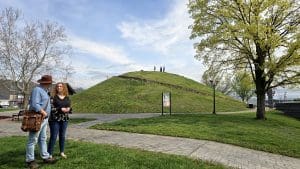
David Sibray and Amanda Hinchman visit the Criel Mound in South Charleston, West Virginia.
Rising above the end of South Charleston’s central avenue, the prehistoric Criel Mound—one of the largest burial mounds in West Virginia—has long captivated both onlookers and archaeologists alike. Yet, something about the mound is remarkably different: the orientation of bodies buried within is unlike that of other mounds, and this, says archaeologist Bob Maslowski, suggests something peculiar. READ MORE…
Sign up to receive a FREE copy of West Virginia Explorer Magazine in your email twice weekly. Sign me up!

Inside Appalachian Escapes: Themed rentals, escape rooms, and a love letter to West Virginia
FAYETTEVILLE, W.Va. — What began as a search for an affordable retirement option has turned into one of southern West Virginia’s most imaginative...
West Virginia bottler wins silver award at international water competition
BERKELEY SPRINGS, W.Va. — Le Sage Natural Water, of Lesage, has been awarded a silver medal for its purified water at the 36th annual Berkeley...
West Virginia uniquely prepared to dominate 21st-century outdoor economy
CHARLESTON, W.Va. — West Virginia is uniquely prepared to dominate in the 21st-century outdoor economy of the U.S., thanks to its unmatched...
Flood risk outpaces warnings, advocates say, as W.Va. considers changes to resiliency fund
CHARLESTON, W.Va. — As the W.Va. House of Delegates considers changes to Senate Bill 390, the West Virginia Rivers Coalition warns that the state...
We asked AI how its own data centers could pollute West Virginia. Here’s what it had to say
(The following article was generated partly by ChatGPT in response to a prompt about how data centers pollute. As ChatGPT is powered by data...
Inaugural W.Va. Outdoor Economy Summit to unite leaders around $2.1 billion growth
CHARLESTON, W.Va. — West Virginia’s outdoors are more than a scenic backdrop. They’re a strategic economic asset. That message will take...
West Virginia State Parks Foundation launches online merchandise store
HURRICANE, W.Va. — The West Virginia State Parks Foundation has launched an official online merchandise store, offering supporters a new way to...
West Virginia Travel Safety: What it means for residents and visitors in 2026
CHARLESTON, W.Va. — Travel safety in West Virginia is shaped less by headline-grabbing crime and more by geography, weather, and the realities of...
Did Abraham Lincoln and Jefferson Davis secretly meet in West Virginia?
PHILIPPI, W.Va. — Did Abraham Lincoln and Jefferson Davis secretly meet in what is now West Virginia just days after the first land battle of the...
Study finds WVU and its health system account for 17% of West Virginia’s economy
MORGANTOWN, W.Va. — West Virginia University and the WVU Health System together generate $14.3 billion in annual economic impact in West Virginia,...