


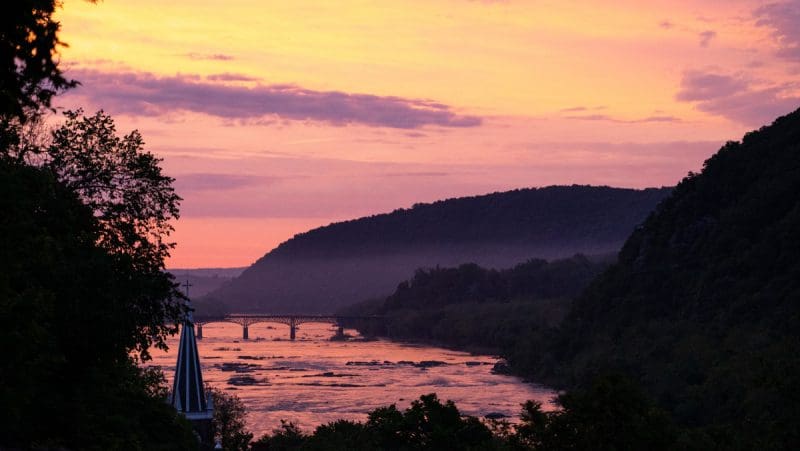
Shenandoah folk song: tracing the origins and meaning of a beloved American ballad
HARPERS FERRY, W.Va. — It’s fair to say that almost anyone who has listened to or read the history of American folk songs is familiar with the haunting melody and words of the “Shenandoah” folk song.

“Oh, Shenandoah, I long to see you,
Roll away, you rolling river
Oh, Shenandoah, I long to see you,
But away, I’m bound away,
Across the wide Missouri.”
It’s generally accepted that the song refers to two famous American rivers—the Shenandoah, which drains a scenic colonial valley in Virginia and West Virginia, and the great Missouri River, which drains much of the American West.
Anyone who loves John Denver’s “Take Me Home, Country Roads” knows that the song’s opening stanza mentions the Shenandoah River and Blue Ridge Mountains. Nineteen of the Shenandoah’s 55 miles are in West Virginia.
Origin of the word “Shenandoah”
The name “Shenandoah” was supposedly given to the river by George Washington, who surveyed much of the area before and after the Revolutionary War, in honor of Chief Skenandoa of the Oneida tribe of New York. Skenandoa had provided arms and food to the Continental Army, according to Carrie Hunter Willis and Etta Belle Walker in Legends of the Skyline Drive and the Great Valley of Virginia.
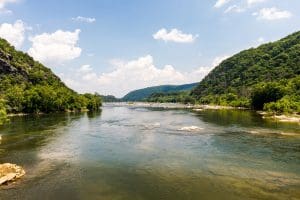
The lower third of the Shenandoah River courses through West Virginia. (Photo: Chris Weisler)
Yet, the name Shenandoah appears on many pre-Revolutionary maps and documents. Most regional histories claim the word derives from the Algonquin or Iroquoian languages and has an unclear meaning. The most prevalent version—first proposed by Joseph Doddridge in A History of the Valley of Virginia (1850) and repeated in the 20th century in several writings by historian John W. Wayland—is that it is a Native American word meaning “Daughter of the Stars.” This is the meaning heard most often by those who are native to or have lived extensively in its valley.
West Virginians might notice a similarity here with the name of the state’s great western river, the “Kanawha.” Both words end with the similar-sounding suffix “-wha.” Both are also derived from an aboriginal word with an unclear meaning. Both also have their origins in the highest elevations of the Appalachian Mountains. They flow northward until they reach the significant rivers into which they empty—the Ohio and Potomac.
Origin of the Shenandoah folk song
Over the years, singers and archivists have published various collections of American folk songs. Some traveled the country, recording and notating songs handed down orally by generations of balladeers. Among the best are the collections published by poet Carl Sandburg and folk singers Burl Ives, Pete Seeger, Jean Ritchie, and Woody Guthrie.
The collections compiled by Alan Lomax and his father, John Avery Lomax, are probably the most definitive. The elder Lomax was the first director of the Archive of American Folk Song at the Library of Congress. The younger assisted his father at the library and later served as director and advisor to the Smithsonian’s annual American Folklife Festival.
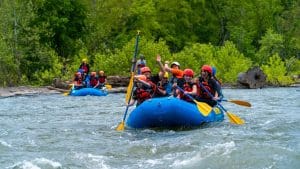
Whitewater rafters and kayakers paddle the Shenandoah River. (Photo: Jefferson County CVB)
All characterize the Shenandoah folk song as a sea shanty or chanty—a song sung by sailors while performing physical labor together. According to Alan Lomax, the song first appeared in print in 1876, in a magazine article that interviewed a former sea captain who claimed to have heard it in the 1850s.
How would a song about two inland rivers become a sea shanty? Lomax wrote that it was “a call from the homeland to the sailor wandering far out across the seas, a call … from the land itself, its rivers, and its familiar and loved hills.”
Matthew Sabatella, a professional folk singer and founder and director of the nonprofit educational group Ballad of America, claims the song originated as a ballad sung by French Canadian explorers and fur traders. They traveled the Mississippi River and its tributaries, including the Missouri, in the years before 1803, when the U.S. completed the Louisiana Purchase from France.
He accepts the explanation that Shenandoah was the name of an Indian leader, but says he believes that the original song was about a fur trader who wanted to marry his daughter. The trader sings to the chief, “Oh, Shenandoah, I love your daughter!” and devises a way to get the chief drunk and flee with the daughter “far away across the wide Missouri.”
Sabatella’s quotes in an online article on his Ballad of America website are pretty entertaining.
Westward Migration from Virginia
Keeping in mind that all of what is now West Virginia was part of Virginia until 1863, and that the sea captain who first published a written version of the song said he heard it around 1850, here is another explanation.
According to historian Otis K. Rice, in his books West Virginia: A History and History of Greenbrier County, the period between 1820 and 1850 saw a great migration of people from Virginia. Most of the best farmland was already settled and parcelled out among landholders’ families, forcing younger generations to seek land elsewhere.
Many families headed to the new states of Indiana and Illinois, which had entered the Union in 1816 and 1817, and beyond the Mississippi to Missouri, which had entered the Union in 1821. The 1850 census was the first to list the names of all persons in a household and their place of birth, and the records for those three states show that hundreds of people were born in Virginia.
In fact, the summary tables for Missouri’s 1850 census show 131,224 of the state’s 313,000 residents were born in states other than Missouri. The 1860 census tables show that just more than 95,000 born in other states were from Virginia.
Searching for new land was just one reason for the westward migration. Some probably went west to see what it was like. Others probably went to escape their lives or families in the East.
Here’s an account from my own ancestry
Around 1852, my maternal third great-grandfather deserted his family around the time of the birth of his youngest son. He was a stagecoach driver for the Porter-and-Belden stage line between Lewisburg and Charleston, Virginia. Supposedly, he was driving a stage west from Charleston to Guyandotte, near present-day Huntington, and just decided to keep going, leaving behind his wife, two daughters, and three sons.
At about the same time, his 15-year-old nephew, who had been orphaned as a baby and was being raised by his grandfather, decided to take off and follow his uncle out West to Missouri. Once there, he never found his uncle but was taken in by a local rancher who gave him room and board and a job as a wrangler.
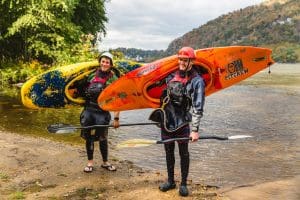
Kayakers fish and paddle the lower 30 miles of the Shenandoah in West Virginia. (Photo courtesy Jefferson County CVB)
He remained in Missouri for the rest of his life and became a prominent cattleman. This is the account he gave to the local newspaper in Salisbury, Missouri, when it interviewed him for its special edition commemorating Missouri’s centennial. At 84, he was described as one of the most prominent and oldest living residents of Chariton County. He died the following year.
In 1997, I traveled to Salisbury, Missouri, to see if I could locate any of his descendants and find out if they ever discovered what happened to his uncle. I was unable to locate any at the time, but with the help of some very nice and very patient ladies at the Chariton County Historical Society, I found the cemetery where this peripheral ancestor was buried, along with his wife and most of his children and grandchildren.
The cemetery is located at a crossroads in the middle of nowhere—a place called Roanoke. There was nothing there but the cemetery and a Union Church, a community church shared by people of different denominations. A few houses stood either way down the crossroad, but nothing else but farmland.
Out of curiosity, I asked the staff at the historical society about the name “Roanoke.” I mentioned I had come through some other small unincorporated places called “Greenbrier,” “Renick,” “Williamsburg,” “Martinsburg,” “Fayette,” “Vandalia,” “Staunton,” and even “Shenandoah.” I told them those were all place names from the Shenandoah, Greenbrier, and New River valleys of Virginia and West Virginia.
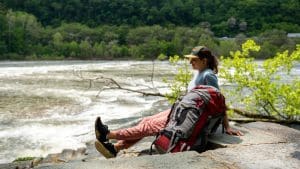
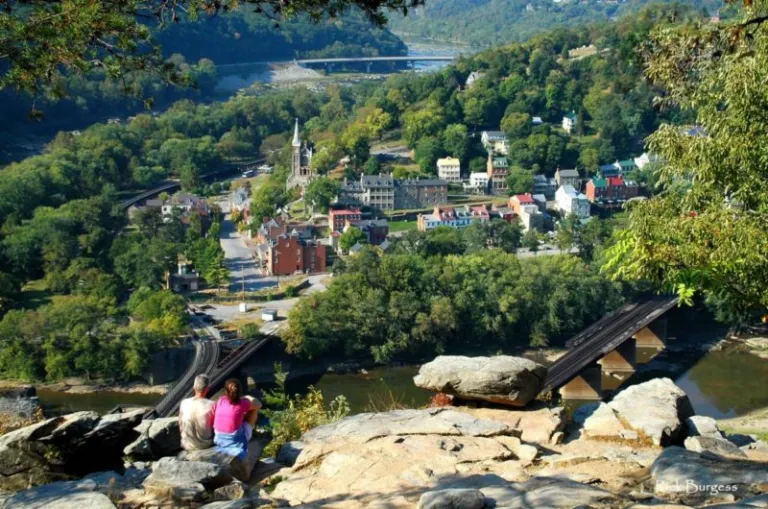
The Appalachian Trail crossed the Shenandoah River near its mouth at Harper’s Ferry. (Photo courtesy Jefferson County CVB)
They then told me that most of Chariton and nearby Howard counties were settled by migrants from Virginia who gave their new settlements the names of the communities they came from.
In the case of Roanoke, they said the oft-told story is that a family traveling west to Kansas or Colorado had an accident when one of the axles on their wagon broke, and no one within miles could repair it. So, they just unpacked, set up a camp, and decided to stay. They opened a small general store and helped establish the Union Church. Eventually, the store closed, the family drifted away, and nothing remained but the church and the cemetery.
The ladies asked me if I had ever heard the song “Oh, Shenandoah,” and I laughed and said, “Who hasn’t?” They told me they had always heard the song originated among the Virginia emigrants traveling west, who missed their Shenandoah Valley but were determined to keep going “across the wide Missouri” to a different, hopefully better life. And that was the first explanation of that song that actually made sense to me.
How much of this is true? No one can say. The origins of most folk songs will always remain unknown, as they have been handed down orally over hundreds of years, with variations across multiple generations and geographical areas.
But all of these are exciting and entertaining legends. As the newspaperman said to Jimmy Stewart’s character in the classic western “The Man Who Shot Liberty Valance,” legends are the heart of folk tales, and “when the legend becomes fact, print the legend.”
For more information on the Shenandoah folk song or traveling the Shenandoah Valley in West Virginia, contact the Jefferson County Convention & Visitors Bureau.

Inside Appalachian Escapes: Themed rentals, escape rooms, and a love letter to West Virginia
West Virginia bottler wins silver award at international water competition
BERKELEY SPRINGS, W.Va. — Le Sage Natural Water, of Lesage, has been awarded a silver medal for its purified water at the 36th annual Berkeley...
West Virginia uniquely prepared to dominate 21st-century outdoor economy
CHARLESTON, W.Va. — West Virginia is uniquely prepared to dominate in the 21st-century outdoor economy of the U.S., thanks to its unmatched...
Flood risk outpaces warnings, advocates say, as W.Va. considers changes to resiliency fund
CHARLESTON, W.Va. — As the W.Va. House of Delegates considers changes to Senate Bill 390, the West Virginia Rivers Coalition warns that the state...
We asked AI how its own data centers could pollute West Virginia. Here’s what it had to say
(The following article was generated partly by ChatGPT in response to a prompt about how data centers pollute. As ChatGPT is powered by data...
Inaugural W.Va. Outdoor Economy Summit to unite leaders around $2.1 billion growth
CHARLESTON, W.Va. — West Virginia’s outdoors are more than a scenic backdrop. They’re a strategic economic asset. That message will take...
West Virginia State Parks Foundation launches online merchandise store
HURRICANE, W.Va. — The West Virginia State Parks Foundation has launched an official online merchandise store, offering supporters a new way to...
West Virginia Travel Safety: What it means for residents and visitors in 2026
CHARLESTON, W.Va. — Travel safety in West Virginia is shaped less by headline-grabbing crime and more by geography, weather, and the realities of...
Did Abraham Lincoln and Jefferson Davis secretly meet in West Virginia?
PHILIPPI, W.Va. — Did Abraham Lincoln and Jefferson Davis secretly meet in what is now West Virginia just days after the first land battle of the...
Study finds WVU and its health system account for 17% of West Virginia’s economy
MORGANTOWN, W.Va. — West Virginia University and the WVU Health System together generate $14.3 billion in annual economic impact in West Virginia,...