



Giant skeletons and buried copper plates—a strange Marion County folktale
FAIRMONT, W.Va. — In the hills and river bottoms of Marion County in north-central West Virginia, stories have long circulated that blur the line between frontier memory and myth. Few are as strange or as enduring as a tale recorded by the late historian Glenn D. Lough in his book “Now and Long Ago: A History of the Marion County Area.
The account, presented by Lough as a record of what earlier residents reported witnessing, includes reports of eight-foot-long skeletons, ancient Indian mounds, mysterious copper plates, and a speculative link to the origins of the Book of Mormon.

Lough made clear that the story reflects belief and recollection rather than proven fact. Still, its persistence offers a revealing glimpse into how 19th-century Appalachians tried to make sense of the ancient landscape around them.
Eight-Foot Skeletons Along the River
One of the most striking claims comes from an interview Lough recounts between Adam O. Heck and a woman identified as “Mrs. Shearer.” According to her recollection, early settlers encountered human remains of extraordinary size along the Monongahela River and its tributaries.
“She said she had heard that these skeletons were, every one, eight feet long,” Lough wrote, adding that the bones were believed to have been washed from graves by floods near the riverbanks.
In one instance near Palatine, now Fairmont, Shearer claimed that pioneer John Beall measured the remains before reburying them. In another account, three similar skeletons were reportedly uncovered years later near the mouth of Paw Paw Creek during bridge construction.
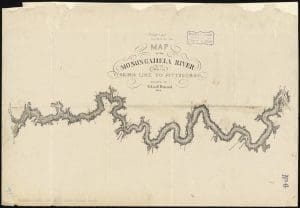
The Monongahela Valley, as shown on a 1841 map, extends north from Fairmont in Marion County to Pittsburgh.
“These bones,” Lough recorded, “were measured, and found to be about eight feet long.” When exposed to the air, she said, the bones “turned black and began to crumble,” prompting their burial in what was then the Jolliffe graveyard near Rivesville.
Archaeologists have long since disproved that prehistoric peoples in the region were “giants.”
A Preacher, Indian Relics, and Strange Plates
The story grows more elaborate with the arrival of a man named Rev. Solomon Spaulding, described as a preacher who came to the region in the summer of 1812 from Amity Village, Pennsylvania.
According to Shearer’s recollection, Spaulding was “more interested in Indian relics than in religion,” spending much of his time digging around old Indian roads, grave sites, and mound locations near present-day Prickett’s Creek.
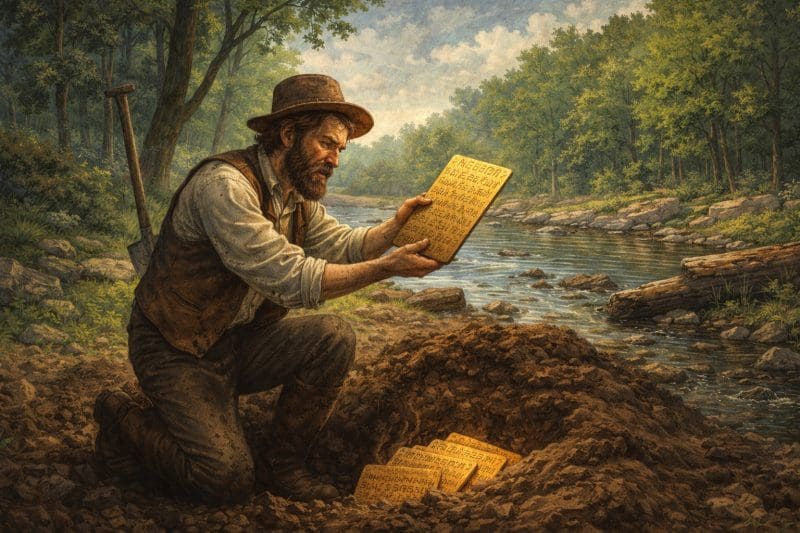
She further claimed that Spaulding unearthed copper plates engraved with writing “that nobody could read,” a discovery that allegedly led to a lawsuit in Pennsylvania years later.
“There was some matter of queer writing on the plates,” Lough quoted, adding that Mrs. Shearer believed the plates were later stolen and turned over to others.
A Speculative Link to the Book of Mormon
Lough devoted several pages to a controversial and now-discredited 19th-century theory suggesting that Spaulding’s unpublished manuscript—sometimes called “Manuscript Found”—may have influenced the Book of Mormon.
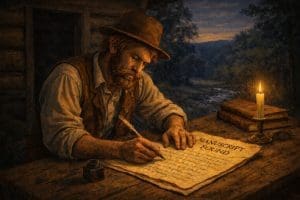
Lough said he believed Spaulding plotted and began writing ‘Manuscript Found’ while visiting in present Marion County.
Quoting older sources, Lough noted that some critics claimed Joseph Smith “had, by some means, got possession of Rev. Spaulding’s manuscript, and possibly made some changes in it, and called it the Book of Mormon.”
Lough also cited a sharply worded passage from the 1902 Encyclopaedia Britannica, which asserted, without modern scholarly support, that the Book of Mormon was “written in 1812 as a historical romance by one Solomon Spaulding.”
At the same time, Lough carefully included dissenting views. He noted that Rev. Levi Shinn, founder of Shinnston, rejected the idea that Spaulding physically found an ancient manuscript in a mound near present-day Hoult in Marion County.
Spaulding’s work recounts a group of Romans in the days of Constantine whose ship, blown off course by a fierce storm, crossed the Atlantic Ocean to what is now the northeastern United States. It recounts the history, wars, and religion of several indigenous groups encountered by the Romans.
“This writer does not believe that Spaulding found engraved copper or gold plates near Pricketts Creek,” Lough wrote, “but he does believe it more than probable that he plotted and began writing ‘Manuscript Found’ while visiting in present Marion County.” (Read also: “What is Manuscript Found?“)
Folklore, Not Proof
Modern historians and archaeologists do not accept claims of giant skeletons, engraved metal plates, or ancient manuscripts buried in West Virginia mounds. Such stories were familiar in the 18th and 19th centuries, when Native American earthworks were poorly understood and often attributed to lost civilizations or biblical peoples.
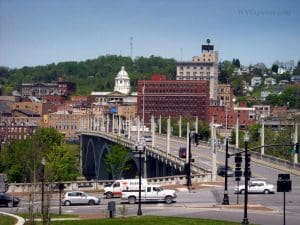
Jefferson Bridge spans the Monongahela River in downtown Fairmont, West Virginia
What gives Lough’s account lasting value is not its factual certainty, but its preservation of how early residents interpreted the land around them through rumor, religious imagination, and frontier storytelling.
“These tales,” Lough implied through careful wording and attribution, belonged to the realm of memory and belief rather than evidence.
Today, they stand as a reminder that Marion County’s past includes not only documented history but also the myths and mysteries that settlers recounted as they sought to explain a landscape shaped long before their arrival.
Prehistory of Marion County
Long before European settlement, the area now known as Marion County was home to Native American peoples whose presence is still evident in ancient earthworks, village sites, and burial mounds scattered along river terraces.
Archaeological evidence shows that Indigenous groups lived, hunted, and farmed here for thousands of years, drawn by the fertile floodplains of the Monongahela River and its tributaries. Many of the mounds and fort-like earthworks date to the Woodland and Late Prehistoric periods, when complex societies built ceremonial and defensive structures across the Ohio Valley.
By the time European explorers and traders entered the region in the 18th century, it lay along a contested frontier ground influenced by Shawnee, Delaware (Lenape), and other Native nations.
Permanent Euro-American settlement began in the mid-1700s, accelerating after the French and Indian War, as pioneers established farms, mills, and river landings—often atop or near much older Indigenous sites whose origins they did not fully understand, giving rise to legends that would later become part of Marion County’s folklore.
Visiting Marion County
Marion County is a welcoming destination where history, culture, and outdoor recreation converge along the scenic Monongahela River. Visitors can explore preserved historic sites, enjoy miles of hiking and biking trails, sample local cuisine in friendly small towns like Fairmont and Rivesville, and discover the region’s rich heritage at museums, festivals, and community events throughout the year.
Whether you’re tracing Indigenous earthworks, strolling charming downtown streets, or paddling quiet waters at sunset, Marion County offers something for every traveler. For trip planning, event calendars, lodging recommendations, and insider tips, check out the Marion County Convention & Visitors Bureau: VisitMarionWV.com
Do three legendary monsters inhabit the Monongahela River in W.Va.?

According to some sources, the “Monongy” has been lurking in the Monongahela since the French and Indian War.
FAIRMONT, W.Va. — Far from the city lights that shimmer about its mouth at the Golden Triangle at Pittsburgh, the Monongahela River rises more than 200 miles away in some of the most remote reaches in the Appalachian Mountains. Many of its tributaries descend from forests so old and large that only the most intrepid hunters have visited them, so it’s hardly surprising that the river has inspired more than its fair share of lore—including monster lore. READ THE FULL STORY HERE.

Inside Appalachian Escapes: Themed rentals, escape rooms, and a love letter to West Virginia
FAYETTEVILLE, W.Va. — What began as a search for an affordable retirement option has turned into one of southern West Virginia’s most imaginative...
West Virginia bottler wins silver award at international water competition
BERKELEY SPRINGS, W.Va. — Le Sage Natural Water, of Lesage, has been awarded a silver medal for its purified water at the 36th annual Berkeley...
West Virginia uniquely prepared to dominate 21st-century outdoor economy
CHARLESTON, W.Va. — West Virginia is uniquely prepared to dominate in the 21st-century outdoor economy of the U.S., thanks to its unmatched...
Flood risk outpaces warnings, advocates say, as W.Va. considers changes to resiliency fund
CHARLESTON, W.Va. — As the W.Va. House of Delegates considers changes to Senate Bill 390, the West Virginia Rivers Coalition warns that the state...
We asked AI how its own data centers could pollute West Virginia. Here’s what it had to say
(The following article was generated partly by ChatGPT in response to a prompt about how data centers pollute. As ChatGPT is powered by data...
Inaugural W.Va. Outdoor Economy Summit to unite leaders around $2.1 billion growth
CHARLESTON, W.Va. — West Virginia’s outdoors are more than a scenic backdrop. They’re a strategic economic asset. That message will take...
West Virginia State Parks Foundation launches online merchandise store
HURRICANE, W.Va. — The West Virginia State Parks Foundation has launched an official online merchandise store, offering supporters a new way to...
West Virginia Travel Safety: What it means for residents and visitors in 2026
CHARLESTON, W.Va. — Travel safety in West Virginia is shaped less by headline-grabbing crime and more by geography, weather, and the realities of...
Did Abraham Lincoln and Jefferson Davis secretly meet in West Virginia?
PHILIPPI, W.Va. — Did Abraham Lincoln and Jefferson Davis secretly meet in what is now West Virginia just days after the first land battle of the...
Study finds WVU and its health system account for 17% of West Virginia’s economy
MORGANTOWN, W.Va. — West Virginia University and the WVU Health System together generate $14.3 billion in annual economic impact in West Virginia,...