









Is it more cost-effective to restore or rebuild in West Virginia downtowns?
CHARLESTON, W.Va. — As communities across West Virginia consider options for aging buildings, one key question keeps coming up: Is it more cost-effective to demolish and rebuild or to restore what’s already there?
According to real estate development consultant David Sibray, more often than not, it's cheaper to restore than to rebuild, especially in the state's downtown historic districts, where funding is available for restoration.

Hinton promises to be one of the most profitable downtowns in West Virginia if restoration guidelines are enforced.
“In most cases, it’s simply cheaper to adapt an old building and more expensive to tear it down and start over,” Sibray said. “Foundations, structural walls, and framing are the most costly parts of a building. If those elements are still solid, you’re already saving a lot of money.”
Studies from architecture and engineering firms support that idea, showing that rehabilitation projects are usually 10 to 30 percent less expensive than new construction.
Demolition incurs additional costs, typically ranging from $8 to $30 per square foot, due to machinery, hauling, landfill fees, and environmental testing.
Sibray said that those figures are even more convincing in West Virginia, where older brick and timber buildings were often overbuilt and remain quite sturdy.
“Most of our early commercial buildings were designed to last,” he said. “Whether you’re talking about Fayetteville, Hinton, or Middleway, these structures typically have good bones.”
Reusing buildings also avoids many costs associated with new construction, such as site work, parking requirements, and upgraded utility systems. In some cases, renovation can qualify for federal and state historic tax credits, which may cut costs by up to 45 percent.
To restore or not to restore? That is the question.
However, Sibray said that reusing a building isn’t always the cheaper choice.
“If the foundation is failing or the layout can’t meet modern codes, then new construction may be the better option,” he said. “There’s a point where fixing up a building becomes more expensive than rebuilding.”
Experts estimate that nationwide, adaptive reuse is the more affordable option 70 to 80 percent of the time, but new construction is favored when there are serious structural issues or environmental dangers.
Communities once defined by underused downtown buildings are seeing renewed interest from remote workers and small businesses.
For West Virginia communities considering redevelopment, Sibray emphasized that the financial and cultural value of preserving older buildings should not be overlooked.
“When we reinvest in the buildings we already have, we save money, preserve character, and strengthen the story of our towns,” he said. “Demolition should be the last resort, not the first impulse.”
Historic Districts make rehabilitation the clear winner
In historic districts, the financial and legal equations tilt even more strongly toward preserving existing buildings rather than tearing them down.
“In a designated historic district, the economic advantage of rehabilitation is enormous,” Sibray said.
“You have access to federal and state historic tax credits, local grants, and often foundation funding. When you combine those incentives, rehabilitation can cost far less than building new.”
Eligible projects in historic districts can take advantage of the 20 percent federal historic rehabilitation tax credit and, in West Virginia, a 25 percent state credit, effectively reducing qualified rehabilitation costs by nearly half.
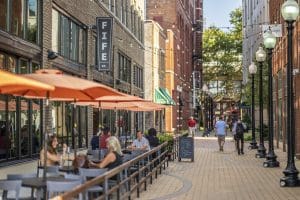
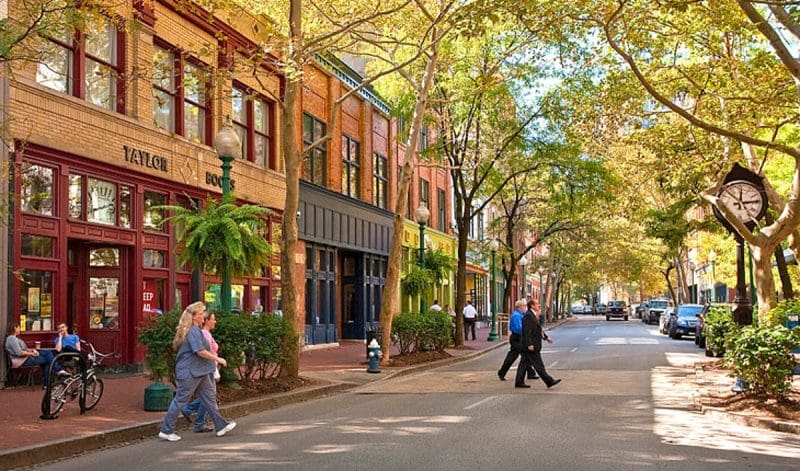
The Fife Brewery in historic downtown Charleston is a popular gathering place. (Photo by Ryan Donnell)
Many towns and counties also offer façade grants, low-interest loans, or matching funds that specifically target historic structures.
“These programs don’t exist for new construction,” Sibray noted. “Every dollar of subsidy pushes the math further toward adaptation rather than demolition.”
But the advantage isn’t only financial: in many historic districts, it’s also the law.
Communities such as Lewisburg, Charleston, and Beckley require property owners to obtain approval from city commissions before altering or demolishing structures that contribute to the area's historic character. In some cases, demolition is outright prohibited.
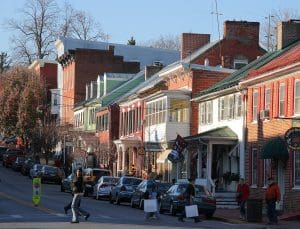
Rural communities, such as Shepherdstown, are becoming more investible. (Photo courtesy Wikipedia)
“People sometimes don’t realize that in a certified historic district, you can’t just bring in an excavator and knock a building down,” Sibray said.
“Demolition can violate local ordinances, design guidelines, and even state preservation laws. The commissions exist specifically to prevent unnecessary loss of historic fabric.”
Sibray said these regulations serve both cultural and economic purposes. Preserved historic districts consistently generate higher property values, stronger tourism activity, and more stable commercial corridors than areas stripped of older architecture.
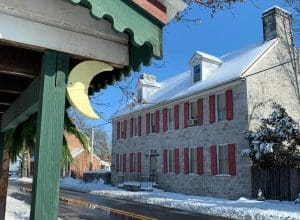
Buildings in historic Middleway are traditionally decorated with a crescent emblem.
“When a historic district stays intact, it becomes an asset,” he said. “It draws visitors, supports small businesses, and maintains the character people travel here to see. The laws are in place because demolition erodes those long-term advantages.”
The combined impact of tax credits, grants, and regulatory protections means restoration is not only the preferred strategy but, in many cases, the only viable one, Sibray said.
“In a historic district, rehabilitation isn’t just the cheaper option,” he said. “It’s the smarter option and often the legally required one.”


Bianca Bosworth
Born in Charleston, Bianca Bosworth spent years traveling the world as a travel nurse and freelance writer. In 2009 she returned to West Virginia to pursue a career in writing and mountaineering. She now calls Putnam County home.
Inside Appalachian Escapes: Themed rentals, escape rooms, and a love letter to West Virginia
FAYETTEVILLE, W.Va. — What began as a search for an affordable retirement option has turned into one of southern West Virginia’s most imaginative...
West Virginia bottler wins silver award at international water competition
BERKELEY SPRINGS, W.Va. — Le Sage Natural Water, of Lesage, has been awarded a silver medal for its purified water at the 36th annual Berkeley...
West Virginia uniquely prepared to dominate 21st-century outdoor economy
CHARLESTON, W.Va. — West Virginia is uniquely prepared to dominate in the 21st-century outdoor economy of the U.S., thanks to its unmatched...
Flood risk outpaces warnings, advocates say, as W.Va. considers changes to resiliency fund
CHARLESTON, W.Va. — As the W.Va. House of Delegates considers changes to Senate Bill 390, the West Virginia Rivers Coalition warns that the state...
We asked AI how its own data centers could pollute West Virginia. Here’s what it had to say
(The following article was generated partly by ChatGPT in response to a prompt about how data centers pollute. As ChatGPT is powered by data...
Inaugural W.Va. Outdoor Economy Summit to unite leaders around $2.1 billion growth
CHARLESTON, W.Va. — West Virginia’s outdoors are more than a scenic backdrop. They’re a strategic economic asset. That message will take...
West Virginia State Parks Foundation launches online merchandise store
HURRICANE, W.Va. — The West Virginia State Parks Foundation has launched an official online merchandise store, offering supporters a new way to...
West Virginia Travel Safety: What it means for residents and visitors in 2026
CHARLESTON, W.Va. — Travel safety in West Virginia is shaped less by headline-grabbing crime and more by geography, weather, and the realities of...
Did Abraham Lincoln and Jefferson Davis secretly meet in West Virginia?
PHILIPPI, W.Va. — Did Abraham Lincoln and Jefferson Davis secretly meet in what is now West Virginia just days after the first land battle of the...
Study finds WVU and its health system account for 17% of West Virginia’s economy
MORGANTOWN, W.Va. — West Virginia University and the WVU Health System together generate $14.3 billion in annual economic impact in West Virginia,...