






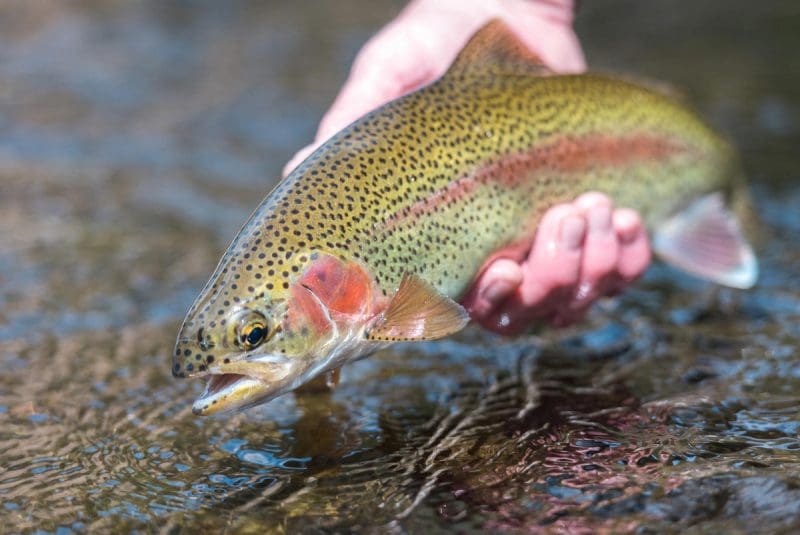
West Virginia trout stocking resumes in lakes and streams statewide
CHARLESTON, W.Va. — Trout stockings have resumed in select lakes and streams across West Virginia, the W.Va. Division of Natural Resources announced, restoring a seasonal boost to recreational fishing around the state.
Brett McMillion, director of the division, said the stockings are part of the agency’s ongoing effort to support anglers and promote year-round outdoor recreation.

“Trout stockings are part of the West Virginia DNR’s ongoing efforts to support recreational fishing and encourage residents and visitors alike to enjoy West Virginia’s lakes and streams all year long,” McMillion said.
“Stockings not only provide anglers additional opportunities to cast their lines but also give sportsmen and sportswomen a chance to stay engaged in the outdoors as they wait for hunting seasons later in the year.”
The agency does not announce daily stocking locations in advance, but it maintains a regularly updated list of recently stocked waters on its website at WVDNR.gov/fish-stocking. Anglers can also check the trout stocking hotline at 304-558-3399 for the latest information.
Details on trout stocking locations are also included on pages 6 and 7 of the annual Fishing Regulations Summary, available online at WVDNR.gov/fishing-regulations.
State law requires all anglers age 15 and older to carry a valid West Virginia fishing license and identification while fishing. A trout stamp is required when targeting trout. Licenses and stamps can be purchased online at WVFish.com, where anglers may also opt for a collectible license card. This year’s designs feature bass and musky.
State officials encourage anglers to review current regulations and stocking updates before heading out, noting that conditions and locations can change throughout the season.
Trout fishing in West Virginia
Trout fishing in West Virginia is a long-established recreational activity supported by the state’s cold-water streams, mountain lakes, and managed fisheries.
Native brook trout (Salvelinus fontinalis) inhabit high-elevation headwaters, particularly in the Allegheny Mountains, while rainbow trout (Oncorhynchus mykiss) and brown trout (Salmo trutta) are widely stocked and, in some waters, naturally reproducing.
The state’s varied topography creates a mix of freestone streams, spring-influenced creeks, and tailwaters below dams, allowing trout fishing opportunities from early spring through late fall, and year-round in designated waters.
Management of trout fisheries is overseen by the W.Va. Division of Natural Resources, which operates hatcheries and conducts regular stockings to supplement wild populations and expand public access.
Regulations include seasonal creel limits, special catch-and-release areas, and delayed-harvest sections designed to balance conservation with angler demand. Trout fishing plays a significant role in outdoor tourism and local economies, drawing residents and visitors to rural communities while reinforcing West Virginia’s broader identity as a destination for fishing, hunting, and outdoor recreation.
Trout stocking in West Virginia
Trout stocking in West Virginia is a structured fisheries management program designed to compensate for limited natural trout reproduction in much of the state. While native brook trout persist in cold, high-elevation headwaters, most rivers and streams experience summer temperatures or flow conditions unsuitable for sustaining trout year-round.
To address this, West Virginia stocks three primary species—brook trout, rainbow trout, and brown trout—into designated waters that can support trout seasonally or under controlled harvest regulations. Stocked waters include small mountain streams, large rivers, reservoirs, tailwaters below dams, and lakes within state parks and wildlife management areas.
The program is operated by the division through a statewide hatchery system that raises trout from eggs to catchable size. Stockings occur primarily in spring and fall, with additional stockings in winter and summer in select waters, including urban fisheries and delayed-harvest sections where harvest is restricted for part of the year.
The primary West Virginia fish hatcheries include:
-
Bowden State Fish Hatchery near Bowden in Randolph County, one of the state’s largest trout production facilities and a major source of rainbow, brown, and brook trout for mountain streams and rivers.
-
Spring Run State Fish Hatchery near Petersburg in Grant County specializes in trout production for the Potomac River watershed and eastern West Virginia waters.
-
Palestine State Fish Hatchery, near Palestine in Wirt County, historically focused on warmwater species such as bass, musky, and walleye, with some trout support.
-
Big Springs Hatchery, near Salem in Harrison County, primarily produces warmwater fish for lakes and rivers statewide.
Stocking locations and schedules are publicly reported, though daily stockings are not announced in advance. Regulations such as trout stamps, creel limits, and special regulation areas are used to balance angler access with conservation goals.

Nightfall’s Value: Light pollution can diminish real estate worth in W.Va.
WINFIELD, W.Va. — An increasing number of new West Virginia residents are being drawn to its rolling hills and quiet valleys to escape brightly lit...
Inside Appalachian Escapes: Themed rentals, escape rooms, and a love letter to West Virginia
FAYETTEVILLE, W.Va. — What began as a search for an affordable retirement option has turned into one of southern West Virginia’s most imaginative...
West Virginia bottler wins silver award at international water competition
BERKELEY SPRINGS, W.Va. — Le Sage Natural Water, of Lesage, has been awarded a silver medal for its purified water at the 36th annual Berkeley...
West Virginia uniquely prepared to dominate 21st-century outdoor economy
CHARLESTON, W.Va. — West Virginia is uniquely prepared to dominate in the 21st-century outdoor economy of the U.S., thanks to its unmatched...
Flood risk outpaces warnings, advocates say, as W.Va. considers changes to resiliency fund
CHARLESTON, W.Va. — As the W.Va. House of Delegates considers changes to Senate Bill 390, the West Virginia Rivers Coalition warns that the state...
We asked AI how its own data centers could pollute West Virginia. Here’s what it had to say
(The following article was generated partly by ChatGPT in response to a prompt about how data centers pollute. As ChatGPT is powered by data...
Inaugural W.Va. Outdoor Economy Summit to unite leaders around $2.1 billion growth
CHARLESTON, W.Va. — West Virginia’s outdoors are more than a scenic backdrop. They’re a strategic economic asset. That message will take...
West Virginia State Parks Foundation launches online merchandise store
HURRICANE, W.Va. — The West Virginia State Parks Foundation has launched an official online merchandise store, offering supporters a new way to...
West Virginia Travel Safety: What it means for residents and visitors in 2026
CHARLESTON, W.Va. — Travel safety in West Virginia is shaped less by headline-grabbing crime and more by geography, weather, and the realities of...
Did Abraham Lincoln and Jefferson Davis secretly meet in West Virginia?
PHILIPPI, W.Va. — Did Abraham Lincoln and Jefferson Davis secretly meet in what is now West Virginia just days after the first land battle of the...