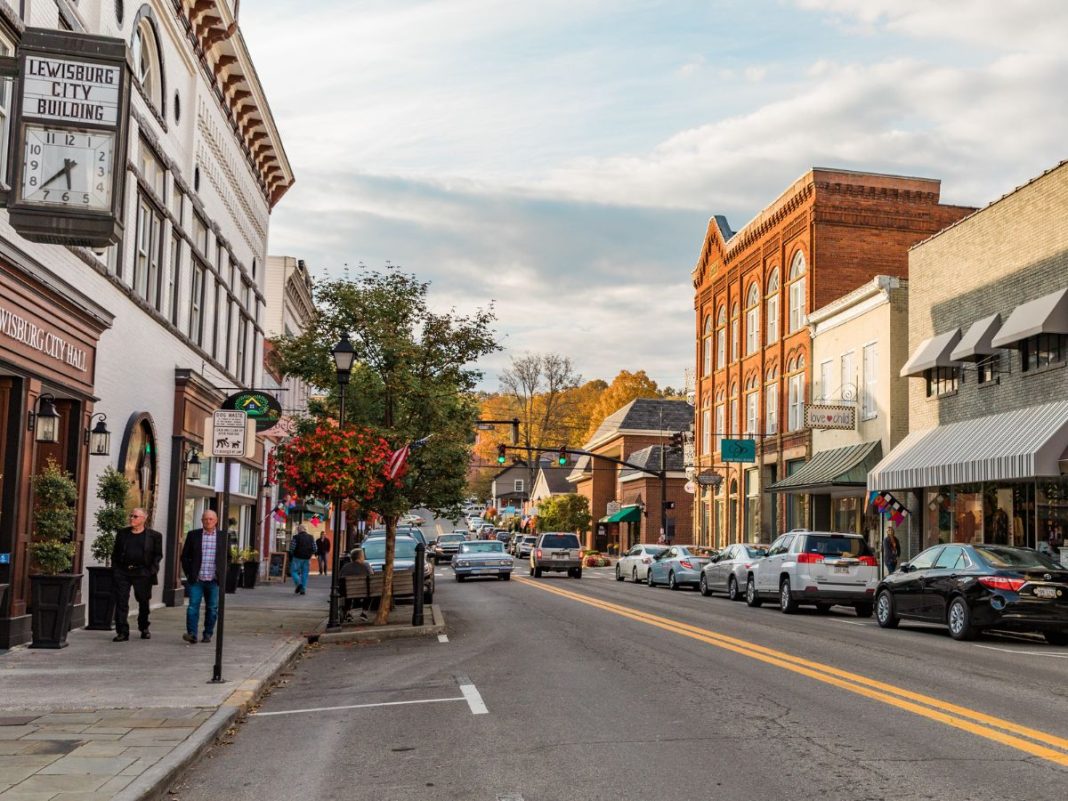

CHARLESTON, W.Va. — As remote work reshapes where Americans choose to live, small-town housing in West Virginia has emerged as a central issue in the state’s economic revival. Communities once defined by vacant upper floors and underused downtown buildings are seeing renewed interest from remote workers, entrepreneurs, and small businesses.
Translating that momentum into lasting growth may depend on how building and fire codes are applied in West Virginia, particularly for apartment buildings in historic town centers.

That matter will take center stage Friday, Jan. 16, 2026, during a free national webinar titled “Allowing Six-Story Single-Egress Stair Buildings to Address Affordable Housing Needs.”
The session will be led by Tom Jaleski, a principal, code analyst, and fire life safety consultant with extensive experience in new, existing, and historic buildings.
The discussion is particularly important to architects, contractors, and local government officials involved in codes and construction, according to Meredith Dreistadt, Deputy State Historic Preservation Officer with the W.Va. State Historic Preservation Office.
"This is a subject that fire, zoning, and code enforcement officials might need to be aware of as our downtown business districts develop," Dreistadt said.
The webinar will be held via Zoom from noon to 1 p.m. Eastern time.
Why single-stair buildings matter to small towns
At issue are small, single-egress stair buildings, typically up to six stories tall, that rely on a single exit stair rather than the two commonly required by U.S. building codes.
Housing advocates and community leaders argue that single-egress stair buildings can make small-scale apartment projects financially feasible, especially in narrow downtown lots or older buildings not designed for multiple stair towers.
Fire officials, however, have expressed concerns that single-stair designs may compromise occupant evacuation or firefighter safety. According to Jaleski, the conversation often becomes too narrow.
“Life safety isn’t defined by one feature,” Jaleski said. “A second stair is one strategy, but it’s not the only way to protect occupants or responders.”
A proven but controversial approach
Single-egress stair buildings are not new. Seattle has permitted five-story single-stair apartment buildings for roughly 50 years, and New York City allows its own version under local code provisions. Internationally, similar buildings are widely accepted in Europe and Japan, where safety is addressed through a range of design and construction strategies.
“These buildings exist because safety is approached as a system,” Jaleski said. “It’s about building size, occupant load, fire-resistance, sprinkler protection, smoke control, and travel distances—not just counting exits.”
For West Virginia, the implications are significant. Many small towns are rich in historic commercial buildings with empty upper floors that could support housing for remote workers and local employees, but only if those spaces can be adapted safely and economically.
Remote work and small-industry growth
The work-from-home shift has made West Virginia’s small towns newly viable for small businesses, creative enterprises, and light industry, all of which benefit from nearby housing and walkable downtowns. Local leaders say flexible housing options are essential to sustaining restaurants, retail, professional services, and emerging industries.
“If codes are applied without flexibility,” Jaleski said, “the result is often no redevelopment at all—and vacant buildings are not safe buildings.”
What the webinar will cover
The Jan. 16 webinar will examine single-egress stair buildings through a broader life-safety lens, emphasizing that evacuation routes are only one part of a comprehensive safety strategy. According to the session outline, participants will explore how alternative protection measures can achieve safety outcomes comparable to, or better than, traditional prescriptive approaches.
After attending, participants are expected to be able to:
- Understand different aspects of occupant safety and discuss why two stairs are not always the best solution
- Identify risks and protection measures specific to single-egress stair buildings
- Recognize the importance of addressing multiple facets of life safety
- Discuss additional life-safety measures that can supplement or enhance protection
Architect participants will earn 1 AIA CES Learning Unit (LU/HSW). Registration is free, though space is limited; those unable to register may email events@sgh.com
to join a waitlist.
A crossroads for West Virginia small-town housing
As interest in living and working in West Virginia’s small towns grows, communities face the question of whether regulatory frameworks can adapt to new realities without compromising safety.
“We need to be open to new ideas and new processes,” Jaleski said. “The goal is safer buildings that people can actually use—and housing that communities can realistically deliver.”
For towns seeking to convert remote-work interest into long-term economic stability, the outcome of debates like this one may help determine whether West Virginia's small-town housing becomes a foundation for revival or another missed opportunity.
Find out more about the seminar by visiting the SGS website. SGS is a global testing, inspection, and certification company best known for verifying that products, buildings, systems, and processes meet safety, quality, and regulatory standards.
Sign up to receive a FREE copy of West Virginia Explorer Magazine in your email weekly. Sign me up!