

Work of eccentric photographer O. Winston Link tied to West Virginia
Photographer O. Winston Link may best be known for his ties to Virginia, home of the O. Winston Link Museum at Roanoke, but museum manager Lynsey Allie says his ties to West Virginia are strong, though fewer people know of them.

“O. Winston Link has fans all over the world,” Allie says. “They come here, of course, but many of the visitors we see also seek out every Link-related site they can find. They just can’t get enough.”
Link, who trained as a civil engineer before moving into photography, is credited with capturing the charm of rural life in the 1950s along with the final days of steam trains in the Northeast.
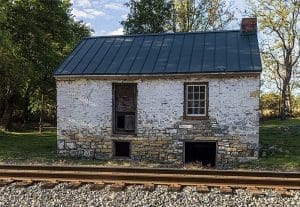
Link’s father knew well the Duffield’s Depot, a possible museum site.
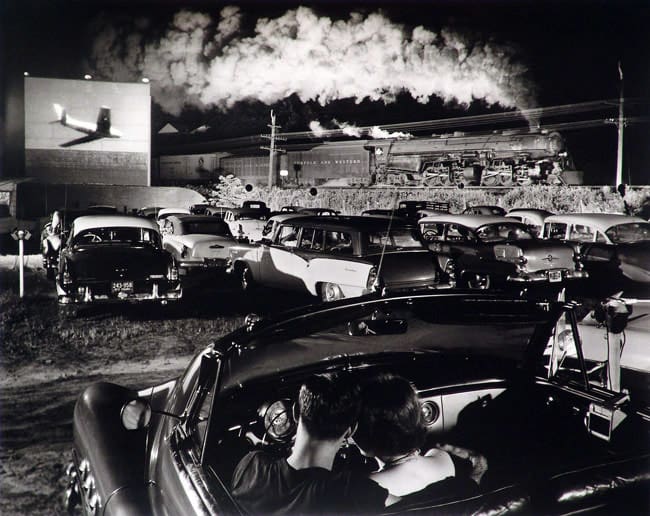
He created some of his best-known works in southern West Virginia, painstakingly capturing a night scene of trains speeding past a swimming pool and a drive-in movie theater in McDowell County.
It only makes sense for the Eastern Panhandle to play up its ties, says Allie, who heads the 17-year-old museum housed in a renovated Norfolk & Western Railway depot.
Link, who died in 2001, is buried in Shepherdstown’s Elmwood Cemetery alongside his parents and other kin.
His father grew up in an all-but-forgotten hamlet of Duffields, halfway between Shepherdstown and Charles Town, and Allie said it’s likely that E. Albert Link developed an interest in trains there as a child and passed the spark along to his son later when the family was living in New York City.
Born in Brooklyn in 1914, O. Winston Link began the project that brought him worldwide acclaim in early 1955. His work as a commercial photographer in New York took him to Staunton, Virginia, for a shoot at a factory making window air conditioners.

Museum Manager Lynsey Allie says Duffields might be an idea Link museum site.
There, Link got sidetracked. He loved to watch nighttime trains, and when he visited nearby Waynesboro, Virginia, to see Norfolk & Western trains, he learned the age of the coal-fired steam locomotives would soon end.
He quickly decided on an ambitious, self-financed project—photographing the final years before the N&W steam locomotive gave way to diesel engines. By the time the last train was taken out of service in the spring of 1960, he had carefully crafted more than 2,400 scenes.
Mostly shooting after dark when he could control the lighting and in black-and-white, which was more affordable than color film, Link made multiple trips all over Virginia and parts of West Virginia, Maryland, and North Carolina to scout out locations and set up his complex synchronized flash system.
The project didn’t initially connect with the public, but the works drew attention after a Museum of Modern Art show in New York in 1976 and an exhibition of his work in London in 1983. Collectors were soon clamoring for his incredible portraits.
“Hotshot” is considered a perfect example of Link’s technical skills and eye for composition. It shows a young man and woman in a convertible watching the Korean War epic “Battle Taxi” as a steam locomotive passes and as a jet fighter zooms across the screen.
The Baltimore & Ohio depot that Albert Link knew as a child still stands just off Flowing Springs Road in Duffields.
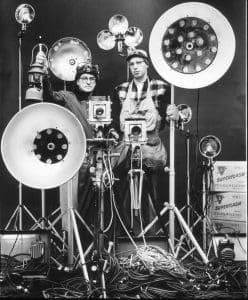
Link and an assistant display some of the specialized equipment employed in Link’s night photography.
Privately constructed in 1839 by landowner Richard Duffields, the building is the Baltimore & Ohio’s second-oldest surviving depot. It’s nine years younger than the station near Baltimore in Ellicott City, Maryland, a building that’s now a museum.
In Albert Link’s day, the stop would have been the village hub—where farmers sent goods to market and picked up their mail, where passengers arrived and departed, where telegrams were sent and received, and, later, where the only payphone within miles was to be found.
But during Albert Link’s early childhood, the historic Duffields Depot was abandoned when the B&O constructed its own modern depot, a Victorian building that stood until 1942.
Since 1986, commuters heading to work in Washington, D.C., have caught the Maryland Transit Administration’s MARC train from a platform called “Duffields.”
The original limestone structure, sitting empty since 1884, is on the National Register of Historic Places. The Jefferson County Historical Landmarks Commission has won preliminary grants to stabilize the building with an eye to someday transforming the building into a museum.
Sign up to receive a FREE copy of West Virginia Explorer Magazine in your email twice weekly. Sign me up!

Inside Appalachian Escapes: Themed rentals, escape rooms, and a love letter to West Virginia
West Virginia bottler wins silver award at international water competition
BERKELEY SPRINGS, W.Va. — Le Sage Natural Water, of Lesage, has been awarded a silver medal for its purified water at the 36th annual Berkeley...
West Virginia uniquely prepared to dominate 21st-century outdoor economy
CHARLESTON, W.Va. — West Virginia is uniquely prepared to dominate in the 21st-century outdoor economy of the U.S., thanks to its unmatched...
Flood risk outpaces warnings, advocates say, as W.Va. considers changes to resiliency fund
CHARLESTON, W.Va. — As the W.Va. House of Delegates considers changes to Senate Bill 390, the West Virginia Rivers Coalition warns that the state...
We asked AI how its own data centers could pollute West Virginia. Here’s what it had to say
(The following article was generated partly by ChatGPT in response to a prompt about how data centers pollute. As ChatGPT is powered by data...
Inaugural W.Va. Outdoor Economy Summit to unite leaders around $2.1 billion growth
CHARLESTON, W.Va. — West Virginia’s outdoors are more than a scenic backdrop. They’re a strategic economic asset. That message will take...
West Virginia State Parks Foundation launches online merchandise store
HURRICANE, W.Va. — The West Virginia State Parks Foundation has launched an official online merchandise store, offering supporters a new way to...
West Virginia Travel Safety: What it means for residents and visitors in 2026
CHARLESTON, W.Va. — Travel safety in West Virginia is shaped less by headline-grabbing crime and more by geography, weather, and the realities of...
Did Abraham Lincoln and Jefferson Davis secretly meet in West Virginia?
PHILIPPI, W.Va. — Did Abraham Lincoln and Jefferson Davis secretly meet in what is now West Virginia just days after the first land battle of the...
Study finds WVU and its health system account for 17% of West Virginia’s economy
MORGANTOWN, W.Va. — West Virginia University and the WVU Health System together generate $14.3 billion in annual economic impact in West Virginia,...