










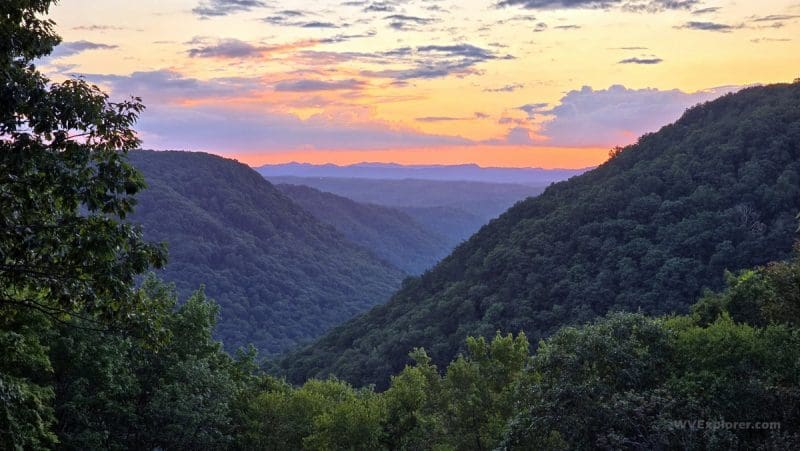
Tourism surge in southern West Virginia yields more than $108 million for local economy
GLEN JEAN, W.Va. — A newly released report from the National Park Service shows that visitation and spending in the three southern West Virginia national park units delivered a significant economic boost in 2024.
The data indicate that 2,080,330 visitors spent $108,387,000 in the counties surrounding those parks, representing a nearly 12 percent increase compared to 2023 in and near the New River Gorge National Park and Preserve, Bluestone National Scenic River, and Gauley River National Recreation Area.

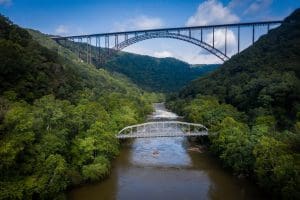
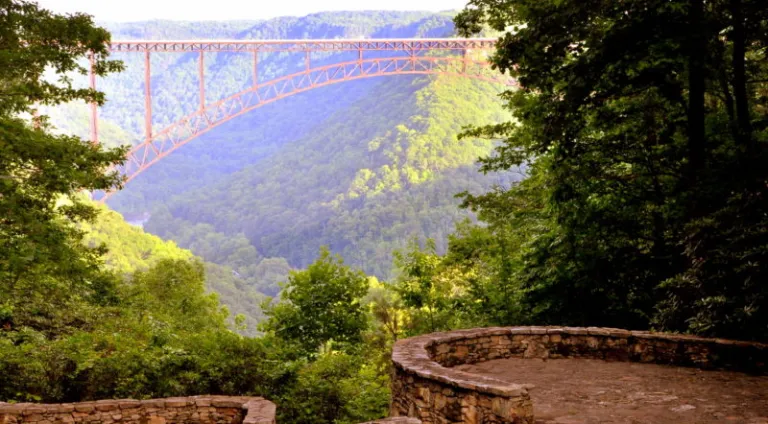
The New River Gorge Bridge and Fayette Station Bridge cross the New River near Fayetteville, West Virginia
Acting Superintendent Eric LaPrice said the jump in spending underscores the growing interest in tourism in the region following the redesignation of New River Gorge.
“Our visitation has increased steadily since redesignation,” LaPrice said. “Alongside the rise in visitation, we’ve witnessed a parallel surge in spending across gateway communities surrounding all three national park sites.”
Local Impact: Visitors, Spending, and Growth
The report — part of the 2024 National Park Visitor Spending Effects series — demonstrates how visitors funnel money into local economies, creating ripple effects beyond the parks themselves. In the three southern West Virginia park areas, visitor spending in 2024 totaled $108.4 million, representing a roughly 12 percent increase from 2023 levels.
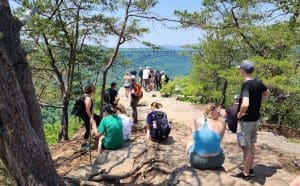
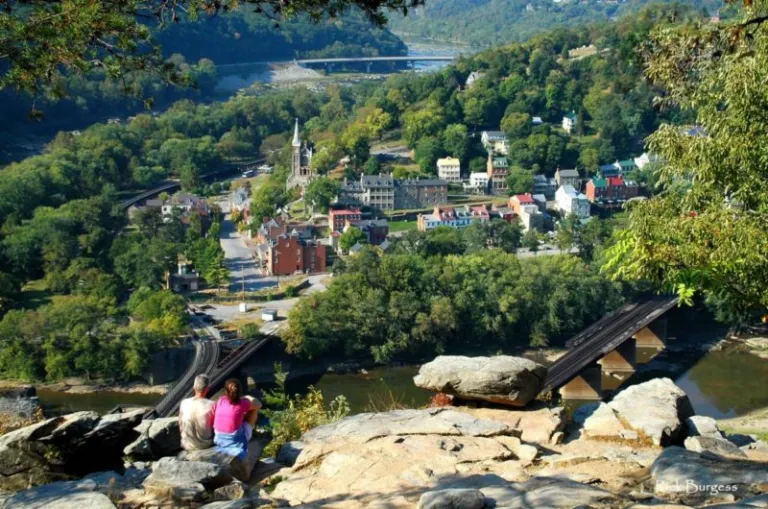
Hikers gather at Long Point in view of the New River Gorge Bridge (center distance). Photo: Sibray / WVExplorer
With 2,080,330 visits recorded, the average spending per visitor amounts to approximately $52.15 in local counties. While that’s a rough estimate (visitor patterns and durations vary), it provides a sense of how small-scale expenditures—such as lodging, food, and local services—add up to a significant economic boost in rural communities.
Local establishments — motels, restaurants, gas stations, outfitters, and retailers — likely absorbed much of that visitor spending. Such expenditures often provide wages, support jobs, and stimulate secondary economic activity, such as supply purchases or infrastructure maintenance.
Travel Bureaus Share Enthusiasm
The directors of travel bureaus in the regions around the national park celebrated the news, sharing similar numbers as well as a feeling of accomplishment.
Lisa Strader, executive director of Visit Southern West Virginia, the largest travel bureau in the state, expressed her well-wishes for park officials who have had to work with a dramatic cut in support in recent years.
“Our region has seen such incredible growth since the national park designation,” Strader said. “As we watch the numbers continue to grow, and our guests coming from all over the world, it showcases what an incredible job our friends at the park are doing.”
The proposed 2026 federal budget aims to reduce approximately $1.2 billion from the park service, including roughly $900 million from park operations alone.
“We know as a whole our national parks are facing challenges, but our park partners are continuing to roll out the red carpet every day and, in turn, helping the economy in southern West Virginia thrive.”
Becky Sullivan, executive director of the New River Gorge Convention and Visitors Bureau, said her agency, which maintains a visitor center at Oak Hill, has witnessed the same increase.
“We’ve seen a 12 percent increase at our visitor center, so those numbers line up,” she said. “We’ve seen guests from 46 states and nine countries through the period and have seen a year-over-year increase since the park was established in 2020.”
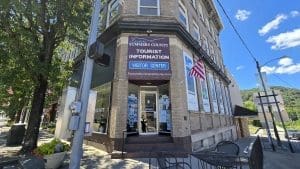
In Hinton, the Explore Summers County travel bureau has witnessed a similar increase.
Sullivan said the chief interests that her bureau fields are questions about Bridge Day, the New River Gorge Bridge, and state and national parks.
Candice Lee Helms, executive director of Explore Summers County, says her bureau has witnessed a similar impact and underscored the cooperation of agencies and communities that have helped market the region.
“I feel like this is validation for the wonderful job our state and its partners are doing marketing the region,” Helms said.
Municipalities located in the region include Hinton, Beckley, Oak Hill, Fayetteville, and Summersville.
National Context: Parks Drive Billions Nationwide
While the southern West Virginia figures are strong, they represent a microcosm of the broader national picture. According to the report, visitors spent $29 billion in communities near national parks in 2024. That spending translated to $18.8 billion in labor income (wages and salaries) and $56.3 billion in economic output across the U.S. economy.
The report highlights the sectors that directly benefit, with lodging leading the way at $11.1 billion in economic output, followed by restaurants at $5.7 billion.
An interactive tool accompanies the report, allowing users to explore visitor spending, labor income, and economic contributions by sector and region, as well as trend data over time.
Impact on West Virginia Communities
These numbers indicate that national parks in southern West Virginia are attracting more visitors and generating greater local economic benefits than ever before. For rural counties, sustained tourism growth can be a crucial source of revenue, particularly in areas where traditional industries are in decline.
The benefits accumulate not only in immediate sales but also in job creation (such as housekeeping, cooking, guiding, and retail), tax revenue, and business growth. Over time, communities that can support tourism infrastructure — including lodging, restaurants, local transportation, and interpretive services — may find a greater ability to diversify their economies.
Challenges and Outlooks
Sustaining and increasing the economic benefits from national park tourism presents challenges. Infrastructure — including roads, parking, trails, and visitor centers — must keep pace with the rising number of visitors. Local businesses need to maintain quality so that visitors stay longer and spend more. Also, environmental impacts and crowding pressures must be managed to preserve the very natural attributes that attract visitors.
From a policy standpoint, cooperation between the National Park Service, state and local governments, and private stakeholders will be key. Marketing, access to funding, visitor services, and conservation must all align to ensure long-term benefits.
For communities adjacent to the New River Gorge, Bluestone, and Gauley River units, the 2024 numbers underscore a promising trend: the region is capitalizing on its scenic, recreational, and natural assets more than ever.
How to Explore More
The full 2024 National Park Visitor Spending Effects report, along with the interactive data tool, is now available on the National Park Service website. The report allows detailed examination of spending impacts by park, county, sector, and over time.
To learn more about national parks in West Virginia — including ongoing efforts in historic preservation, environmental conservation, and recreational planning — visit nps.gov/westvirginia.

Nightfall’s Value: Light pollution can diminish real estate worth in W.Va.
WINFIELD, W.Va. — An increasing number of new West Virginia residents are being drawn to its rolling hills and quiet valleys to escape brightly lit...
Inside Appalachian Escapes: Themed rentals, escape rooms, and a love letter to West Virginia
FAYETTEVILLE, W.Va. — What began as a search for an affordable retirement option has turned into one of southern West Virginia’s most imaginative...
West Virginia bottler wins silver award at international water competition
BERKELEY SPRINGS, W.Va. — Le Sage Natural Water, of Lesage, has been awarded a silver medal for its purified water at the 36th annual Berkeley...
West Virginia uniquely prepared to dominate 21st-century outdoor economy
CHARLESTON, W.Va. — West Virginia is uniquely prepared to dominate in the 21st-century outdoor economy of the U.S., thanks to its unmatched...
Flood risk outpaces warnings, advocates say, as W.Va. considers changes to resiliency fund
CHARLESTON, W.Va. — As the W.Va. House of Delegates considers changes to Senate Bill 390, the West Virginia Rivers Coalition warns that the state...
We asked AI how its own data centers could pollute West Virginia. Here’s what it had to say
(The following article was generated partly by ChatGPT in response to a prompt about how data centers pollute. As ChatGPT is powered by data...
Inaugural W.Va. Outdoor Economy Summit to unite leaders around $2.1 billion growth
CHARLESTON, W.Va. — West Virginia’s outdoors are more than a scenic backdrop. They’re a strategic economic asset. That message will take...
West Virginia State Parks Foundation launches online merchandise store
HURRICANE, W.Va. — The West Virginia State Parks Foundation has launched an official online merchandise store, offering supporters a new way to...
West Virginia Travel Safety: What it means for residents and visitors in 2026
CHARLESTON, W.Va. — Travel safety in West Virginia is shaped less by headline-grabbing crime and more by geography, weather, and the realities of...
Did Abraham Lincoln and Jefferson Davis secretly meet in West Virginia?
PHILIPPI, W.Va. — Did Abraham Lincoln and Jefferson Davis secretly meet in what is now West Virginia just days after the first land battle of the...