



West Virginia hosts outdoor economy summit as communities rethink economics
CHARLESTON, W.Va. — For many West Virginia communities, outdoor recreation is no longer a quality-of-life extra. It’s the new economic infrastructure that’s attracting private investment, supporting small businesses, and helping retain and attract a workforce.
That shift in thinking is the driving force behind the inaugural West Virginia Outdoor Economy Summit, which will bring civic leaders and entrepreneurs to Charleston Feb. 17–19, 2026, at the Charleston Coliseum & Convention Center.
Outdoor recreation emerges as economic infrastructure
Presented by the Charleston Convention & Visitors Bureau and hosted by The Nature Conservancy and the Brad and Alys Smith Outdoor Economic Development Collaborative, the summit is the state’s first cross-sector forum focused specifically on outdoor recreation as an economic development strategy.
Across the United States, trails, rivers, parks, and public lands are increasingly leveraged as anchors for local economies. In West Virginia, where natural assets are abundant but traditional industries have declined, outdoor recreation offers a development model that is place-based, scalable, and difficult to outsource.
How trails, rivers, and public lands generate local economic activity
Unlike one-time development projects, outdoor infrastructure tends to produce recurring economic activity. Trail systems, paddling routes, climbing areas, and destination parks support lodging, food service, retail, guiding services, and equipment manufacturing. These businesses generate sales and lodging taxes while creating jobs often tied directly to downtowns and small commercial districts.
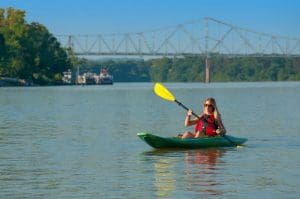
A kayaker paddles the peaceful Ohio near the mouth of the Little Kanawha. (Photo courtesy Parkersburg CVB)
According to Heidi Prior, outdoor business development coordinator for the collaborative, the state’s outdoor recreation sector currently contributes an estimated $2.1 billion annually to the state economy, but summit organizers say many local governments lack access to the planning tools, financing models, and case studies needed to fully leverage those assets.
“This summit is designed to help local leaders make informed decisions,” Prior says. “We want mayors, planners, lenders, and economic developers to leave with a clearer understanding of how outdoor recreation fits into community development and what it takes to implement projects that are financially and environmentally sustainable.”
Summit programming will include keynote sessions, plenary discussions, and applied breakout workshops organized around four tracks:
- Outdoor Destination Development
- Managing Outdoor Assets
- Outdoor Workforce and Business Growth
- Activating People and Places
Topics will include funding outdoor infrastructure, integrating recreation into comprehensive plans, supporting outdoor-based entrepreneurs, and managing public assets to generate economic returns while maintaining conservation standards.
Why outdoor amenities matter for workforce attraction and retention
Outdoor recreation is also increasingly influencing business location decisions. Employers— particularly in technology, professional services, and advanced manufacturing—now consider access to outdoor amenities when deciding where to locate or expand. For communities competing to attract remote workers and skilled employees, outdoor assets can serve as a key differentiator.
From a municipal finance perspective, outdoor investments often require lower upfront capital than traditional industrial recruitment while delivering broader community benefits. Trails and river access points can be phased over time, funded through a mix of public, private, and philanthropic sources, and maintained at relatively low cost compared to large-scale infrastructure.
From tourism to tax base: the economic ripple effect of outdoor investment
Outdoor amenities also tend to increase adjacent property values and spur reinvestment in underused areas. In many towns, trailheads and riverfronts have become catalysts for downtown redevelopment, adaptive reuse of historic buildings, and infill housing, expanding the local tax base without the need for extensive new public services.

The dome of the West Virginia Statehouse rises above one of the nation’s new biking destinations. (Photo courtesy Charleston CVB)
Charleston was selected as the host city in part because it reflects the type of mixed-use, outdoor-adjacent development many West Virginia communities are pursuing. The capital city combines river access, trail networks, nearby public lands, a walkable downtown, and established business infrastructure.
“Charleston offers a working example of how outdoor amenities can support broader economic goals,” said Timothy Brady, president and CEO of the Charleston Convention & Visitors Bureau. “Participants will be able to see how outdoor assets connect to tourism, private investment, and downtown activity.”
The summit will conclude Feb. 19 at the West Virginia State Capitol with Outdoor Economy Day, giving community leaders and organizations an opportunity to engage directly with legislators and state officials on policy, funding, and regulatory considerations tied to outdoor recreation development.
Eriks Brolis, director of economic development and strategic initiatives for The Nature Conservancy, said the event is designed to encourage coordination across sectors that often operate independently.
“Outdoor recreation sits at the intersection of land use, economic development, workforce, and infrastructure,” Brolis said. “This summit creates a shared space for community leaders to examine how strategic investment in outdoor assets can produce measurable economic outcomes for West Virginia.”
Additional information is available at WVOutdoorEconomy.com.
Overview: Outdoor recreation is becoming economic infrastructure in West Virginia
Outdoor recreation is increasingly being treated as core economic infrastructure in West Virginia, alongside roads, utilities, and broadband.
Trails, river access points, parks, and public lands are driving private investment, small business growth, and workforce attraction—especially in communities seeking sustainable alternatives to declining traditional industries.
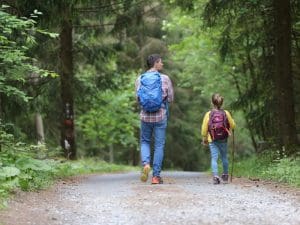
Hikers escape into the mountains of eastern West Virginia near Washington, D.C. (Photo: David Sibray)
That shift is the focus of the inaugural West Virginia Outdoor Economy Summit, scheduled for Feb. 17–19, 2026, in Charleston. The event brings together mayors, planners, lenders, and entrepreneurs to examine how outdoor assets can be planned, financed, and managed as long-term economic engines.
With outdoor recreation already contributing an estimated $2.1 billion annually to the state economy, organizers say the summit aims to give communities practical tools to turn natural assets into durable, locally rooted economic growth.
Nightfall’s Value: Light pollution can diminish real estate worth in W.Va.
WINFIELD, W.Va. — An increasing number of new West Virginia residents are being drawn to its rolling hills and quiet valleys to escape brightly lit...
Inside Appalachian Escapes: Themed rentals, escape rooms, and a love letter to West Virginia
FAYETTEVILLE, W.Va. — What began as a search for an affordable retirement option has turned into one of southern West Virginia’s most imaginative...
West Virginia bottler wins silver award at international water competition
BERKELEY SPRINGS, W.Va. — Le Sage Natural Water, of Lesage, has been awarded a silver medal for its purified water at the 36th annual Berkeley...
West Virginia uniquely prepared to dominate 21st-century outdoor economy
CHARLESTON, W.Va. — West Virginia is uniquely prepared to dominate in the 21st-century outdoor economy of the U.S., thanks to its unmatched...
Flood risk outpaces warnings, advocates say, as W.Va. considers changes to resiliency fund
CHARLESTON, W.Va. — As the W.Va. House of Delegates considers changes to Senate Bill 390, the West Virginia Rivers Coalition warns that the state...
We asked AI how its own data centers could pollute West Virginia. Here’s what it had to say
(The following article was generated partly by ChatGPT in response to a prompt about how data centers pollute. As ChatGPT is powered by data...
Inaugural W.Va. Outdoor Economy Summit to unite leaders around $2.1 billion growth
CHARLESTON, W.Va. — West Virginia’s outdoors are more than a scenic backdrop. They’re a strategic economic asset. That message will take...
West Virginia State Parks Foundation launches online merchandise store
HURRICANE, W.Va. — The West Virginia State Parks Foundation has launched an official online merchandise store, offering supporters a new way to...
West Virginia Travel Safety: What it means for residents and visitors in 2026
CHARLESTON, W.Va. — Travel safety in West Virginia is shaped less by headline-grabbing crime and more by geography, weather, and the realities of...
Did Abraham Lincoln and Jefferson Davis secretly meet in West Virginia?
PHILIPPI, W.Va. — Did Abraham Lincoln and Jefferson Davis secretly meet in what is now West Virginia just days after the first land battle of the...