

Did Abraham Lincoln and Jefferson Davis secretly meet in West Virginia?
PHILIPPI, W.Va. — Did Abraham Lincoln and Jefferson Davis secretly meet in what is now West Virginia just days after the first land battle of the Civil War?
It is a question that’s lingered for more than a century and a half, whispered in local lore, debated by historians, and preserved in the pages of the West Virginia Heritage Encyclopedia. According to that account, an extraordinary and clandestine encounter may have unfolded on the evening of June 5, 1861, inside the covered bridge at Philippi.

A town sealed in silence
Just two days after the Battle of Philippi, often called the first organized land battle of the Civil War, the village found itself under military control once again. At precisely 5 p.m., two cavalry units thundered into town from opposite directions. One wore Union blue, approaching from the north. The other arrived from the south in Confederate gray.
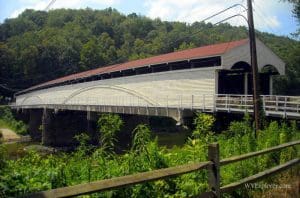
Philippi Covered Bridge
Without a word exchanged, the troops sealed off both ends of the covered bridge spanning the Tygart Valley River. Civilians were ordered indoors. Wagons and riders were halted well away from the bridge. There were no bugle calls, no shouted commands, no skirmishing—only the clink of sabers, the creak of leather saddles, and the restless scrape of horseshoes on gravel.
For a county already torn apart by divided loyalties, the tension was palpable. Barbour County had sent sons to both armies. Families were split. Neighbors stood on opposite sides of the war. The silence that afternoon was as heavy as the fear still hanging over the town from the battle fought just 48 hours earlier.
Two black coaches meet at the bridge
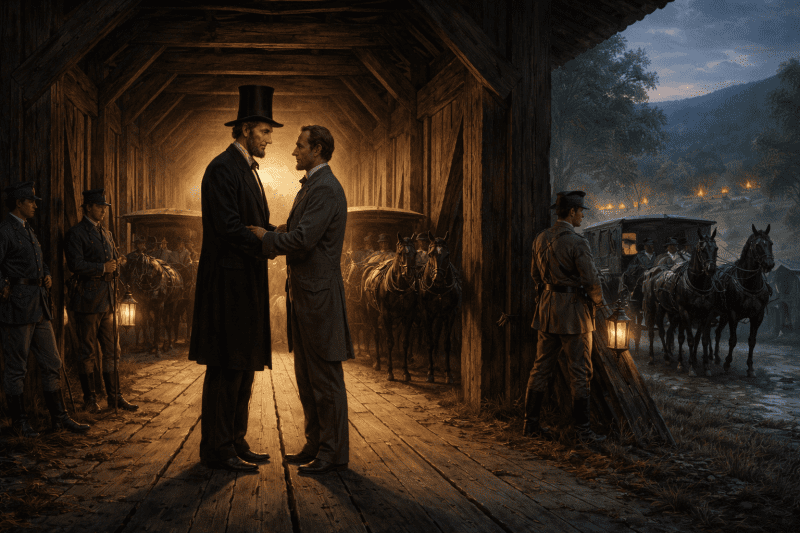
At 5:30 p.m., two nearly identical black coaches appeared—one from the north, one from the south—each drawn by teams of four black horses showing signs of hard driving. The cavalry escorts fell back. The coaches entered the covered bridge from opposite ends and stopped in the middle, hidden from public view by the long, dark tunnel of the structure.
For thirty minutes, nothing moved.
Then, at exactly 6 p.m., the coaches reemerged, turned around, and departed in the directions from which they had come, cavalry galloping behind them. The troops withdrew. The bridge reopened. But the mystery remained.
Who had met there and why?
Two witnesses in the rafters
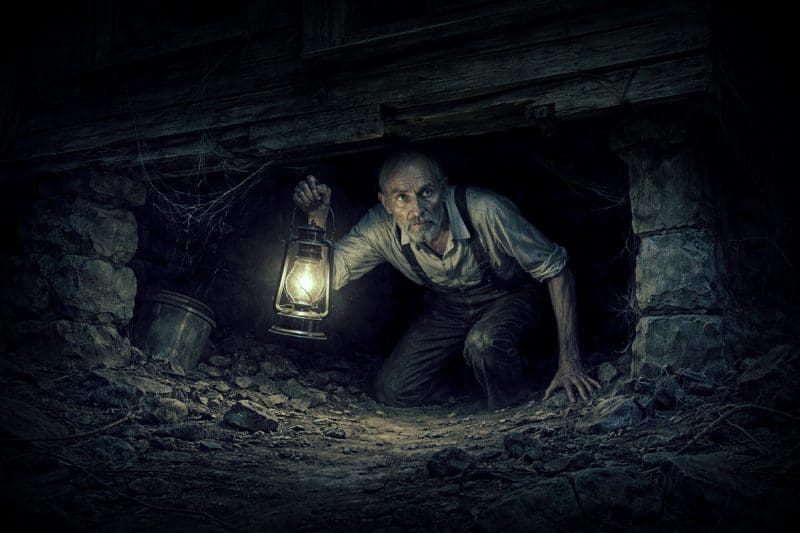
Despite the airtight security, the encyclopedia recounts that two eyewitnesses remained hidden on the bridge. Chick Simons and Shelton Reger, both about 15 years old at the time, had been playing inside the structure when the soldiers arrived. Terrified, they scrambled into the rafters overhead and stayed silent.
Years later, Simons recalled seeing a towering man step from the northern coach.
“He was the tallest man I ever seed,” Simons said, remembering how the man’s stovepipe hat nearly brushed the rafters. The figure removed his hat, bent through the wooden braces separating the bridge’s lanes, and entered the southern coach, illuminated by a lantern.
Simons said the man had a gaunt face and a fringe of whiskers along his jaw—features long associated with Abraham Lincoln.
When the man emerged some time later, Simons recalled, his shoulders were slumped. He appeared exhausted and deeply emotional. Many years later, he recalled the event:
“I don’t remember much of what happened after we clumb into the rafters. I was froze-scared. I was like a cake of ice lying on that rafter, and Shelt says he was like that, too. As cold as I was from being afraid, I distinctly recollect seeing a man get out of the surrey that come in from Webster-way.
“He was the tallest man I ever seed, for when he got out of the surrey and straightened up I thought his high stovepipe hat was going to knock me right off my rafter. Then he took off his hat and bent over and went through the braces between the lanes of the bridge and got into the other surrey.
“There was a lighted lantern in this surrey and when he opened the door I seed his, the tall man’s face. He was awful ugly and had a fringe of whiskers around his jaw.
“As I said, me and Shelt was froze stiff. We stayed where we were I expect because we couldn’t have moved if we’d tried. An’ course, we never made a sound. After a while the tall man got out of the other man’s surrey. His shoulders seemed to be slumped over as if he was powerful tired.
“I seed his face good, and danged iffen he didn’t look like he was going to cry. He sort of hesitated, then he looked into the surrey and said something about may-God-forgive-our-something-or-other, and he hoped somebody would have mercy on somebody’s soul or other. And then he turned back and slowly climbed into his own surrey.
“Me and Shelt thawed out after a long spell and lit out lickety-split for home. He ain’t talked much about this bridge business, and nuther have I. When I think of it, I just freeze up again, and he says he does, too. But Shelt, he recollects better’n me so many of the important things about it that didn’t happen.”
Both boys fled the bridge only after the soldiers had gone. According to Simons, neither spoke much of the incident afterward, even as adults.
History or legend?
No official records confirm such a meeting. Mainstream historians have never accepted the story as documented fact, and no correspondence from Lincoln or Davis references a rendezvous in Philippi. Yet the account persists, rooted in a detailed narrative recorded decades later and passed down by witnesses who insisted on their truthfulness.
If true, the implications would be staggering: a last-ditch, secret attempt at reconciliation just days after open warfare had begun. If false, the episode remains one of West Virginia’s most enduring Civil War legends—a story shaped by fear, division, and the haunting uncertainty of a nation tearing itself apart.
Whether history or myth, the story reflects the raw, intimate nature of the Civil War in West Virginia, where battles were fought not only on the fields but also in families, towns, and memories that never quite let go.

Nightfall’s Value: Light pollution can diminish real estate worth in W.Va.
WINFIELD, W.Va. — An increasing number of new West Virginia residents are being drawn to its rolling hills and quiet valleys to escape brightly lit...
Inside Appalachian Escapes: Themed rentals, escape rooms, and a love letter to West Virginia
FAYETTEVILLE, W.Va. — What began as a search for an affordable retirement option has turned into one of southern West Virginia’s most imaginative...
West Virginia bottler wins silver award at international water competition
BERKELEY SPRINGS, W.Va. — Le Sage Natural Water, of Lesage, has been awarded a silver medal for its purified water at the 36th annual Berkeley...
West Virginia uniquely prepared to dominate 21st-century outdoor economy
CHARLESTON, W.Va. — West Virginia is uniquely prepared to dominate in the 21st-century outdoor economy of the U.S., thanks to its unmatched...
Flood risk outpaces warnings, advocates say, as W.Va. considers changes to resiliency fund
CHARLESTON, W.Va. — As the W.Va. House of Delegates considers changes to Senate Bill 390, the West Virginia Rivers Coalition warns that the state...
We asked AI how its own data centers could pollute West Virginia. Here’s what it had to say
(The following article was generated partly by ChatGPT in response to a prompt about how data centers pollute. As ChatGPT is powered by data...
Inaugural W.Va. Outdoor Economy Summit to unite leaders around $2.1 billion growth
CHARLESTON, W.Va. — West Virginia’s outdoors are more than a scenic backdrop. They’re a strategic economic asset. That message will take...
West Virginia State Parks Foundation launches online merchandise store
HURRICANE, W.Va. — The West Virginia State Parks Foundation has launched an official online merchandise store, offering supporters a new way to...
West Virginia Travel Safety: What it means for residents and visitors in 2026
CHARLESTON, W.Va. — Travel safety in West Virginia is shaped less by headline-grabbing crime and more by geography, weather, and the realities of...
Study finds WVU and its health system account for 17% of West Virginia’s economy
MORGANTOWN, W.Va. — West Virginia University and the WVU Health System together generate $14.3 billion in annual economic impact in West Virginia,...