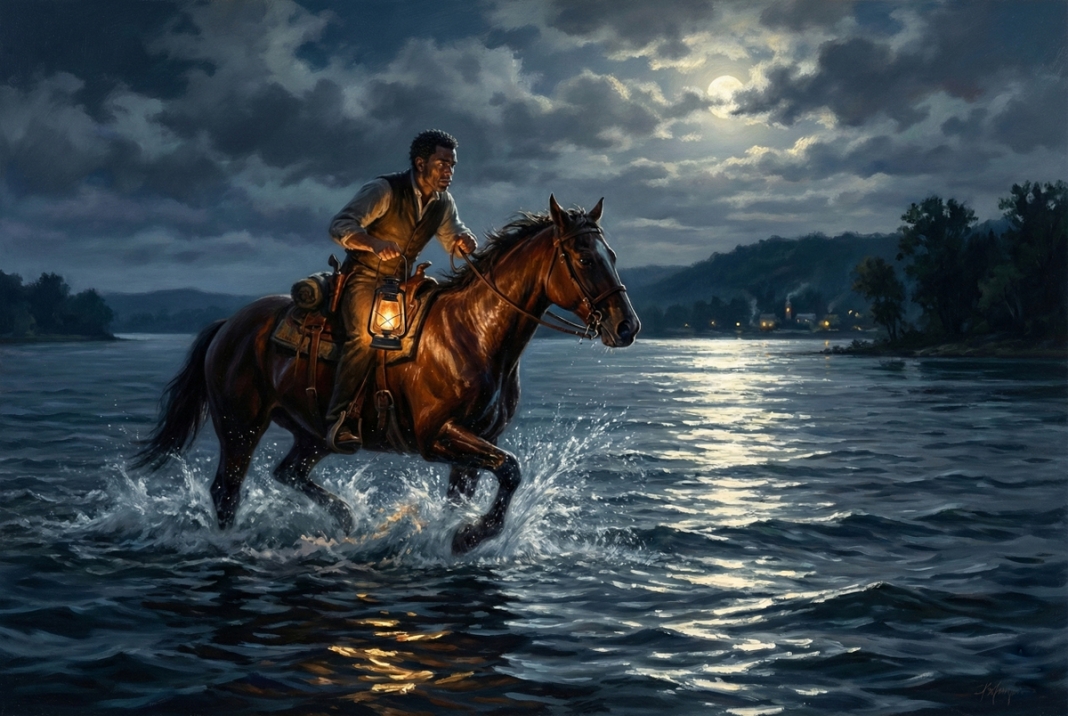

CLARKSBURG, W.Va. — On a September morning in 1856, attorney James Jackson awoke to learn that one of the people he claimed to be his property had stolen one of his horses and fled for freedom. Jackson was a member of one of Harrison County’s most prominent families and a relative of Thomas “Stonewall” Jackson.
He posted an advertisement in several regional newspapers, offering a reward for the return of a man he called “Charles.” He offered a reward of $200 for Charles's capture in Virginia or $300 for his return from out of state. He advertised an additional $20 reward for the “dark sorrel mare” which the runaway had taken to secure his freedom.
Escape across the Ohio River
The runaway fled west and north, crossing the Ohio River at St. Marys, now in West Virginia, and then traveled about sixty miles north to the town of Barnesville, Ohio. There, he introduced himself as “William” and let people know he was looking for work.
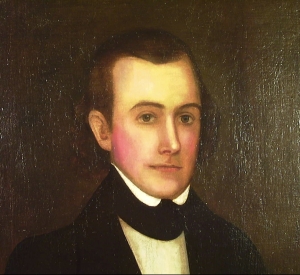
Samuel Briggs, a local farmer, hired him as a farmhand, and William settled in. It was a risky decision. Barnesville was just thirty miles west of Wheeling, and Jackson had published his runaway slave notice in the Wheeling papers, which would have circulated in Barnesville.
That advertisement described “Charles” as being “about five-feet-nine-or-ten inches high, a very dark mulatto, aged about 26 or 27 years, stout made, stoop shoulders, has a down look when spoken to, and steps wide and long when walking,” and also described the horse he was traveling on, a “dark sorrel mare, about nine years old, fifteen hands high, a very fast walker and may be recognized by a small white spot on the side of her face, three or four inches below her right eye.”
If any resident of Barnesville wondered about the newcomer who called himself “William,” that advertisement might have given them an answer. Perhaps some folks had, but Quakers had founded the farming community of Barnesville, and many still lived in the region. Quakers were among the first Christian sects to embrace antislavery views, so perhaps any locals who knew who William was kept the secret on moral grounds.
The risk of staying under the Fugitive Slave Act
Nevertheless, William took a huge risk by not moving on. Since 1850, a new federal Fugitive Slave Act had given bounty hunters extraordinary powers to roam through free states and seize people of color they claimed as runaways and send them into slavery.

The evidence that the slave catchers were required to provide to local courts was so slim that even legally free people of color in Ohio were at risk of being kidnapped and carried into slavery. After 1850, when a runaway in Ohio found help from sympathetic local abolitionists, they were typically encouraged to keep moving north to Canada, where they could secure true freedom. Perhaps it was the attention of a kind-hearted young woman that encouraged William to throw caution to the wind and stick around.
Falling in love with Phoebe Briggs
Phoebe was the daughter of Samuel Briggs, the farmer who had hired William. She was about 21 years old when she met William, and the two eventually began a secret romance. William worked for the family for more than two years and drew little attention until Phoebe became pregnant, at which point the secret relationship was exposed.
Phoebe’s family was outraged when they learned that the father was William. Out-of-wedlock pregnancies were not uncommon in the mid-19th century, but interracial relationships were still considered taboo by many.
Phoebe was turned out by her family, and someone in the community suddenly seemed to know that William was the fugitive slave who had fled Clarksburg more than two years earlier. They sent word to James Jackson, who reaffirmed his offer of a reward for “Charles’” return. Many Ohioans would gladly help capture William in exchange for a substantial reward.
Phoebe and William fled Barnesville and headed to Zanesville, a town with a sizeable free Black population and a history of active participation in the Underground Railroad. According to Zanesville history, “a colored woman” took in Phoebe, William, and their child.
The deception of Mordecai Hunnicutt
Among the bounty hunters who offered their services to James Jackson was Mordecai Hunnicutt, who lived south of Zanesville and seemed to know the local free Black population quite well. Hunnicutt launched a deceptive plan to lure William out of hiding.
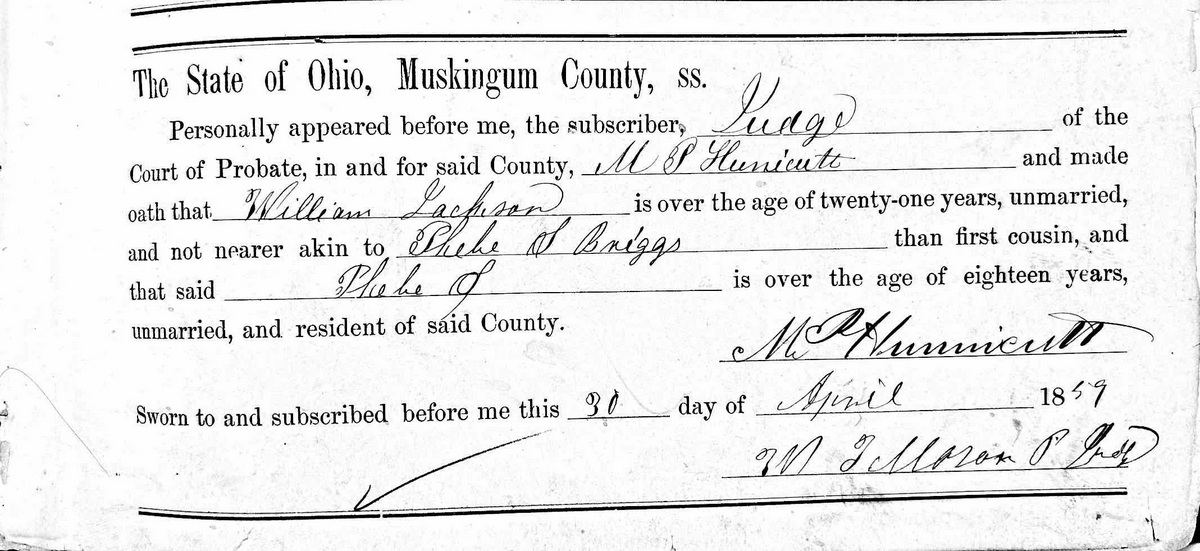
He went to the courthouse and filed a marriage affidavit for Phoebe and William. A marriage affidavit was essentially the equivalent of a marriage license today. It required a third person to testify before a judge that the two people seeking to marry were of legal age and not closely related. The betrothed were not required to be present to secure this document.
Hunnicutt appeared in court, claiming to be a close friend of Phoebe and William, and he testified before the judge and signed the affidavit. He planned to use this legal document to lure William and Phoebe out of hiding.
Hunnicutt targets Abolitionist Simpson
He approached Josh McCarter Simpson, an herbalist and the city’s leading Black abolitionist. Hunnicutt was sure that if anyone knew William and Phoebe’s whereabouts, it would be Simpson.
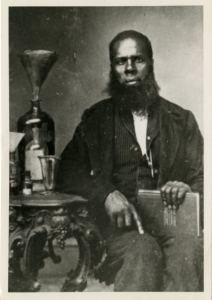
Simpson had been born free in Ohio, had published a book of antislavery songs titled "The Emancipation Car," wrote for several abolitionist newspapers, and was one of the local conveners of the "Underground Railroad Convention," a Black abolitionist organization that had recently emerged in Ohio.
Hunnicutt told Simpson that he represented Phoebe’s family, and that they wanted her to know that she would be forgiven if she married William and the two moved to Canada, so that the stain on the family’s honor might be forgotten back in Barnesville. He said the family was willing to provide William and Phoebe with the money they needed to be resettled in Canada. And then he pulled out the marriage affidavit and shared it with Simpson.
The paperwork was already filed, Hunnicutt declared, and Simpson just needed to get word to William and Phoebe to meet him at the courthouse at a designated time, where they could be wed. He would give them the money they needed to travel to Canada. The deceit worked, and Simpson persuaded William and Phoebe to come out of hiding and meet Hunnicutt.
The Capture in Zanesville
Before the designated meeting time, Hunnicutt deployed the power given him by the Fugitive Slave Act to gather a posse and forcibly deputize additional locals to help him seize William. The deputies waited near the courthouse when Phoebe and William arrived.
Hunnicutt and his men immediately seized William and took him to the courthouse, hoping to get a judge to quickly declare that William was a fugitive slave and allow the armed deputies to take him on a train to Wheeling, where he would be returned to slavery.
As word spread across Zanesville that William had been captured, a crowd gathered around the courthouse. A group of free persons of color tried to wrest William away from the deputies, and violence ensued. One Black man named Reuben aimed a pistol at a deputy, but it misfired.
Forced removal to Wheeling
A local abolitionist attorney argued before the judge that William’s seizure violated an anti-kidnapping law Ohio had passed a year earlier. Still, the judge ultimately ruled that the Federal Fugitive Slave Law took precedence over the state law and decided in favor of the slave catchers.
Hunnicutt needed to get his “prize” to the railroad depot and on a train to Wheeling to get his reward. He deputized more armed local men to guard William at the train station and to travel with him on the train to Wheeling, concerned that there might be further attempts to rescue him from the train before it arrived.
The Wheeling Intelligencer reported on the train’s arrival on May 4th, 1859, noting that William “was accompanied by about twenty men, all of whom were armed to the teeth and ready to defend the distinguished colored gentleman to the death.”
Zanesville crisis shifted public opinion
The dramatic events in Zanesville strengthened antislavery feeling in the city less than two years before the outbreak of the war. Many white residents who had not been active in antislavery causes deeply resented the turmoil and expenses thrust upon their community, all in the service of an out-of-state enslaver.
Members of Zanesville’s Market Street Baptist Church, who ten years earlier had not been active in the antislavery movement, acted to expel a church member named Ezekiel Cox, who had cooperated with the return of William Jackson to slavery.
Cox defended his actions, saying he was only following the law, but his fellow congregants had apparently concluded that God’s law was more important than man’s law, and that as a Christian he should have refused to cooperate when deputized. Many historians have concluded that the 1850 Fugitive Slave Law and the many dramas it created in towns like Zanesville did more to convert white northerners to the antislavery cause than anything else.
William’s unknown fate
Within days, “William” Jackson was back in Clarksburg, but his fate remains a mystery. Local stories indicate that James Jackson sold the returned fugitive south shortly after he returned.
This was a common practice by enslavers when runaways were returned. They understood that a person who had struck for freedom once was likely to try again, and it was better to get a return on their “investment” by selling them quickly.
We don’t know if William survived the Civil War, secured his freedom, and found happiness. Records of freedmen after the Civil War are incomplete, and Jackson—if that is even the surname he used—was a very common name for formerly enslaved people.
What Became of Phoebe Briggs?
What happened to Phoebe and her baby? We have no record of what happened to the baby. Perhaps the child was adopted by a local Black family.
By 1870, Phoebe was married with several children—none of them old enough to be her child with William—and was living at the county poor farm. She outlived that husband, married a second time, and outlived the second husband, too.
Late in life, she was a member of Zanesville’s Market Street Baptist Church, perhaps attracted to that church because of the antislavery stand they took after her beloved William was ripped away from her.
Phoebe passed away in 1930 and is buried in the Greenwood Cemetery in Zanesville, not far from the gravestone of Josh McCarter Simpson, the local Black abolitionist who unwittingly had become the pawn of the conniving slave catcher Mordecai Hunnicutt.
The later life of Mordecai Hunnicutt
For his cruel deceit, Hunnicutt was reviled by free Black people living along the Muskingum River, and some sought revenge. A small group of men launched a plan to jump Hunnicutt and give him a beating, but he was alerted to the plan and made a narrow escape. After the Civil War, Hunnicutt moved to Texas, became a local sheriff, and found himself in legal trouble, accused of killing a young boy.
Sign up to receive a FREE copy of West Virginia Explorer Magazine in your email weekly. Sign me up!