
FRANKFORD, W.Va. — Long before viral videos and roadside attractions, West Virginia produced a creature so outsized that stories about him drifted into legend. Yet, despite decades of exaggeration, the animal at the center of the tale did exist.
According to the late Jim Comstock, the renowned West Virginia storyteller and publisher of the West Virginia Hillbilly, the massive steer known as "Stonewall Jackson" was no myth. Comstock preserved the story in the West Virginia Heritage Encyclopedia (p. 2876), carefully separating folklore from fact, or so he implied.
"Despite the stories which have clustered about Col. Samuel C. Ludington’s famous steer and have imbued the fabulous beast with mythological aspects, the animal did exist," Comstock wrote.
Born on a Greenbrier County Farm
Stonewall Jackson’s story begins more than a century ago in Blue Sulphur Springs, in Greenbrier County, where farmer Joe Jarrett raised a promising young Shorthorn steer. Even as a yearling, it dwarfed its working partner in a matched yoke of oxen. It soon became obvious this was no ordinary farm animal.
Jarrett sold the giant ox to Col. Samuel C. Ludington, a wealthy cattleman with a large Shorthorn herd based near Frankford. Ludington, according to Comstock, recognized the ox’s extraordinary size early and named him "Stonewall Jackson," in honor of the famed Confederate general.
Feeding an army and fueling tall tales
During the Civil War, a Confederate beef contractor reportedly traveled through the area in search of cattle. Fearing the ox would be seized anyway, Ludington sold him for army use. Instead of being slaughtered, however, Stonewall was kept alive throughout the war, becoming the subject of countless stories.
Comstock says farmhands and fairgoers tested the ox’s immensity in playful ways. At one exhibition, a half-bushel of shelled corn was poured onto his back. Not a single grain rolled off if the stunt was correctly performed. In later retellings, the amount swelled to “two bushels.”
A Fairground Sensation
The only time Stonewall Jackson was officially exhibited to the public came at a fair in Lewisburg in 1868. A local newspaper proclaimed the ox “one of the greatest curiosities of the age,” noting that he would later be transported to New York—a journey that proved ill-fated.
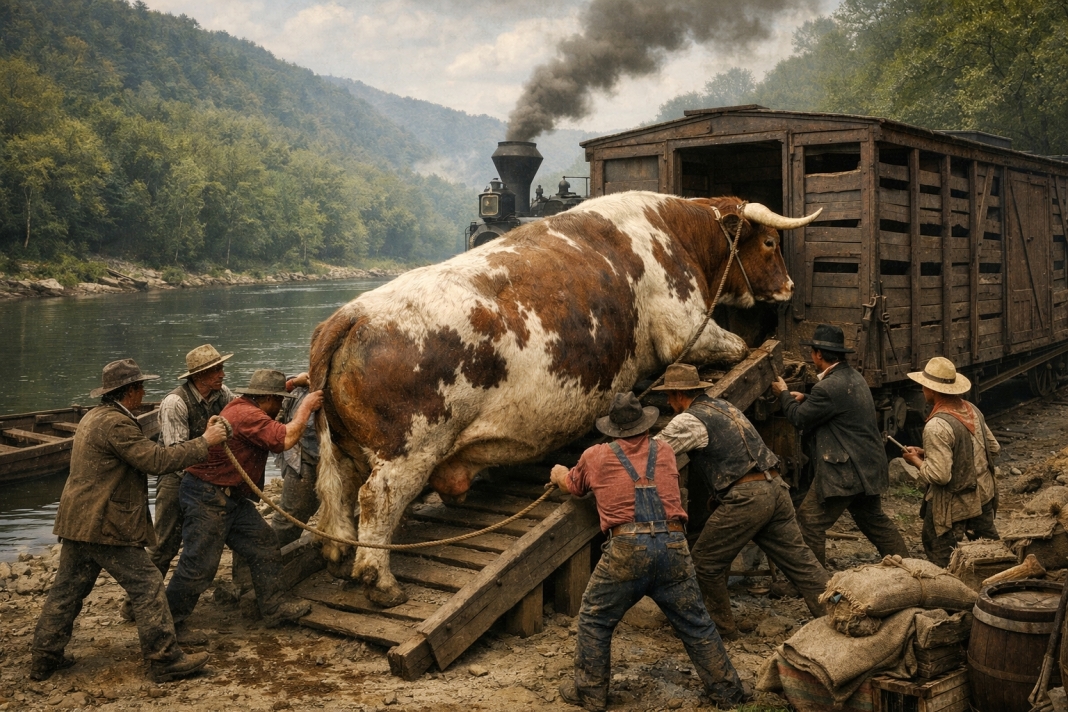
The Chesapeake & Ohio Railway reached White Sulphur Springs by that time, and Ludington attempted to move his prized ox by rail. But the specially built wagon carrying Stonewall Jackson broke down under his enormous weight. After miles of travel barefoot, the ox’s hooves became so sore that leather “shoes” had to be fashioned on the spot.
The Journey That Ended the Legend
Even after reaching White Sulphur Springs, the railroad was unprepared for such cargo. With no cattle cars available, workers improvised a fenced enclosure on a flatcar. The train departed, and fate intervened once more.
The train stopped suddenly. Stonewall Jackson suffered a severe leg injury. Though the leg was not believed to be broken, the damage was severe enough that the ox could not be returned. Ludington reluctantly sold him to George S. Peyton, manager of the Old White Hotel, for $500 cash.
Stonewall Jackson’s life ended not in glory, but in the slaughterhouse—a fate Comstock notes with deliberate irony.
"Mr. Peyton privately exhibited the giant ox as long as he could, but inevitably, Stonewall’s life, which had begun at one famous mineral springs, ended in the slaughterhouse of another."
The Weight That Settled Everything
The failed New York trip did answer one lingering question—Stonewall Jackson’s exact weight. When placed on railroad scales, the ox tipped them at 4,450 pounds.
For decades afterward, Comstock said, Greenbrier Valley stockmen measured their own prize animals against the shadow of Stonewall Jackson. Though later world-record steers emerged in the late 19th century, none clearly surpassed him.
Unofficially, Ludington’s ox held the world record for beef cattle for nearly a century — and for all breeds for 46 years.
"With the decline of the work animal, gradually yielding to the gasoline motor," Comstock lamented, "the word 'ox' has almost been lost to cattle parlance, so in retrospect, Colonel Ludington’s ox is more often referred to as 'The Ludington Steer.' ”
A Quiet, Forgotten Ending
Comstock closes the story on a somber note. Colonel Ludington, who had no children, suffered financial losses and declining health in his later years. He rode his horse daily, surveying land he once owned, and was buried in the Ludington family cemetery near his old brick home.
"The ending to the story of Colonel Ludington is as sad as that of his ox," Comstock writes. "He had no children. He suffered financial reverses and poor health.
Yet the man who helped feed the Confederate Army of southwest Virginia now lies in a sunken, unmarked grave, his legacy remembered primarily through the story of a giant ox that briefly captured the imagination of a nation.
Sign up to receive a FREE copy of West Virginia Explorer Magazine in your email weekly. Sign me up!