






Kanawha Coal Field
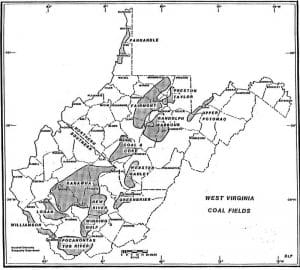
Map of coal fields of northern and southern West Virginia.
The Kanawha Coal Field is the name used to describe a coal-producing section of West Virginia that includes the following counties, in whole or in part: Kanawha, Putnam, Mason, Clay, Boone, Lincoln, and Nicholas counties.

Coal Seams in the Kanawha Coal Field
The principal seams that have been worked in the Kanawha Field are a part of the upper Kanawha Group and include the Stockton or Lewiston, the Coalburg, and the Winifrede. Most of the coal known as the Kanawha Splint Coal has been mined from the Winifrede, Coalburg, and Stockton-Lewiston seams. Lying below the Stockton, Coalburg, and Winifred seams is the softer Chilton coal, which reached its best development on the head of Coal River in Boone County. Above the Kanawha Group in the Allegheny series, the No. 5 Block coal is mined, mostly in eastern Kanawha and Clay counties.
Development of the Kanawha Coal Field
The Kanawha Coal Field is one of the oldest fields in West Virginia. The first commercial mining of coal in the Kanawha field resulted from the demands of the salt-making operations located at the Kanawha Salines. In 1817, David Ruffner began was the first to use coal to evaporate salt, the coal apparently coming from a mine opened the same year, by John P. Turner, located at the mouth of Burning Spring Branch, seven miles east of present-day Charleston, WV, on the north side of the Kanawha River.
Interest in the shipment of coal on the Kanawha via flatboats and steamboats, to markets in Cincinnati, began during the 1830s, following the incorporation of the first commercial coal company in the Kanawha Valley in 1834. In 1836 Colonel Aaron Stock opened a coal bank near the site of present-day Cannelton, WV, and soon afterward shipped coal via the Kanawha to either Cincinnati or New Orleans. This is said to be the first shipment of coal via flatboat from the Kanawha Valley.
In about 1859, Col. William M. Peyton of Virginia bought a large tract of land where Peytona is now located. Peyton’s intent was to open a cannel coal mine and to ship the coal to market via the Coal River when water levels were sufficient. He managed to ship about 50,000 bushels of cannel coal prior to 1857. About 1853 or 1855 the property was purchased by New York and Company and “Western Mining and Manufacturing Company.”
In 1849, a charter was granted to the Coal River Navigation Company and preliminary arrangements made to commence work on improving the Coal River. Work progressed slowly until 1856 and 1857, when nine locks and dams were completed. Eight were located on (Big) Coal River and Locks A on Little Coal River. Three or four of the locks and dams were damaged badly in 1858 by a period of high water. They were repaired but again in September of 1861, a huge flood damaged all of the river’s locks and dams.
During the Civil War the companies operating at Peytona closed. The Peytona Cannel Coal Company was organized in 1865 and began operations at Peytona, on Coal River in 1866. The company was organized by Dr. Henry DuBois, of New Haven, Connecticut along with several New York capitalists. The old locks and dams on Coal River were rebuilt by the Navigation Company of Coal River and the river opened for the passage of traffic in the spring of 1867. By December of 1880, the Peytonna Cannel Coal Company had ceased operation because of a decline in the prices of coal and because of the large costs of maintaining the locks and dams.
Following the completion of the Chesapeake & Ohio Railway (C&O) in 1873, numerous mining operations opened in the Kanawha field. The mines at Cannelton, located on the opposite side of the Kanawha from the rail line, began sending its coal across the river to the railroad by ferry. Within three years of the line’s opening, eighteen mining operations had opened along the C&O’s rail line on the south side of the New and Kanawha rivers.
In 1893, the Kanawha & Michigan Railroad (K&M) completed a line between Charleson and Gauley Bridge, WV, allowing the development of additional mines along the north side of the Kanawha. From Charleston, the K&M line ran to Corning, OH, thus providing the Kanawha coal operators with access to the “western markets.” In later years, the K&M built a five-mile branch line, the Smithers Creek Branch, from Cannelton and Smithers, WV, along Smithers Creek to Marting, West Virginia. The K&M line later became part of the New York Central System.
By 1906, 261 coal mines were operating within a 60-mile radius of Charleston, West Virginia, located in the Kanawha and New River coal fields.

Recent Articles
Nightfall’s Value: Light pollution can diminish real estate worth in W.Va.
WINFIELD, W.Va. — An increasing number of new West Virginia residents are being drawn to its rolling hills and quiet valleys to escape brightly lit...
Inside Appalachian Escapes: Themed rentals, escape rooms, and a love letter to West Virginia
FAYETTEVILLE, W.Va. — What began as a search for an affordable retirement option has turned into one of southern West Virginia’s most imaginative...
West Virginia bottler wins silver award at international water competition
BERKELEY SPRINGS, W.Va. — Le Sage Natural Water, of Lesage, has been awarded a silver medal for its purified water at the 36th annual Berkeley...
West Virginia uniquely prepared to dominate 21st-century outdoor economy
CHARLESTON, W.Va. — West Virginia is uniquely prepared to dominate in the 21st-century outdoor economy of the U.S., thanks to its unmatched...
Flood risk outpaces warnings, advocates say, as W.Va. considers changes to resiliency fund
CHARLESTON, W.Va. — As the W.Va. House of Delegates considers changes to Senate Bill 390, the West Virginia Rivers Coalition warns that the state...
We asked AI how its own data centers could pollute West Virginia. Here’s what it had to say
(The following article was generated partly by ChatGPT in response to a prompt about how data centers pollute. As ChatGPT is powered by data...
Inaugural W.Va. Outdoor Economy Summit to unite leaders around $2.1 billion growth
CHARLESTON, W.Va. — West Virginia’s outdoors are more than a scenic backdrop. They’re a strategic economic asset. That message will take...
West Virginia State Parks Foundation launches online merchandise store
HURRICANE, W.Va. — The West Virginia State Parks Foundation has launched an official online merchandise store, offering supporters a new way to...
West Virginia Travel Safety: What it means for residents and visitors in 2026
CHARLESTON, W.Va. — Travel safety in West Virginia is shaped less by headline-grabbing crime and more by geography, weather, and the realities of...
Did Abraham Lincoln and Jefferson Davis secretly meet in West Virginia?
PHILIPPI, W.Va. — Did Abraham Lincoln and Jefferson Davis secretly meet in what is now West Virginia just days after the first land battle of the...