
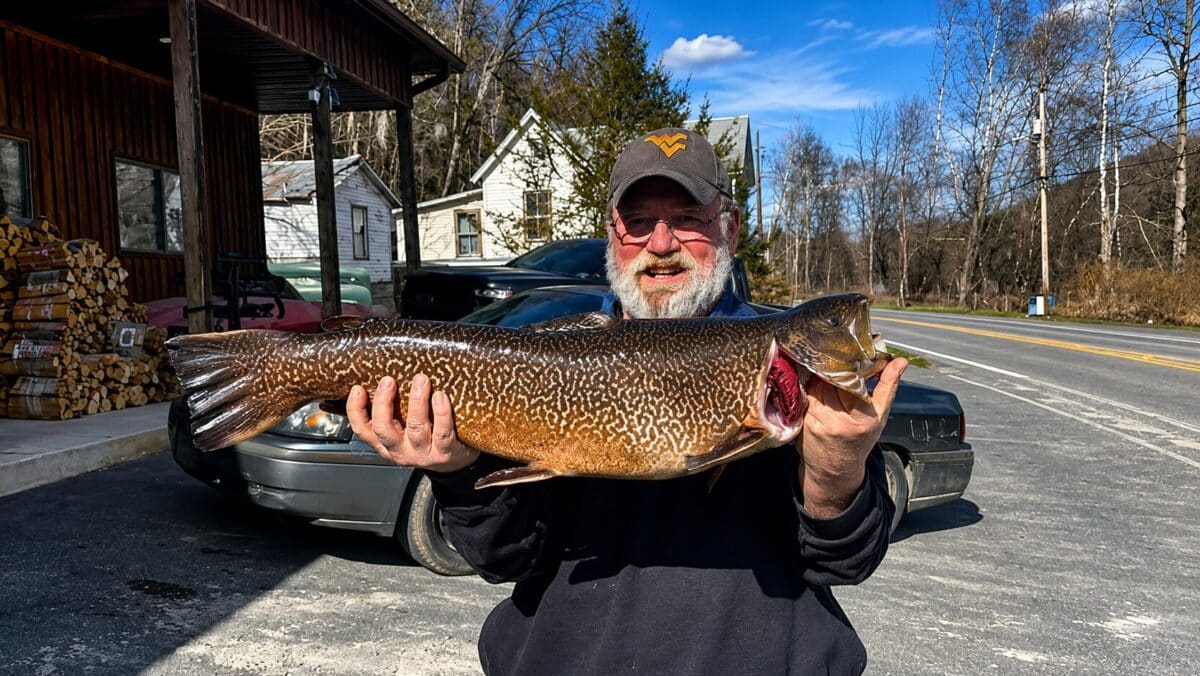
MARLINTON, W.Va. — John Terry, of Gallagher, in Kanawha County, set a new state record for tiger trout on March 19 by catching a 29.13-inch, 11.04-pound tiger trout from Seneca Lake in Pocahontas County.

The trophy catch surpasses the previous state length record of 28.7 inches recorded by Mike Connelly in 2011 at Krodel Lake at Point Pleasant, according to Brett McMillion, director of the W.Va. Division of Natural Resources. Terry used a Panther Martin Spinner and four-pound test line, McMillion said.
“We are excited to recognize Mr. Terry for setting a new state record for tiger trout,” McMillion said. “His accomplishment showcases the outstanding fishing experiences West Virginia has to offer and reflects the passion anglers bring to the waters throughout the state.”
To learn more about state fish record categories, check page 24 in the West Virginia Fishing Regulations Summary, available to download at WVDNR.gov/fishing-regulations. Information pertaining to the Trophy Fish Citation and Master Angler programs can be found on page 27.
All anglers 15 and older must have a West Virginia fishing license, which can be purchased online at WVFish.com. Anglers are reminded that a trout stamp is required when fishing for trout. They are also encouraged to enhance their fishing experience by opting for a physical license card when purchasing their 2026 fishing license.
About Seneca Lake
Seneca Lake is a four-acre lake located in Seneca State Forest near Dunmore, West Virginia, near the Greenbrier River, Thorny Mountain Fire Tower, and the town of Marlinton. The lake is known for trout fishing, bass fishing, camping, and boating. Forest facilities include campgrounds, cabins, hiking trails, and picnic areas.
The lake is stocked with trout and also contains largemouth bass, bluegill, and other panfish. Trout fishing is usually best in spring and fall when water temperatures are cooler. Because the lake is only about four acres, it is more popular for casual shore fishing and small boats. The quiet setting and relatively light fishing pressure are part of its appeal.
About Tiger Trout
Tiger trout (Salmo trutta × Salvelinus fontinalis) is a hybrid of brown trout (Salmo trutta) and brook trout (Salvelinus fontinalis), named for its striped coloration, reminiscent of a tiger’s. They are a rare anomaly in the wild because the parent species are distantly related, belonging to different genera, though specialized hatchery rearing techniques can produce tiger trout to meet the demands of stocking programs.
Prior to the 19th century, naturally occurring tiger trout were impossible because the native ranges of brown trout in Eurasia and brook trout in North America did not overlap, so the species could never have encountered one another in the wild.
However, when the widespread stocking of non-native gamefish began in the 1800s, brown trout and brook trout established wild populations alongside one another in some places, creating opportunities for hybridization. Instances of stream-born tiger trout were recorded in the U.S. as early as 1944, and despite their exceptional rarity, they’ve been documented numerous times in the 20th and 21st centuries.
They are useful controls against rough fish populations. Along with their desirability as novel game fish, tigers have continued to be popular with many fish stocking programs.
Fishing in West Virginia
Fishing is one of West Virginia’s most established outdoor traditions, supported by more than 20,000 miles of streams and rivers and over 100 public fishing lakes across the Mountain State. Cold, forested headwaters in the Allegheny Mountains sustain native brook trout populations, while larger rivers such as the New, Potomac, Greenbrier, and Ohio support fisheries for smallmouth bass, muskellunge, walleye, and catfish.
The state is especially known for trout fishing, including its distinctive golden rainbow trout program administered by the W.Va. Division of Natural Resources. Fishing tourism contributes significantly to the state’s outdoor recreation economy, drawing anglers for float, fly, and lake fishing, as well as seasonal trout stockings.
I’m not sure what’s more impressive, the trout , or the 2001 Chevy impala battling the mountainous terrain in Pocahontas county for the past 25 years,and still running. Good catch ole buddy.