
OAKVALE, W.Va.— Motorists traveling along US 460 east of 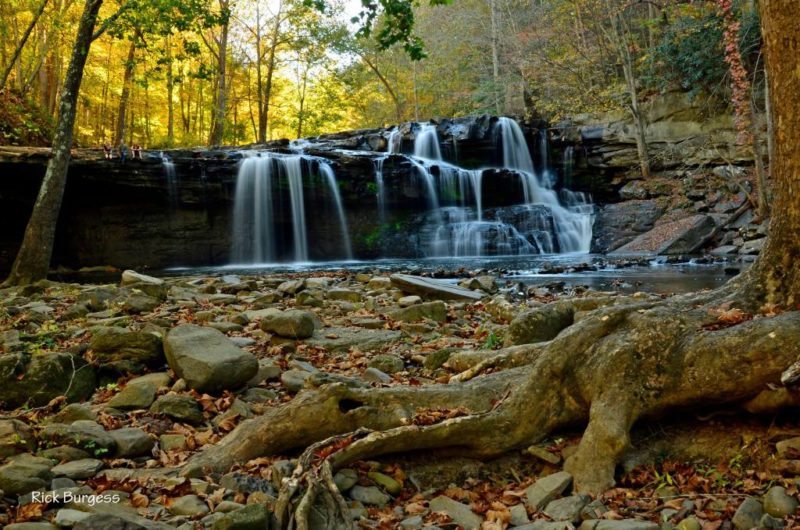 Autumn at Brush Creek Falls in Mercer County near the Bluestone National Scenic River.[/caption]

The incident, remembered as the Pauley Massacre, was among many deadly clashes that marked the struggle for control of the Appalachian backcountry during the Revolutionary War era. Much of the conflict pitted Virginia settlers against Shawnee forces allied with the British, though historical accounts indicate the attackers in this case were a party of Miami warriors.
The following account of the massacre was recorded by historian Jim Comstock in volume seven of the West Virginia Heritage Encyclopedia.
The Pauley Massacre
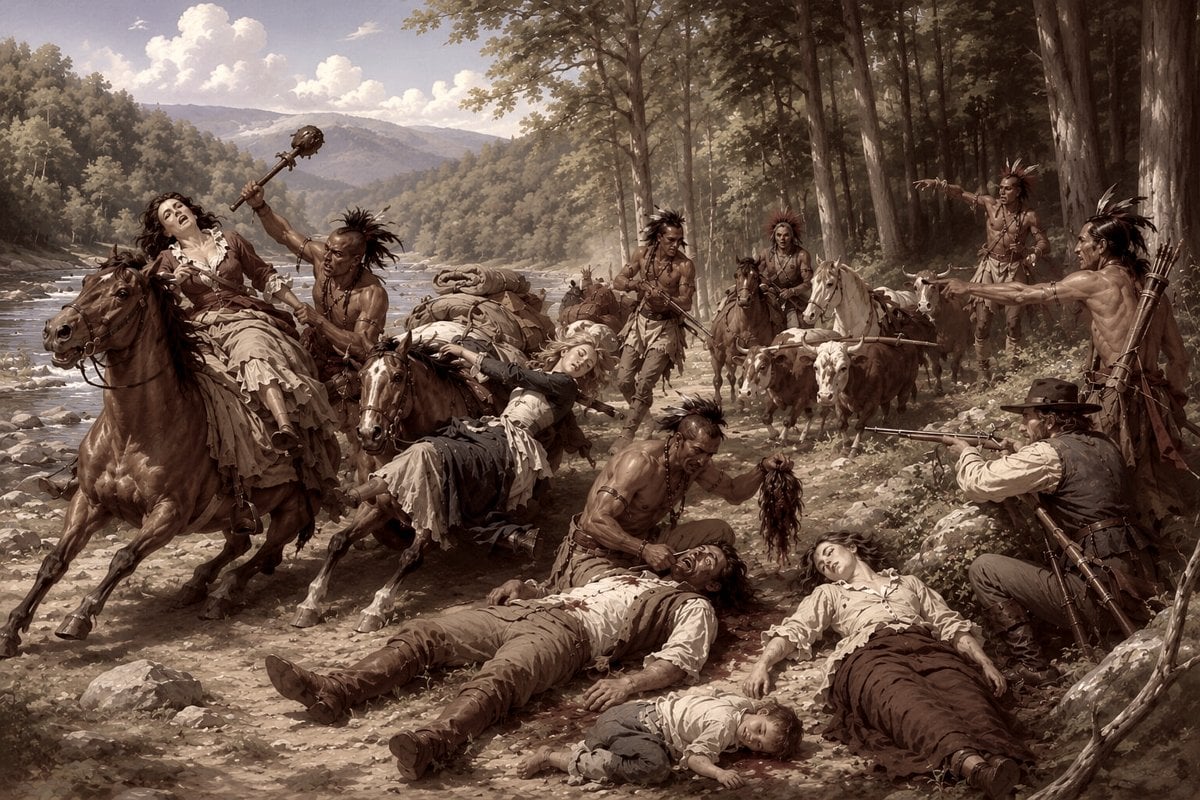
On September 23, 1779, Margaret Pauley and her husband, John, together with James Pauley and his wife and child, Robert Wallace and his wife, and Brice Miller, set out from the Greenbrier section to go to Kentucky. They crossed New River at the horse ford at the mouth of Rich Creek, then down New River and up East River, which was the shortest route to the Cumberland Gap.
Each of the men had his rifle; the women on the horses, on which were packed what household goods they could carry, were in front, the men in the rear driving the cattle.
About noon, and when the party had reached a point on East River thereof—supposed to have been near the upper end of the old farm of Captain William Smith—they were attacked by five Indians and one white man by the name of Morgan, a renegade, who was in company with the Indians.
The women, Mrs. John and James Pauley, were knocked down from their horses by the Indians with their clubs. Wallace and the two children were killed and scalped, and John Pauley, though fatally wounded, escaped and succeeded in reaching Wood’s Fort on Rich Creek, where he died.
The Indians took the Pauleys prisoner, and on leaving the scene of their atrocities, went up East River to the mouth of Five Mile Fork, and thence up the same to the head across the Bluestone, and on to the Ohio and to the Indian towns of the Miami. There were two women and the little boy of Mary Pauley, born shortly after she reached the Indian towns, who remained prisoners for about two years.
Finally, Mrs. James Pauley escaped, and shortly after, Margaret Pauley and her child were ransomed. The travelers shared their fate with other frontier heroines, including 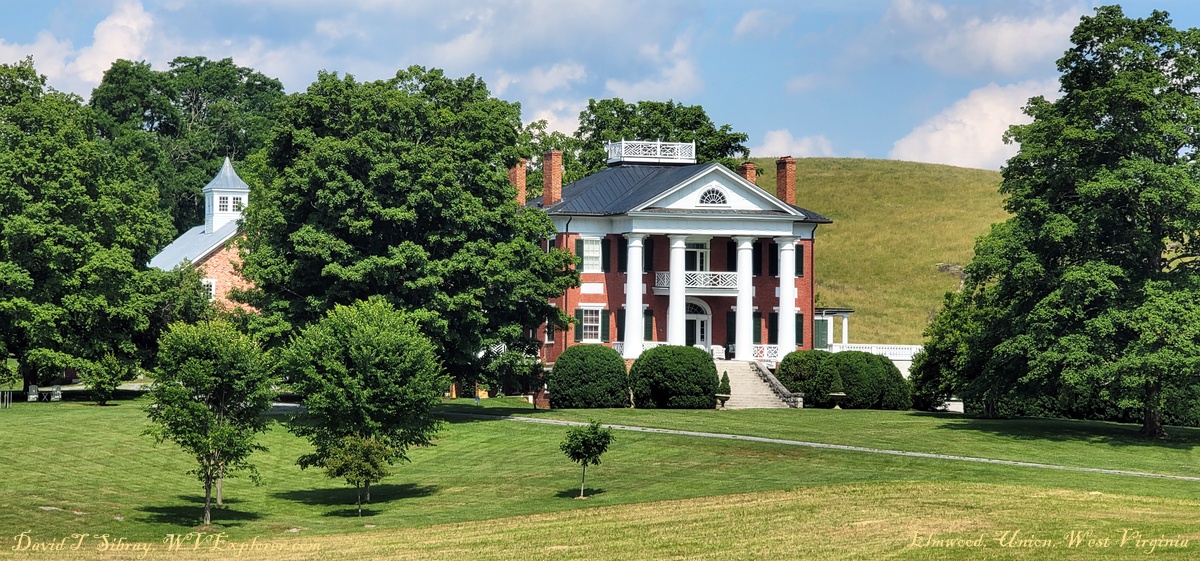 Scenic Monroe County features some of the best-preserved architecture in the eastern U.S. (Elmwood, Hugh Caperton House, c. 1830)[/caption]
After the return of Margaret Pauley, she married a Mr. Erskine, by whom she had a daughter, who married Hugh Caperton, who became a distinguished man, and who was the father of U.S. Senator Allen T. Caperton, of Monroe County.
Adam Caperton, the father of Hugh Caperton, was killed in a battle with the natives at the Little Mountain, or Estell’s Defeat, near where Mt. Sterling, Kentucky, is now situated. Captain Estell and six of his men were killed, and 17 of the Indians were killed. This battle was fought on the 22nd day of March, 1782.
The Shawnee and the Miami
The Shawnee and Miami were frequently allied during the 18th century, especially in resisting colonial expansion into the Appalachian frontier.
Both nations were part of a broad network of native alliances that shifted over time in response to trade, warfare, and diplomacy. During conflicts such as the French and Indian War and, later, the American Revolutionary War, Shawnee and Miami leaders often cooperated militarily and politically with other indigenous nations, including the Delaware, Wyandot, and Mingo.
The Miami-Shawnee alliances were further strengthened by geography and shared interests. The Miami were centered primarily in present-day Ohio and Indiana, while the Shawnee occupied portions of Ohio and Kentucky. Both faced increasing pressure from settlers moving westward from Virginia and Pennsylvania, though the king of England had forbidden settlement in the Appalachians in his Royal Proclamation of 1763.
During the Revolutionary War era, many Shawnee and Miami warriors fought alongside the British, hoping to slow or stop American settlement beyond the Appalachians. Raids and counterattacks became common along frontier settlements in what is now West Virginia and Kentucky.

Notable leaders such as Little Turtle of the Miami and Blue Jacket later worked within larger intertribal confederacies to oppose U.S. expansion during the Northwest Indian War of the late 1700s.
It is also important to note that the word “massacre” in frontier histories was often applied selectively by settler historians. Modern historians generally place these events within the broader context of violent territorial conflict between Indigenous nations and colonial settlers moving into the Ohio Valley and Appalachian frontier.
Dave, who were the other “Frontier heroines” mentioned in the article, with which the Pauley travelers shared a similar fate? On the mobile version of this article, the sentence is cut-off by a picture of Elmwood in Monroe Co.
Very Interesting.