



Charles Town grave marks the last resting place of restless John Yeats Beall
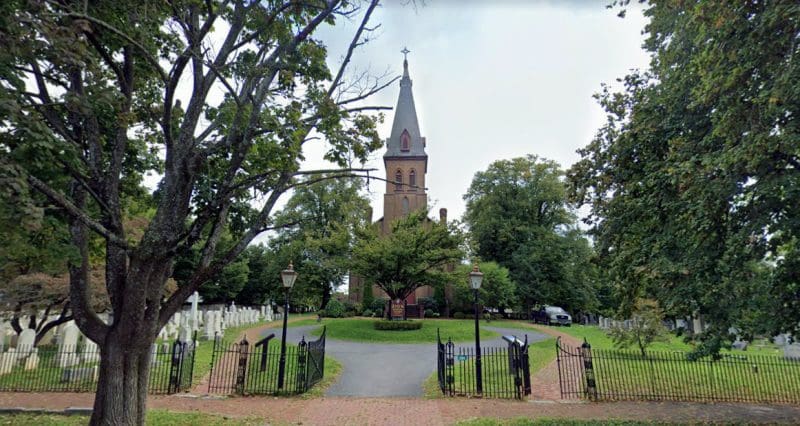
CHARLES TOWN, W.Va. — In the Zion Episcopal churchyard in Charles Town, West Virginia, lies the grave of John Yates Beall, one of the state’s most audacious Confederate partisans.
Beall was born in Jefferson County, Virginia, in 1835, and grew up in a wealthy, slave owning family. When the American Civil War broke out in 1861, he inherited a plantation of his own and claimed more than 100 enslaved people as his property.

Believing his material interests were threatened by the election of Lincoln to the presidency, he didn’t hesitate to join the Confederate cause, enlisting as the Captain of Company G, 2nd Virginia Infantry, which was attached to Stonewall Jackson’s Brigade.
John Yates Beall in Charles Town
Six months into the war, Beall received a severe chest wound in a skirmish with Union troops in Jefferson County, a wound that never fully healed. Undaunted, he attempted to rejoin Jackson during the 1862 Shenandoah Valley campaign but was physically unable to keep up.
For a short time, it seemed he was done with war and went to Iowa, where he took a job at a gristmill under an assumed name. But when his Confederate identity was exposed, he fled to Canada and came up with a new plan to help the Confederacy—launching naval raids across the Great Lakes, using Canadian waters as a safe haven.
Raids from Chesapeake to Potomac
When he pitched the idea to the Confederate Government, Richmond hesitated, for they feared such actions might antagonize Great Britain and draw them into the conflict on the Union side. But Beall did not give up easily.
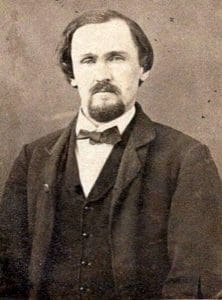
Bealle’s last words: “I die in the service and defense of my country.”
He soon adapted his plan to leading privateering raids in the Chesapeake Bay, and acquired two small vessels—the Raven and the Swan—recruited a band of eighteen men to launch raids across the Chesapeake Bay and into the Potomac River, and began disrupting Union supply lines and capturing merchant ships carrying goods to Union ports.
In November of 1863, Union forces caught up with him. He was arrested and held at Baltimore’s Fort McHenry but released in a prisoner exchange six months later.
Confederate Plans from Canada
As soon as he was released, he slipped across the Canadian border and traveled to Amherstburg, Ontario, where he learned Confederate agents were planning a dramatic prison break. Their target was Johnson’s Island, a prison camp off Lake Erie’s Ohio shore, where hundreds of captured Confederate officers were detained.
On September 18, 1864, Beall and his men seized a commercial steamer called the Philo Parsons after walking on as ordinary passengers and seizing control of the vessel in the middle of the lake. They then approached another ship, the Island Queen, and scuttled it.
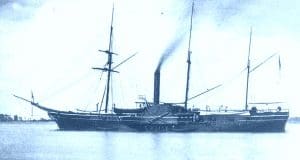
The U.S.S. Michigan was a target of Beall’s crew, who lost their nerve, and he was forced to abort the mission.
Their next target was the U.S.S. Michigan, which guarded Johnson’s Island, but some of Beall’s crew lost their nerve, and Beall was forced to abort the mission. While one of his co-conspirators was arrested when they returned to Canada, Beall managed to slip away, determined to launch one more desperate scheme to derail a train near Niagara, New York, to free Confederate officers in transit.
The plan, however, was thwarted before it began. Beall was arrested on December 16, 1864, and imprisoned at Fort Lafayette. A co-conspirator agreed to testify against him in exchange for leniency.
Execution of John Yates Beall
Beall’s trial was swift and secretive. Held before a military commission under General John Adams Dix, his trial in January lasted only a few weeks. On February 8, he was found guilty of sabotage, espionage, and violating the laws of war and sentenced to death.
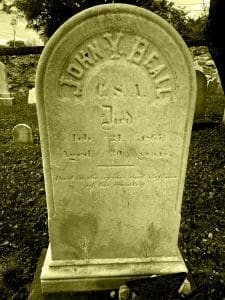
John Yates Beall Grave at Charles Town, West Virginia
Surprisingly, many members of the public and some politicians appealed to Lincoln to spare him. It appeared that many were impressed by his courage and audacity. But Lincoln refused a pardon.
On the morning of February 25, 1865, with the end of the war near and the Confederacy in its death throes, Beall ascended the scaffold. Declining to wear a blindfold, his last words were: “I protest against this execution. It is absolute murder—brutal murder. I die in the service and defense of my country.”
His body was returned to Jefferson County, West Virginia, and lies just a few blocks away from the spot where John Brown was executed just six years earlier.
Zion Episcopal Cemetery in Charles Town
A book by William C. Harris, The Life of John Yates Beall: Confederate Privateer, tells his full story. You can visit John Yates Beall’s grave today in the Zion Episcopal Cemetery in Charles Town, West Virginia.

Inside Appalachian Escapes: Themed rentals, escape rooms, and a love letter to West Virginia
FAYETTEVILLE, W.Va. — What began as a search for an affordable retirement option has turned into one of southern West Virginia’s most imaginative...
West Virginia bottler wins silver award at international water competition
BERKELEY SPRINGS, W.Va. — Le Sage Natural Water, of Lesage, has been awarded a silver medal for its purified water at the 36th annual Berkeley...
West Virginia uniquely prepared to dominate 21st-century outdoor economy
CHARLESTON, W.Va. — West Virginia is uniquely prepared to dominate in the 21st-century outdoor economy of the U.S., thanks to its unmatched...
Flood risk outpaces warnings, advocates say, as W.Va. considers changes to resiliency fund
CHARLESTON, W.Va. — As the W.Va. House of Delegates considers changes to Senate Bill 390, the West Virginia Rivers Coalition warns that the state...
We asked AI how its own data centers could pollute West Virginia. Here’s what it had to say
(The following article was generated partly by ChatGPT in response to a prompt about how data centers pollute. As ChatGPT is powered by data...
Inaugural W.Va. Outdoor Economy Summit to unite leaders around $2.1 billion growth
CHARLESTON, W.Va. — West Virginia’s outdoors are more than a scenic backdrop. They’re a strategic economic asset. That message will take...
West Virginia State Parks Foundation launches online merchandise store
HURRICANE, W.Va. — The West Virginia State Parks Foundation has launched an official online merchandise store, offering supporters a new way to...
West Virginia Travel Safety: What it means for residents and visitors in 2026
CHARLESTON, W.Va. — Travel safety in West Virginia is shaped less by headline-grabbing crime and more by geography, weather, and the realities of...
Did Abraham Lincoln and Jefferson Davis secretly meet in West Virginia?
PHILIPPI, W.Va. — Did Abraham Lincoln and Jefferson Davis secretly meet in what is now West Virginia just days after the first land battle of the...
Study finds WVU and its health system account for 17% of West Virginia’s economy
MORGANTOWN, W.Va. — West Virginia University and the WVU Health System together generate $14.3 billion in annual economic impact in West Virginia,...