





Prehistoric burial mound in West Virginia contains remarkable secret
SOUTH CHARLESTON, W.Va. — Rising above the end of this city’s central avenue, the prehistoric Criel Mound—one of the largest burial mounds in West Virginia—has long captivated both onlookers and archaeologists alike.

Over the years, its origins have sparked countless theories—ranging from tales of mythic giants to speculation about a lost tribe of Israelites.
In reality, it was constructed nearly 2,000 years ago by indigenous peoples—“Indians” who were of average stature, and it shares similarities with many other mounds and earthworks throughout the eastern U.S.
Yet, something about the mound is remarkably different: the orientation of bodies buried within it is unlike that of other mounds, and this, says archaeologist Bob Maslowski, suggests something peculiar.
“The Criel mound is the only mound in the area with a central burial surrounded by other burials,” he says. In other mounds, burials appear to be more haphazard.
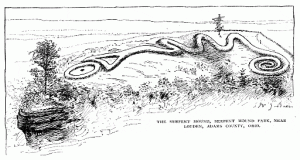
The Serpent Mound in Ohio is an effigy mound attributed to the Adena. (Illustration from The Century periodical, April 1890)
This could imply that the mound at South Charleston marked the site of a kind of nexus—a center point at which many people converged. The mound may represent alliances between tribal groups, and the burials may represent different ethnic groups placed together to solidify alliances.
“Most mounds will have burials that appear to be in random order in terms of directions, and one of the theories about Adena, especially in Kentucky and other areas of West Virginia, is that the burials don’t represent a particular Adena population,” Maslowski says.
“So what you’re getting is groups of people coming together to solidify treaties and other things. It’s a way of cooperating and reduces conflict between groups.”
The term “Adena” is a modern designation used to describe people who shared common practices and inhabited the Ohio Valley region from approximately 500 B.C. to 400 A.D. Their traditions overlapped with those of the Hopewell culture, which occupied the western part of the same region from around 100 B.C. to 400 A.D.
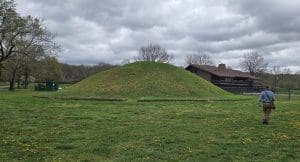
Sibray visits the Dunbar Mound at Shawnee Park, named for the Shawnee tribe, though the mound was built by an earlier culture.
Like the Adena and Hopewell, descendant Native American groups in the 1600s and 1700s followed similar practices, although they did not build large mounds.
“Certain tribes buried their dead with their heads in a particular direction. Local Siouan tribes buried the dead with their heads east, toward the rising sun. Some Algonquian tribes, like the Shawnee, buried their dead with the heads to the west; others buried their dead with heads to the north or south.”
What early archaeologists found at South Charleston
Many of the first Virginian colonists to reach the valley in the late 1700s may have believed the mounds were built by a race that predated the indigenous peoples of the Americas. However, scholars now know they were the forebears of the present-day Native Americans.
While laypersons occasionally dug into the mounds, a serious archaeological study wasn’t performed until 1884. American ethnologist and entomologist Cyrus Thomas spearheaded a survey with the Smithsonian Institution, investigating dozens of mounds and earthworks in the central Kanawha Valley, including those around what’s now Dunbar, Charleston, Saint Albans, and South Charleston.
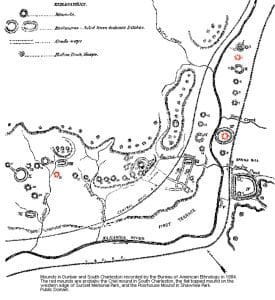
A full-scale map of prehistoric mounds appears to include existing mounds at Shawnee Park and in South Charleston in red.
Thomas and his team partially excavated the Criel mound, then owned by the Criel family, which farmed the valley after the American Civil War, and discovered 13 bodies interred at two different depths. Four feet below the surface, they found two skeletons buried with stone hoes, a projectile point, and stone disks.
At the bottom of the mound, however, they found 11 skeletons — 10 of which surrounded a central figure. Thomas wrote of a similar mound in Sullivan County, Tenn., but most other mound sites in the valley had burials that appeared to be randomly distributed.
Maslowski says the five burials on the east side were found with burial goods, while those on the west side had none, potentially representing two different tribes.
The figure in the center is believed to have been a chief or shaman—someone of great importance, buried with shell beads and copper fragments, which are thought to be remnants of a headdress.
“These customs may go back to the local Adena mound builders, but it hasn’t been studied yet,” says Maslowski. Artifacts excavated from the mound are now housed at the Smithsonian.
Giants, Israelites, and other fallacies about the mound builders
Over the years, myths have circulated surrounding burial mounds. One myth is that giants built the mounds. According to the National Register nomination for the mound, a Charleston resident who assisted in its excavations stated that one of the skeletons measured 6 feet, 8 inches.
However, Maslowski said this was an exaggeration or miscalculation, possibly caused by the pressure of the earth pressing down on the skeleton over time. Most of the bodies recovered were in poor condition, and none were provided to the Smithsonian.
Much of the spectacle about giants and non-native origin was also political propaganda that justified taking land from the Indigenous peoples.
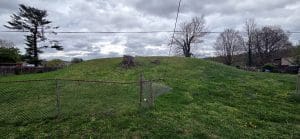
The top of the neglected Sunset Mound at South Charleston has been leveled.
“The intellectuals at that time knew that the mounds were built by Indians. They knew that these Indians most likely came from Asia,” Maslowski says.
“Thomas Jefferson excavated a mound and demonstrated this in the early 1800s. Later on, you get the development of the myths about the Lost Tribes of Israel and all kinds of things like this.”
“If you look at the landscape at Institute and the original maps by the Smithsonian, it looks like some of the picnic shelters are built on top of mounds.
“I don’t know if they did any archaeological work there or not, but that leveling of some of the mounds prevented any further excavations to see if there was evidence of feasting ceremonies. It’s been a major loss in terms of archaeological information.”
This loss also means it is difficult to prove precisely when these mounds were built.
“There’s a lot in the Smithsonian from these mound excavations, but the provenance isn’t well documented, and the problem is we don’t have a lot of radiocarbon dates,” he says.
“We can’t put a modern up-to-date sequence of the building of these mounds—how long mound-building periods lasted, when it ended, what changes were made after it ended.”
It’s essential to preserve the remaining mounds and learn from those who came before, he says.
Most of the mounds in the Kanawha Valley were destroyed during the area’s industrialization, which began in the 1870s. Four known remaining mounds are the Criel Mound, the Wilson Mound in Institute, the Shawnee Mound in Dunbar, and a flat-topped mound adjacent to Sunset Memorial Park.
“It’s part of the history of the area and the human race. Archaeologists feel that you can learn a lot from studying these ancient civilizations, how they changed and adapted to change,” Maslowski said.
“When you look at it from a world perspective, societies have been adapting to climate change and economic change for tens of thousands of years, and how those societies adapt determines whether they continue to exist or become extinct.”
Kanawha Valley in W.Va. had the highest concentration of burial mounds
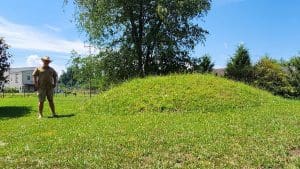
David Sibray visits the site of a potential prehistoric burial mound at Pinch, West Virginia.
SOUTH CHARLESTON, W.Va. — The Kanawha Valley in western West Virginia once had the highest concentration of burial mounds in North America, though most were destroyed. More than 400 mounds have been recorded in West Virginia, and their presence was once so extensive that explorers couldn’t believe they were of Native American origin. READ MORE…
For more stories like this, sign up to receive a FREE copy of West Virginia Explorer Magazine in your email twice weekly. Sign me up!


Amanda Larch Hinchman
Amanda Larch is a freelance writer and editor and a 2020 graduate of Marshall University. In her spare time, she enjoys hiking, antique shopping, reading, and baking. She resides in Hurricane.
Inside Appalachian Escapes: Themed rentals, escape rooms, and a love letter to West Virginia
West Virginia bottler wins silver award at international water competition
BERKELEY SPRINGS, W.Va. — Le Sage Natural Water, of Lesage, has been awarded a silver medal for its purified water at the 36th annual Berkeley...
West Virginia uniquely prepared to dominate 21st-century outdoor economy
CHARLESTON, W.Va. — West Virginia is uniquely prepared to dominate in the 21st-century outdoor economy of the U.S., thanks to its unmatched...
Flood risk outpaces warnings, advocates say, as W.Va. considers changes to resiliency fund
CHARLESTON, W.Va. — As the W.Va. House of Delegates considers changes to Senate Bill 390, the West Virginia Rivers Coalition warns that the state...
We asked AI how its own data centers could pollute West Virginia. Here’s what it had to say
(The following article was generated partly by ChatGPT in response to a prompt about how data centers pollute. As ChatGPT is powered by data...
Inaugural W.Va. Outdoor Economy Summit to unite leaders around $2.1 billion growth
CHARLESTON, W.Va. — West Virginia’s outdoors are more than a scenic backdrop. They’re a strategic economic asset. That message will take...
West Virginia State Parks Foundation launches online merchandise store
HURRICANE, W.Va. — The West Virginia State Parks Foundation has launched an official online merchandise store, offering supporters a new way to...
West Virginia Travel Safety: What it means for residents and visitors in 2026
CHARLESTON, W.Va. — Travel safety in West Virginia is shaped less by headline-grabbing crime and more by geography, weather, and the realities of...
Did Abraham Lincoln and Jefferson Davis secretly meet in West Virginia?
PHILIPPI, W.Va. — Did Abraham Lincoln and Jefferson Davis secretly meet in what is now West Virginia just days after the first land battle of the...
Study finds WVU and its health system account for 17% of West Virginia’s economy
MORGANTOWN, W.Va. — West Virginia University and the WVU Health System together generate $14.3 billion in annual economic impact in West Virginia,...