




First documented poltergeist in U.S. haunted this historic W.Va. town
MIDDLEWAY, W.Va. — The Wizard Clip haunting, the first documented poltergeist in America, occurred in the late 1700s in the eastern panhandle of West Virginia. Though centuries have passed, its legend endures, earning residents the nickname “Clippers” to this day.

Referred to as the “truest ghost story ever told” by the late James Cardinal Gibbons, editor of the Catholic Review, the hauntings reportedly began when a mysterious stranger arrived at the home of Adam Livingston, according to Jessie Norris, president of the Middleway Conservancy.
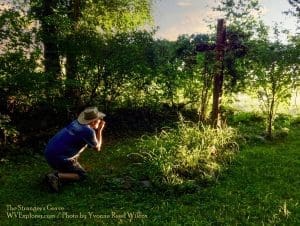
West Virginia Explorer publisher David Sibray visits the Stranger’s Grave at Middleway. (Photo courtesy Yvonne Reed Wilcox)
A terrible storm came through and, with it, a stranger to their doorstep who asked to stay the night,” Norris says. “He and his horse were exhausted and couldn’t make it to their final destination. The way it begins is just like any good, scary story—a dark and stormy night.”
The family allowed the stranger to spend the night in their home, but as it became clear he would not survive until morning, he requested a priest to administer his last rites. The Livingstons, a staunchly Lutheran family, refused. At the time, Middleway—then known as Smithfield—was a Protestant town, and the nearest Roman Catholic priest was more than a day’s journey away.
A stranger passes in the night
According to some accounts, the moment the stranger passed, every candle in the room was snuffed and had its wick mysteriously cut. Norris suggests this may be the first recorded instance of the eerie “clipping” phenomenon, which would later give the haunting its name.
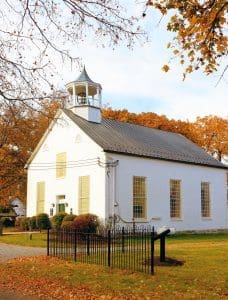
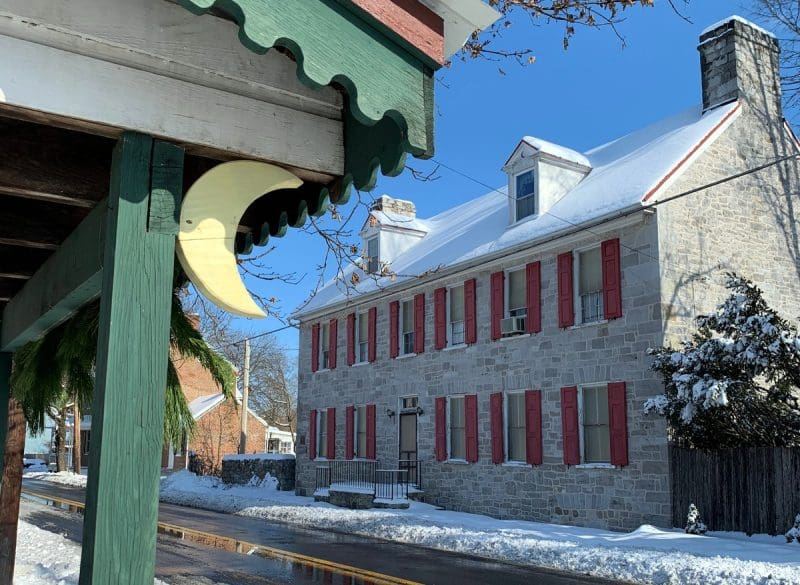
The Union Church at Middleway is considered one of the district’s landmark structures. (Photo courtesy of Gabby Berry)
“The name Wizard Clip would have come from a wizard or a male witch, and the clipping is coming from the poltergeist or ghost making a lot of clipping sounds,” Norris says.
The next morning, the family buried the man in an unconsecrated grave, but their troubles were only beginning. In the days that followed, the Livingstons were plagued by an unrelenting barrage of mysterious sounds—banging, the gallop of unseen horses, and the relentless snipping of shears.
Their barn burned to the ground, their livestock perished, and an eerie pattern emerged: crescent moons were inexplicably cut into every piece of fabric in the home, including clothing and linens stored in locked trunks.
“Pretty much as soon as the gentleman passes away, things start to go a little awry,” Norris says.
The poltergeist takes its toll
“They are constantly hearing clipping sounds in their ears and incessantly keeping them up at night, and other things befall the Livingstons. It gets pretty graphic. They’ve lost a lot of their livelihood, and they’re not sleeping, so they’re not doing too well mentally, either.”
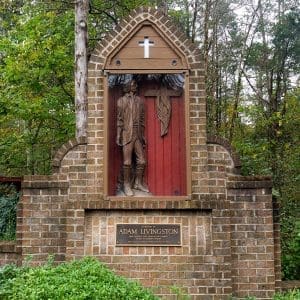
A monument to Adam Livingston is located at the Priest Field Pastoral Retreat Center.
Word of the Livingstons’ poltergeist spread quickly, drawing curious visitors to their home. According to one account, a woman who had carefully tucked a silk kerchief into her pocket afterward found it mysteriously shredded with crescent moon shapes—another chilling sign that the strange forces at work were not confined to the Livingston home.
“The moon symbol became very big in Middleway because of the Wizard Clip lore,” Norris says. “They would be hanging up clothes, go to hang up the next blanket or garment, and turn back around to find that the previous one had crescent moons cut out of it.”
The Livingstons sought help from nearby ministers, but none could rid the home of its tormenting spirit. When they attempted to enter, rocks rained down upon them, blocking their way. In a further attempt to understand the haunting, the family invited conjurers from Winchester to conduct séances, but their efforts also failed.
A Roman Catholic priest arrives
Desperate, Adam Livingston turned to what for him was an unlikely source—Father Dennis Cahill, a Roman Catholic priest in Shepherdstown. Though skeptical, Father Cahill reluctantly agreed to bless the home after townspeople vouched for the bizarre and persistent disturbances.
“The night before Adam travels to Shepherdstown, he has this dream where he sees a man he’s not familiar with in unfamiliar clothing with a voice that says, ‘This is the person who is going to bring you salvation, who is going to save you from this torture,’” Norris says.
“They get to the church and find that the man getting ready to start Mass is the gentleman Adam dreamt of.”
Upon his arrival at the Livingston farm, Father Cahill heard the shears clipping in his ears and witnessed stones, crockery, and firewood flying around the home.
“He is beside himself and decides to bless the home,” Norris says. “Father Cahill calls it a win and finds a little pouch of money that he lost sitting at the stoop of the front door he’s leaving. So he considers it a good omen. He’s done something right and is able to leave the Livingston family.”
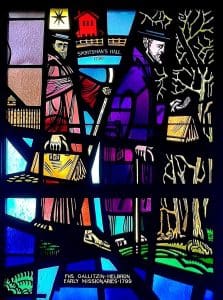
Stained-glass depictions of Father Demetrius Gallitzin and Father Peter Helbron appear in St. Patrick’s Church in Canonsburg, Pennsylvania.
At first, Father Cahill’s blessing seemed to work—the poltergeist ceased, and a calm settled over the home. But before long, the disturbances returned, stronger than before. Determined to find a lasting solution, Cahill reached out to the diocese in Baltimore, which dispatched another priest, Father Demetrius Gallitzin.
A former Russian nobleman, Gallitzin had traveled to the Americas to explore the New World, documenting his encounters and interviewing locals about supernatural occurrences. Now, he set out for the Livingston home, ready to confront whatever force lurked within.
“What many don’t realize is that in order to do an exorcism of a spirit, you have to have permission from the Catholic Church, and it is quite an extensive process,” Norris says.
“He takes notes for about three months, which you can still access the archives of, and essentially gets permission from the Catholic Church to do this exorcism.”

The altar artwork from All Souls Chapel depicts on the left Fr. Demetrius Gallitzin and, behind him, a cloth showing evidence of the “Wizard Clip.”
After an explosive exorcism, in which the house shook and rattled, Cahill and Gallitzin also visited the stranger’s grave to read him his last rites, finally. In most accounts of the legend, the poltergeist finally ceased after this, and before moving back to Pennsylvania, Adam Livingston donated more than 30 acres of his land to the Catholic Church in gratitude and “to help witness to people, bring them closer to God and use it as a place of being able to renew oneself,” Norris says.
A gift to the Roman Catholic church
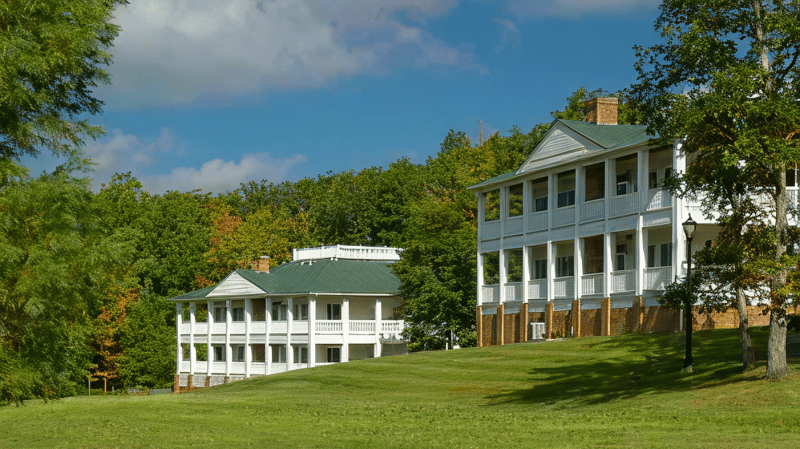
Today, the land is now the Priest Field Pastoral Retreat Center. There are statues commemorating Adam Livingston, as well as the stranger at the pastoral center, and while a grave commonly referred to as the Stranger’s Grave exists, Norris says it has not been proven.
“You hear ghost stories like the South Mountain Witch and the Blair Witch, but with Wizard Clip, you can go to exactly where the poltergeist or ghost was removed from the home,” Norris says. “We’re not sure where the stranger is buried. They have a marker, people assume that it’s the grave, but they’ve done scans, and there are no human remains buried there.”
Part of the oral history and tradition of Middleway, the legend of Wizard Clip contains many variations. In one, there’s no stranger, which led some to believe he was added later as a catalyst for the haunting that may have begun before the Livingstons moved to Middleway. In other accounts, the spirit followed the Livingston family back to Pennsylvania.
“Which is why it would be considered a poltergeist—because it’s attached to something,” Norris says. “There are a lot of parts of the story that overlap, and where they diverge is just as interesting.”
Norris says there are primary sources for the poltergeist, including newspaper articles, records from the Catholic Church, and retellings from townspeople.
“With oral history, you have to really look at the sources you’re given,” she says. “It’s almost like a police investigation: this part of the story corroborates the other.
“Definitely something had crescent moons cut out of it at some point in the story. Definitely, no other religion was able to exorcise this poltergeist from the house except for the Catholic Church.
“But just like with anything, when you’re telling a story, it’s hard not to add your own embellishments to it. You can question whether it’s the truth or not, but ultimately, there are those pieces of overlap that I think really help strengthen the story and make it one so eerie that you want to tell other people.”
She says that telling these stories and keeping oral traditions alive are important, as they bring people of all different backgrounds together.
“You can have a different belief system, and we all agree that this is a great story to tell,” she says.
“It wasn’t great marketing for the Methodists or Baptists, and yet they still told the story in Middleway and the surrounding areas. It was incredibly impactful. Oral history creates a bond and a tradition to pass down, and I think it actually helps strengthen a community to have those kinds of stories to share and bond around.”
Keeping in mind the German, Irish, and Scottish ancestry of many settlers in the Middleway area might help explain the pull and fascination of this story, Norris says.

“There’s a lot of lore in those areas of the world as well,” she says. “I am sure a lot of that spirituality or the need to find something bigger than themselves carried over and was passed down. It’s not hard to imagine that was still happening here in Middleway.”
Wizard Clip is not the only ghostly tale from Middleway. The town hosts ghost tours each fall, with the proceeds benefiting the Middleway Conservancy.
“None quite as elaborate as the legend of Wizard Clip, but there are some pretty fun, interesting ghost stories that have been collected from residents past and present,” Norris says. “We have definitely seen a lot of history.”
Sign up to receive of FREE copy of West Virginia Explorer Magazine in your email weekly. Sign me up!

Amanda Larch Hinchman
Amanda Larch is a freelance writer and editor and a 2020 graduate of Marshall University. In her spare time, she enjoys hiking, antique shopping, reading, and baking. She resides in Hurricane.
Inside Appalachian Escapes: Themed rentals, escape rooms, and a love letter to West Virginia
West Virginia bottler wins silver award at international water competition
BERKELEY SPRINGS, W.Va. — Le Sage Natural Water, of Lesage, has been awarded a silver medal for its purified water at the 36th annual Berkeley...
West Virginia uniquely prepared to dominate 21st-century outdoor economy
CHARLESTON, W.Va. — West Virginia is uniquely prepared to dominate in the 21st-century outdoor economy of the U.S., thanks to its unmatched...
Flood risk outpaces warnings, advocates say, as W.Va. considers changes to resiliency fund
CHARLESTON, W.Va. — As the W.Va. House of Delegates considers changes to Senate Bill 390, the West Virginia Rivers Coalition warns that the state...
We asked AI how its own data centers could pollute West Virginia. Here’s what it had to say
(The following article was generated partly by ChatGPT in response to a prompt about how data centers pollute. As ChatGPT is powered by data...
Inaugural W.Va. Outdoor Economy Summit to unite leaders around $2.1 billion growth
CHARLESTON, W.Va. — West Virginia’s outdoors are more than a scenic backdrop. They’re a strategic economic asset. That message will take...
West Virginia State Parks Foundation launches online merchandise store
HURRICANE, W.Va. — The West Virginia State Parks Foundation has launched an official online merchandise store, offering supporters a new way to...
West Virginia Travel Safety: What it means for residents and visitors in 2026
CHARLESTON, W.Va. — Travel safety in West Virginia is shaped less by headline-grabbing crime and more by geography, weather, and the realities of...
Did Abraham Lincoln and Jefferson Davis secretly meet in West Virginia?
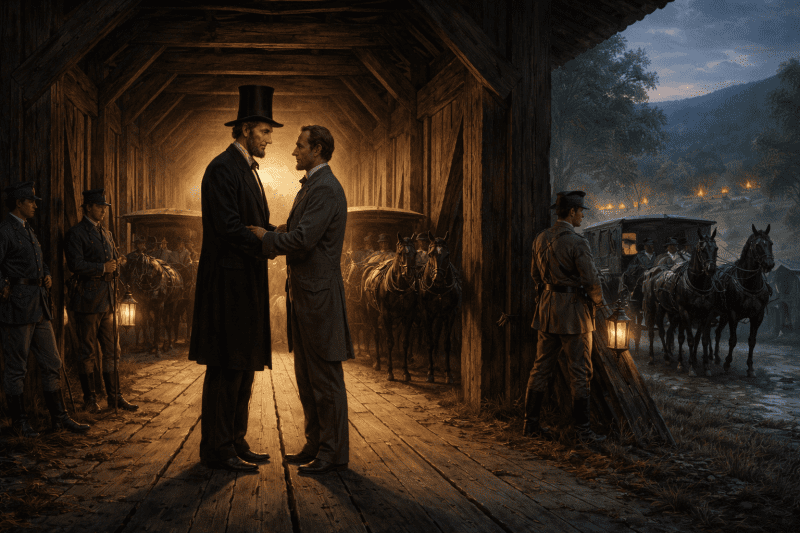
PHILIPPI, W.Va. — Did Abraham Lincoln and Jefferson Davis secretly meet in what is now West Virginia just days after the first land battle of the...
Study finds WVU and its health system account for 17% of West Virginia’s economy
MORGANTOWN, W.Va. — West Virginia University and the WVU Health System together generate $14.3 billion in annual economic impact in West Virginia,...