













Vape shops and gray-area drugs put West Virginia towns at a regulatory crossroads
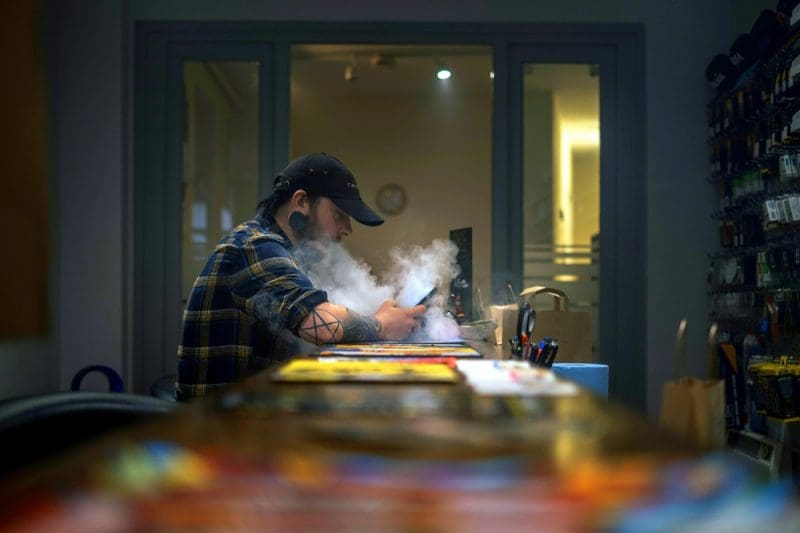
BECKLEY, W.Va. — They’re hard to miss in downtowns and along highway strips in West Virginia with their neon-bright window graphics, flavor names splashed across posters, and glass cases filled with sleek devices and colorful packaging.
Over the past decade, vape shops have spread from big cities into small towns and rural communities across Appalachia, including West Virginia, riding a fast-moving market that blends nicotine, hemp-derived intoxicants, and a growing list of legally ambiguous products.

At their core, vape shops are specialty retailers that sell electronic nicotine delivery systems, or “ENDS,” an acronym used by the U.S. Food and Drug Administration to describe e-cigarettes, vape pens, pods, disposable devices, and bottled e-liquids.
But in many communities, the modern vape shop has evolved into something broader: a retail hub for products that promise stimulation, relaxation, or intoxication while skirting the edges of traditional drug and alcohol regulation.
That evolution has placed vape shops at the center of debates over public health, youth exposure, zoning, and the limits of local control.
How vape shops came to be
The rise of vape shops followed two major shifts in consumer behavior.
First came the surge in e-cigarettes as an alternative to combustible cigarettes, marketed primarily to adult smokers. While public-health agencies continue to stress that cigarettes remain uniquely deadly, the idea of “harm reduction” helped open space for new nicotine products and new retail formats.
Second, the products themselves changed rapidly. Disposable vapes and flavored offerings expanded the customer base and made specialty retail viable beyond major metropolitan areas. National retail data tracked by the Centers for Disease Control and Prevention show a sharp move toward disposables in the early 2020s, a trend that favored small storefronts able to rotate inventory quickly.
As demand grew, vape shops emerged as a distinct category: places where customers could compare devices, ask about nicotine strengths, coils, and batteries, and browse dozens—and sometimes hundreds—of flavors. In many towns, they filled empty strip-mall units or former mall spaces, opening with lower startup costs than restaurants or full-line retail.
Health risks and public-health warnings
The health debate surrounding vape shops is inseparable from the products they sell.
The CDC says most e-cigarettes contain nicotine, a highly addictive chemical, and warns that nicotine exposure during adolescence can harm brain development, which continues into the mid-20s.
The agency also notes that e-cigarette aerosol can contain heavy metals, volatile organic compounds, and cancer-causing chemicals, and that some flavorings safe to eat may not be safe to inhale.
Use among youth remains a central concern. In 2024, an estimated 1.63 million U.S. middle and high school students reported e-cigarette use, according to CDC data—a figure that, while down from peak years, continues to alarm health officials.
Research on adult health impacts is still evolving, but major medical institutions have pushed back against claims that vaping is harmless. A 2025 analysis led by Johns Hopkins Medicine found associations between e-cigarette use and higher risks of conditions such as COPD and high blood pressure.
Public-health agencies are consistent on one point: vaping is not safe for children, teens, or young adults, and nicotine addiction can begin quickly.
Legal vapes, illegal vapes, and a crowded gray market
Vape shops operate in a regulatory environment that often confuses consumers and frustrates regulators.
At the federal level, the FDA requires manufacturers to receive authorization before marketing new tobacco products under the Family Smoking Prevention and Tobacco Control Act. In 2025, the U.S. Supreme Court unanimously upheld the FDA’s authority to deny applications for certain flavored e-liquids, reinforcing the agency’s youth-protection rationale.
Enforcement, however, has struggled to keep pace with the market—particularly with respect to flavored disposable vapes. Reuters reported that illegal U.S. vape sales reached at least $2.4 billion in 2024, citing retail data and widespread circulation of unauthorized products.
For local governments, the result is a moving target. Even where laws exist, product lines can change overnight, and enforcement can be uneven from town to town.
Beyond nicotine: marijuana alternatives and controversial legal drugs
One of the most contentious developments is that many vape shops no longer sell only nicotine.
In West Virginia and elsewhere in the U.S., shops often stock hemp-derived intoxicants sometimes described as “marijuana alternatives.” These include delta-8 THC, delta-10 THC, HHC, THCP, and THCa flower, as well as CBD products. They are sold as vape cartridges, gummies, edibles, pre-rolled hemp flower, and concentrates, often with cannabis-style branding.
The legal loophole traces back to the 2018 federal Farm Bill, which legalized hemp defined as cannabis containing less than 0.3% delta-9 THC by dry weight. Manufacturers exploited that definition by chemically converting CBD into psychoactive compounds or by selling products that meet the delta-9 threshold on paper while still producing intoxication.
Unlike state-regulated marijuana systems, most hemp-derived intoxicants are not subject to seed-to-sale tracking, standardized dosage limits, or tightly controlled retail channels. That regulatory gap is one reason vape shops, rather than licensed dispensaries, became a primary outlet.
Many shops also sell other non-controlled but controversial substances, including kratom, high-dose stimulant blends, and synthetic “mushroom” products marketed as nootropics. These items are legal in many jurisdictions but draw scrutiny over addiction potential, inconsistent dosing, and limited clinical research.
Do vape shops attract crime?
The evidence here is mixed and often overstated. Some researchers have examined links between tobacco retailers and neighborhood crime, occasionally describing certain stores as potential “nuisance properties.” But those studies do not prove causation, nor do they apply uniformly across communities. Retail clustering often follows traffic patterns and zoning decisions that also correlate with other neighborhood conditions.
Local officials cite quality-of-life concerns more frequently: proximity to schools, dense clustering, signage, and the perception that shops selling intoxicating products belong in stricter zones.
West Virginia: demand, dollars, and local pushback
West Virginia has long ranked high for adult cigarette smoking, according to America’s Health Rankings, and vaping is concentrated among younger adults.
High underlying demand for nicotine products can translate into more retailers, but without standardized counts, it is not possible to say definitively that West Virginia has more vape shops than other states.
Economically, vape shops are small businesses. They lease storefronts, employ workers, pay utility bills, and generate sales tax revenue. At the state level, West Virginia imposes an excise tax of 7.5 cents per milliliter on e-liquid, creating a direct revenue stream tied to vaping products.
Those benefits come with costs. Public-health agencies warn of long-term burdens tied to addiction, enforcement, and youth exposure—costs that rarely appear on a balance sheet.
Can governments limit or eliminate vape shops?
Limiting them is far easier than eliminating them. Governments typically act through four channels: federal product authorization, state taxation, retail licensing and inspections, and local zoning. Zoning has become the most visible tool, allowing cities and counties to impose distance buffers from schools, cap density, regulate signage, or require conditional-use permits.
In 2025, Raleigh County adopted an ordinance restricting the establishment of new vape shops, including spacing requirements near schools and day care centers. Other West Virginia communities have explored similar approaches, reflecting a shift from debating whether vape shops should exist to deciding where they should be located and what they can sell.
Vape shops and gray-area drugs in West Virginia
Vape shops are no longer just nicotine retailers. They are modern storefronts built on rapid product innovation, flavored inventory, and legal gray areas that blur the line between tobacco, hemp, and psychoactive substances.
For communities—especially small towns—the challenge is balancing local economic activity with public health warnings and evolving law. As regulators, courts, and legislatures continue to tighten rules, the question facing many Main Streets is no longer abstract: how much gray-area commerce is too much, and who gets to decide?

Nightfall’s Value: Light pollution can diminish real estate worth in W.Va.
WINFIELD, W.Va. — An increasing number of new West Virginia residents are being drawn to its rolling hills and quiet valleys to escape brightly lit...
Inside Appalachian Escapes: Themed rentals, escape rooms, and a love letter to West Virginia
FAYETTEVILLE, W.Va. — What began as a search for an affordable retirement option has turned into one of southern West Virginia’s most imaginative...
West Virginia bottler wins silver award at international water competition
BERKELEY SPRINGS, W.Va. — Le Sage Natural Water, of Lesage, has been awarded a silver medal for its purified water at the 36th annual Berkeley...
West Virginia uniquely prepared to dominate 21st-century outdoor economy
CHARLESTON, W.Va. — West Virginia is uniquely prepared to dominate in the 21st-century outdoor economy of the U.S., thanks to its unmatched...
Flood risk outpaces warnings, advocates say, as W.Va. considers changes to resiliency fund
CHARLESTON, W.Va. — As the W.Va. House of Delegates considers changes to Senate Bill 390, the West Virginia Rivers Coalition warns that the state...
We asked AI how its own data centers could pollute West Virginia. Here’s what it had to say
(The following article was generated partly by ChatGPT in response to a prompt about how data centers pollute. As ChatGPT is powered by data...
Inaugural W.Va. Outdoor Economy Summit to unite leaders around $2.1 billion growth
CHARLESTON, W.Va. — West Virginia’s outdoors are more than a scenic backdrop. They’re a strategic economic asset. That message will take...
West Virginia State Parks Foundation launches online merchandise store
HURRICANE, W.Va. — The West Virginia State Parks Foundation has launched an official online merchandise store, offering supporters a new way to...
West Virginia Travel Safety: What it means for residents and visitors in 2026
CHARLESTON, W.Va. — Travel safety in West Virginia is shaped less by headline-grabbing crime and more by geography, weather, and the realities of...
Did Abraham Lincoln and Jefferson Davis secretly meet in West Virginia?
PHILIPPI, W.Va. — Did Abraham Lincoln and Jefferson Davis secretly meet in what is now West Virginia just days after the first land battle of the...