





The house that vanished overnight: West Virginia’s Neerly House haunting
FAIRMONT, W.Va. — At least two mysteries tangle in the tale of the Neerly house. What happened to the house? What happened to “old man Neerly? And where did the late folklorist Ruth Ann Musick encounter the legend?
The following version of the West Virginia tale appears in the West Virginia Heritage Encyclopedia, edited and published in 1976 by Jim Comstock, a storyteller himself. Its author, Musick, meticulously documented the sources of her collections, though, notably, none exist, as far as is known.
A reader might also surmise that the story was told to Musick by a source named Aaron. When she submitted the story to Comstock, that had not been established. He is perhaps portrayed as an unreliable narrator whose account cannot be fully trusted. The story was published posthumously.
Regarding the location of “Houltown,” the name appears to refer to the community known today as “Hoult” along the Monongahela River, north of Fairmont. Established as a “stringtown” on the Baltimore & Ohio Railroad, it was first a mining community of railroad shanties but is now a pleasant riverside suburb.
Neerly House Mystery
By Ruth Ann Musick
A family by the name of Dotson, from Parkersburg, rented the Neerly house on the Pitcher land across the river from Houltown. Nobody had lived there for years. Some folks said there was something under the house. Dotson and his wife and six growing kids made up the family.

“Hoult” appears in a section of a 1905 U.S. Geological Survey Map of the Blacksville, West Virginia, quadrangle.
Nobody seems to have heard any of them complain about the house, particularly, that is, at first. Then one day, at the store, Dotson said there was something that kept crawling around beneath the house late at night. Said he heard it, something that seemed to be dragging itself along and grunting every few minutes.
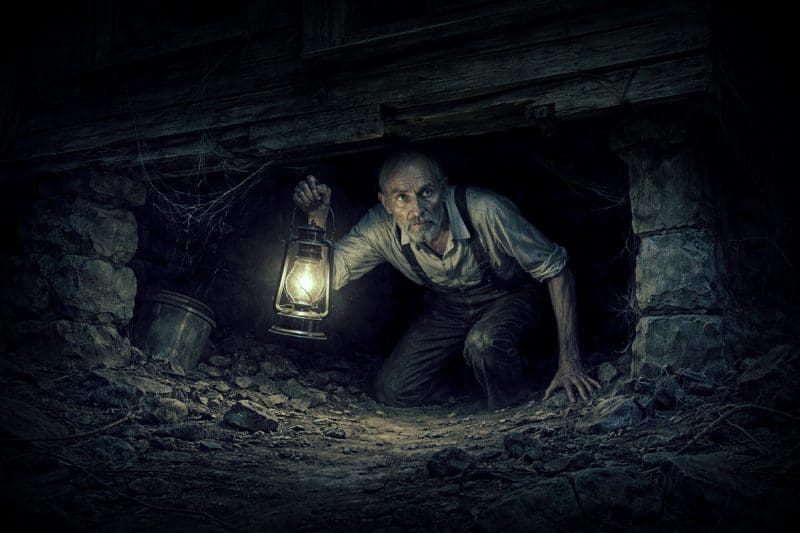
Somebody asked if he looked to see if he could see it, and he said yes, he did. Took a lantern and went out and looked—called out the oldest boy from his bed, and they both looked. Nothing there. Wasn’t even a sign that anything had been there, he said.
The next time Dotson mentioned the house, he said it shook a bit when the thing, or things, were crawling around under it and dragging themselves along. Said it trembled, he did—the whole house, and kind of rocked from corner to corner.
Nobody could sleep, he said. They’d got used to the crawling and grunting sounds and were sleeping soundly again, then this thing started. The whole blame house shook and rocked!
Aaron said he asked Dotson why he didn’t move out and told him that about fifty other families had moved in and out of that house.
He told him, too, that old man Neerly, who built the house, disappeared in it, said goodnight to a neighbor one night, went into the house, locked the doors, and went to bed, and that was the last known about him, ever.
Dotson listened, nodding his head, and said, when Aaron was finished, that he guessed old man Neerly probably left out in the night and went south or somewhere, maybe owed a lot of bills, he said. Then he said he didn’t expect to move out of the house, said he’d moved in there to stay.
And that’s pretty near the end of the story. The next morning, there wasn’t any house there. It had gone and left out during the night. Wasn’t anything at all there. Even the foundations were completely gone.
About Ruth Ann Musick
The Neerly House mystery is only one of many stories collected by Ruth Ann Musick, an American folklorist, educator, and author whose work played a major role in documenting and preserving the ghost stories, legends, and folk beliefs of central Appalachia, especially West Virginia.
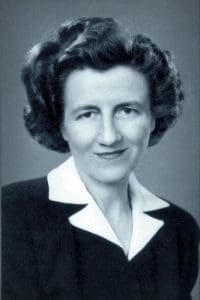
Ruth Ann Musick grew up hearing traditional stories passed down in rural mountain communities.
Born in 1899 near Rupert in Greenbrier County, she grew up hearing traditional stories passed down through generations in rural mountain communities. She received her undergraduate education at Concord College (now Concord University) and later earned graduate degrees from West Virginia University and The Ohio State University, blending academic training with deep personal familiarity with Appalachian oral traditions.
She is best known for The Telltale Lilac Bush and Other West Virginia Ghost Tales (1965) and Coffin Hollow and Other Ghost Tales (1966), collections that presented regional folklore in a clear narrative style while maintaining careful attention to sources and authenticity.
At a time when Appalachian culture was often stereotyped or overlooked, her work helped establish folklore as a serious field of study and preserved stories that might otherwise have been lost.
Today, Musick is regarded as a foundational figure in Appalachian folklore scholarship, and her books remain widely read and frequently cited in studies of Appalachian history and culture.
The Neerly House tale and idiomatic writing
The tale of the Neerly House mystery depends on “eye dialect,” a literary technique in which writers deliberately alter standard spelling to suggest a speaker’s accent or speech patterns, even when the pronunciation is essentially the same as in standard English.
Rather than capturing exact sounds, eye dialect works visually, signaling differences through words such as “sez” for “says” or “wuz” for “was”. The effect cues readers to hear a particular voice, region, or social background without requiring a full phonetic transcription, making it especially common in fiction, folklore, and dialogue-driven storytelling.
Because eye dialect relies on visual cues, it can be powerful but also controversial. When used sparingly, it adds authenticity and rhythm to spoken language; when overused, it can slow reading, obscure meaning, or reinforce stereotypes.
Modern editors and folklorists often favor restrained use, balancing respect for speakers with clarity for readers—an approach that preserves voice without turning dialect into a distraction. Charles Dickens combined eye dialect with pronunciation, spelling, and nonstandard grammar in the speech of his uneducated characters. Musick rarely used it in her published work.
Do three legendary monsters inhabit the Monongahela River?

The Ogua, a legendary Monongahela River monster, featured in native lore.
FAIRMONT, W.Va. — Far from the city lights that shimmer about its mouth at the Golden Triangle at Pittsburgh, the Monongahela River rises more than 200 miles away in some of the most remote reaches in the Appalachian Mountains. Many of its tributaries descend from forests so old and large that only the most intrepid hunters have visited them, so it’s hardly surprising that the river has inspired more than its fair share of lore—including monster lore. READ ABOUT THE LEGENDS HERE.
Nightfall’s Value: Light pollution can diminish real estate worth in W.Va.
WINFIELD, W.Va. — An increasing number of new West Virginia residents are being drawn to its rolling hills and quiet valleys to escape brightly lit...
Inside Appalachian Escapes: Themed rentals, escape rooms, and a love letter to West Virginia
FAYETTEVILLE, W.Va. — What began as a search for an affordable retirement option has turned into one of southern West Virginia’s most imaginative...
West Virginia bottler wins silver award at international water competition
BERKELEY SPRINGS, W.Va. — Le Sage Natural Water, of Lesage, has been awarded a silver medal for its purified water at the 36th annual Berkeley...
West Virginia uniquely prepared to dominate 21st-century outdoor economy
CHARLESTON, W.Va. — West Virginia is uniquely prepared to dominate in the 21st-century outdoor economy of the U.S., thanks to its unmatched...
Flood risk outpaces warnings, advocates say, as W.Va. considers changes to resiliency fund
CHARLESTON, W.Va. — As the W.Va. House of Delegates considers changes to Senate Bill 390, the West Virginia Rivers Coalition warns that the state...
We asked AI how its own data centers could pollute West Virginia. Here’s what it had to say
(The following article was generated partly by ChatGPT in response to a prompt about how data centers pollute. As ChatGPT is powered by data...
Inaugural W.Va. Outdoor Economy Summit to unite leaders around $2.1 billion growth
CHARLESTON, W.Va. — West Virginia’s outdoors are more than a scenic backdrop. They’re a strategic economic asset. That message will take...
West Virginia State Parks Foundation launches online merchandise store
HURRICANE, W.Va. — The West Virginia State Parks Foundation has launched an official online merchandise store, offering supporters a new way to...
West Virginia Travel Safety: What it means for residents and visitors in 2026
CHARLESTON, W.Va. — Travel safety in West Virginia is shaped less by headline-grabbing crime and more by geography, weather, and the realities of...
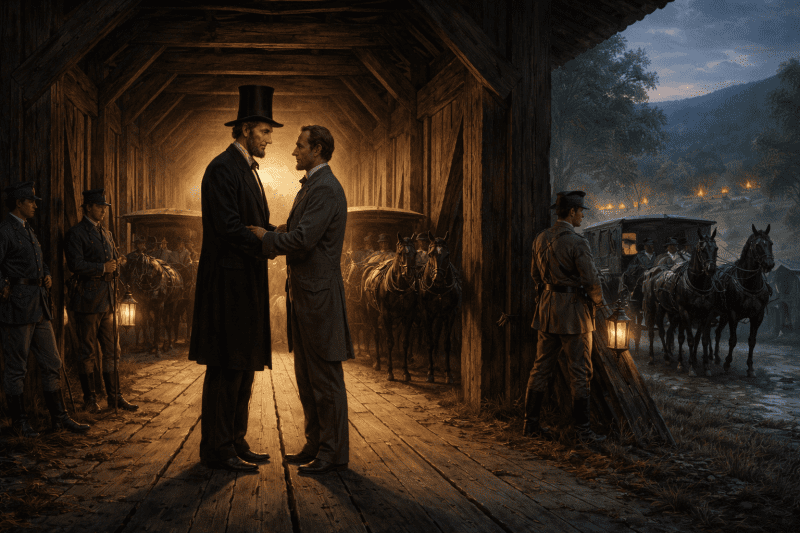
Did Abraham Lincoln and Jefferson Davis secretly meet in West Virginia?
PHILIPPI, W.Va. — Did Abraham Lincoln and Jefferson Davis secretly meet in what is now West Virginia just days after the first land battle of the...