


Coffindaffer’s Crosses
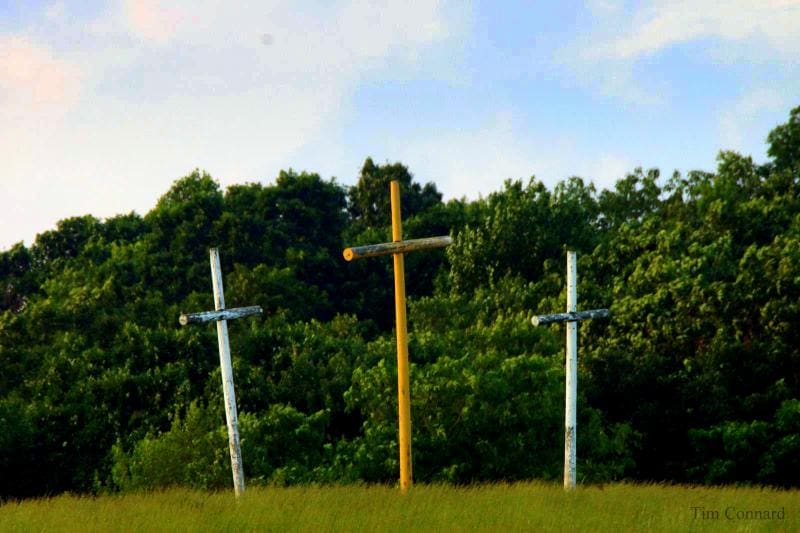
Coffindaffer’s Crosses in a pasture near Pluto, West Virginia in Raleigh County.

Crosses, crosses everywhere! Or so it would seem traveling through West Virginia.
Every few miles, groups of three crosses stand like sentinels along its roadways — a high gold cross flanked by two smaller light blue crosses. Most travelers recognize them as monuments to the crucifixion of Jesus of Nazareth, a central event in Christianity. But have you ever wondered where these crosses come from? Why they were raised? And who is responsible?
Bernard Coffindaffer, a Marine veteran and a native of Craigsville, West Virginia, was the man behind the crosses. It was his desire to remind people that Jesus had been crucified at Calvary to forgive their sins and that he’d be coming back again.
After leaving the military and earning a business degree from the University of Charleston, Coffindaffer worked in the oil industry. though he made his fortune founding a coal-washing business. After undergoing two heart by-pass operations, he liquidated his business.
Two years later he had a vision that sparked the building of the groups of crosses and spent the remainder of his life and money erecting 1,864 sets in 29 states, in the District of Columbia, and in Zambia and the Philippines. Land owners donated the sites, and Coffindaffer funded the construction. West Virginia was home to 352 sets of crosses — more than any other state. Most are visible from major highways, though some are tucked away in remote locations. He established the first set outside his hometown in Nicholas County.
All the crosses are made of Douglas Fir and weigh 400 pounds. At the height of his ministry, nine full-time employees were helping erect the crosses. His non-profit organization, “Crosses of Mercy – Cast Thy Bread Inc.,” was run from the basement of his home.
According to Sara Stevenson Abraham, co-founder and executive director of Crosses Across America Inc., the non-profit organization perpetuating his mission, Coffindaffer never took a penny from anyone to construct and erect the crosses. He spent more than $3,000,000, and raised the last group in Ozark, Alabama, in September 1993. Less than a month later, on October 6, 1993, he suffered a fatal heart attack at home.
Crosses Across America, headquartered in Vickburg, Mississippi, was established in 1999 to locate and restore the crosses, Coffindaffer left no trust for their upkeep. The organization hopes to plant clusters of crosses every 50 miles along both sides of the 45,000 miles of interstate and highways in the United States, proceed to four-lane highways, and then move into Mexico and Canada. The new crosses are of a lighter, plastic material that can withstand 200 mph winds.
West Virginia photographer Tim Connard, a Raleigh County native, has a vision of his own concerning the crosses. Despite 52-year-old Connard’s battle with Parkinson’s disease, he desires to photograph as many of the crosses still standing in West Virginia as he can. So far, he has captured approximately 24 sets and hopes to shoot another 12 before the end of 2014.
Connard first became interested in the crosses just after Easter in 2012 when a group on the hillside on I-81 near Winchester, Virginia, caught his eye. He stopped the vehicle he was driving so suddenly that it startled the passengers. After returning to his home in Prosperity, West Virginia, he began to research the crosses, which have now have become an integral part of his life.
While most of the crosses he’s photographed are located along I-79 and U.S. 19 in West Virginia, the first set he shot are situated in a field off Pluto Road in Raleigh County. Other remote locations in which he’s captured images of the crosses include the scenic overlook on Powell Mountain about a mile from the Birch River exit on U.S. 19 and on an island in the Kanawha River above its falls. on U.S. 60.
One night in Summers County he was questioned by a police officer while trying to capture crosses in the moonlight. Connard offers print through his wife’s business, Mountaineer Photographic Memories, and all profit from their sales goes to Crosses Across America.
Gallery of Coffindaffer’s Crosses

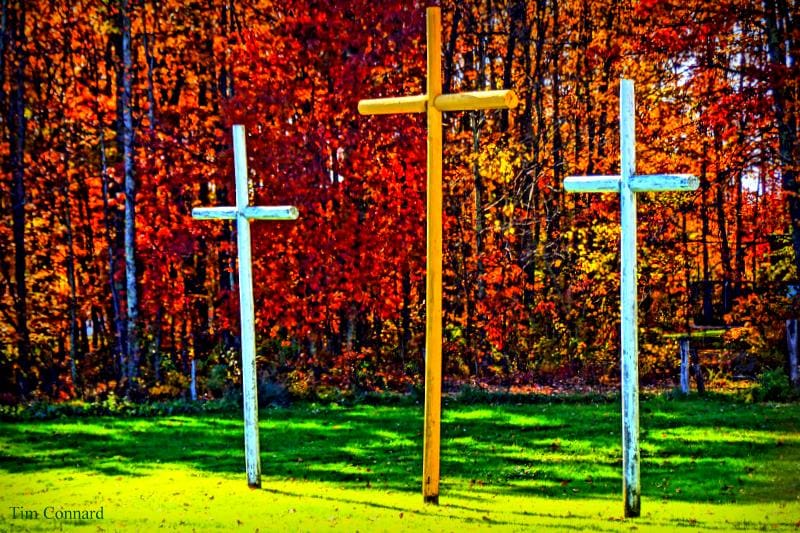
Mount Zion Crosses above New River

Crosses in the Kanawha River

Crosses near Affinity, West Virginia

Crosses near Weyer’s Cave, Va.
Author Jackie Carman Blankenship, a West Virginia native, presently resides in Colorado Springs, Colorado, with her two daughters and several furbabies.

Recent Articles
Inside Appalachian Escapes: Themed rentals, escape rooms, and a love letter to West Virginia
West Virginia bottler wins silver award at international water competition
BERKELEY SPRINGS, W.Va. — Le Sage Natural Water, of Lesage, has been awarded a silver medal for its purified water at the 36th annual Berkeley...
West Virginia uniquely prepared to dominate 21st-century outdoor economy
CHARLESTON, W.Va. — West Virginia is uniquely prepared to dominate in the 21st-century outdoor economy of the U.S., thanks to its unmatched...
Flood risk outpaces warnings, advocates say, as W.Va. considers changes to resiliency fund
CHARLESTON, W.Va. — As the W.Va. House of Delegates considers changes to Senate Bill 390, the West Virginia Rivers Coalition warns that the state...
We asked AI how its own data centers could pollute West Virginia. Here’s what it had to say
(The following article was generated partly by ChatGPT in response to a prompt about how data centers pollute. As ChatGPT is powered by data...
Inaugural W.Va. Outdoor Economy Summit to unite leaders around $2.1 billion growth
CHARLESTON, W.Va. — West Virginia’s outdoors are more than a scenic backdrop. They’re a strategic economic asset. That message will take...
West Virginia State Parks Foundation launches online merchandise store
HURRICANE, W.Va. — The West Virginia State Parks Foundation has launched an official online merchandise store, offering supporters a new way to...
West Virginia Travel Safety: What it means for residents and visitors in 2026
CHARLESTON, W.Va. — Travel safety in West Virginia is shaped less by headline-grabbing crime and more by geography, weather, and the realities of...
Did Abraham Lincoln and Jefferson Davis secretly meet in West Virginia?
PHILIPPI, W.Va. — Did Abraham Lincoln and Jefferson Davis secretly meet in what is now West Virginia just days after the first land battle of the...
Study finds WVU and its health system account for 17% of West Virginia’s economy
MORGANTOWN, W.Va. — West Virginia University and the WVU Health System together generate $14.3 billion in annual economic impact in West Virginia,...