
CHARLESTON, W.Va. — Long before Interstate 77 became the modern four-lane highway travelers know today, state troopers and maintenance workers along the West Virginia Turnpike were telling some remarkably strange stories.
One officer described a glittering object hovering above the mountains. A maintenance supervisor who insisted he didn’t believe in ghosts recalled an antique military ambulance appearing along railroad tracks—and foxhounds that could be heard circling him in fresh snow but left no tracks.
Then there were stories of a phantom hitchhiker, mysterious lights, and cold hands that seemed to reach out of nowhere.
The accounts might have disappeared with the people who told them if West Virginia folklorist Dennis Deitz hadn’t recorded them. Together, they helped create one of the state’s strangest bodies of highway folklore—the ghosts of the West Virginia Turnpike.
Deitz collected the accounts in The Greenbrier Ghost and Other Strange Stories, published in 1990. Rather than presenting anonymous campfire tales, he identified state troopers, Turnpike employees, and residents who described experiences they couldn’t explain.
Whether anything supernatural occurred is another question. What can be documented is that people who worked and traveled the highway told these stories—and that an unusual number of them centered on one relatively short stretch of the old Turnpike.
The old West Virginia Turnpike was a different road
The West Virginia Turnpike opened in 1954, connecting Beckley, Princeton, and Charleston through 88 miles of extraordinarily difficult mountain terrain.
Today’s four-lane interstate can obscure just how different the original highway was. It was largely a two-lane toll road characterized by steep grades, tight curves, and long stretches through sparsely populated mountain country.
The West Virginia State Police established a special Turnpike Division to patrol the new road. According to the agency’s history, the unit included 17 experienced officers. For troopers working at night, the Turnpike could be a lonely place.
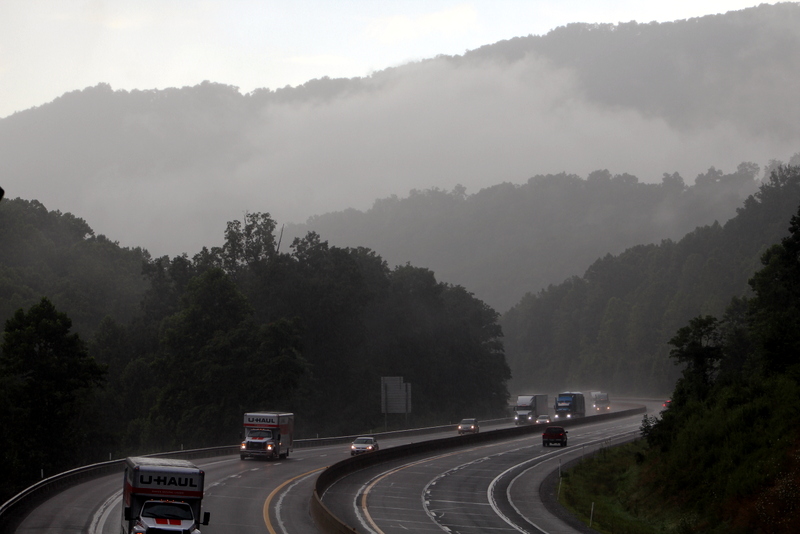
The road was incorporated into the Interstate Highway System in 1958, but its transformation into the highway motorists recognize today took decades. Reconstruction eventually widened and modernized the road, with the upgrade to four-lane interstate standards completed in 1987.
Many of the stories Deitz collected belonged to the earlier Turnpike—the darker, narrower mountain road that existed before that transformation.
Why did so many stories come from the same place?
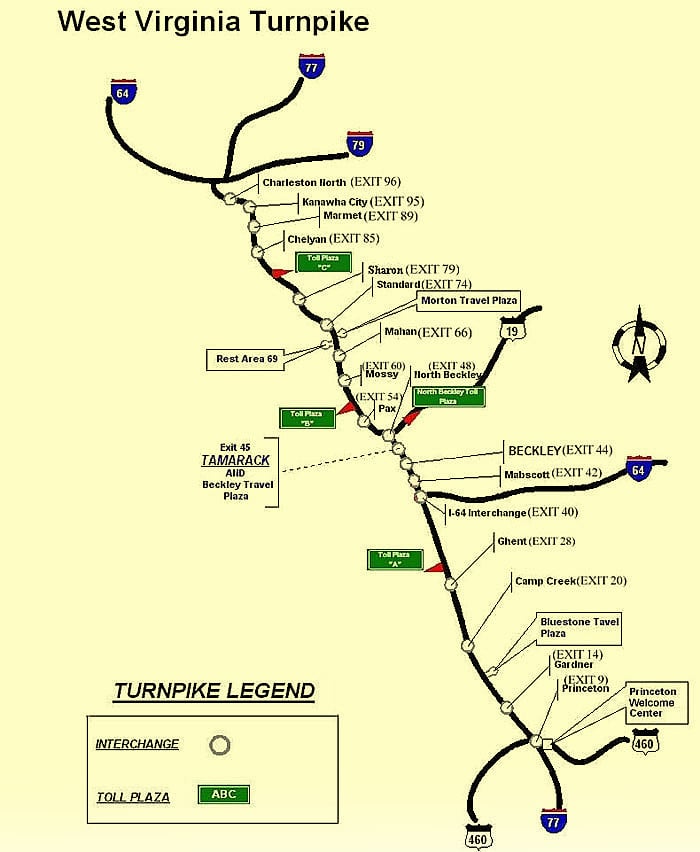
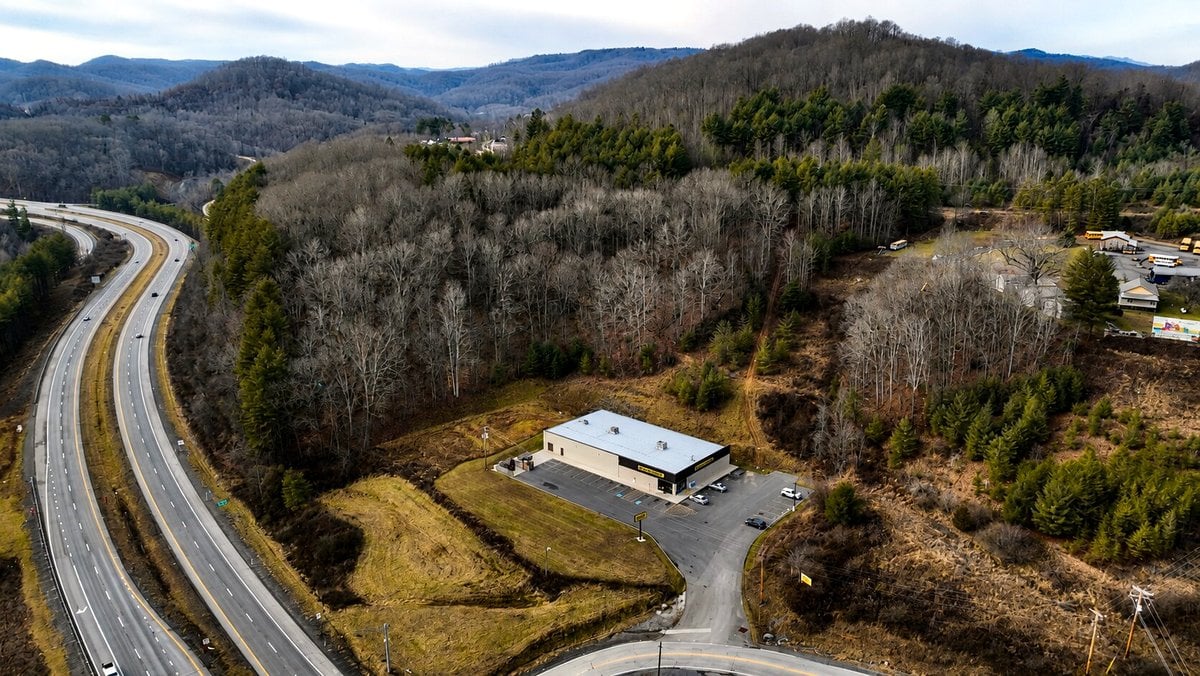
What makes Deitz’s collection particularly intriguing is its geography. He associated many of the accounts with an approximately 15-mile section of the Turnpike between Mossy and Standard, particularly around Morton and Nuckolls in the Paint Creek country south of Charleston.
Deitz had his own explanation for the concentration. The region had endured mining accidents, devastating floods and some of the violence associated with the Paint Creek-Cabin Creek labor conflict of the early 20th century. He also wrote of cemeteries and graves disturbed as the Turnpike was constructed.
Deitz wondered whether that history somehow accounted for the stories that followed. That was his interpretation, not an established explanation. But the combination of an isolated mountain highway and a landscape carrying generations of difficult history provided fertile ground for folklore.
A state trooper sees something above the mountains
James A. “Abe” Roberts, a retired West Virginia State Police sergeant, told Deitz he had patrolled the Charleston-to-Beckley stretch for years without seeing anything unusual.
Then, one night near Nuckolls, just beyond the old Morton Truck Stop, something in the sky caught his attention. Roberts described a glowing or sparkling object hovering above the hills, perhaps 1,000 to 1,500 feet up. He estimated it was 15 to 20 feet across and compared its appearance to glittering Christmas tinsel.
Then it disappeared. Roberts told Deitz he initially kept the experience to himself. Only after newspaper reports appeared about unidentified objects seen near Dunbar did he say anything. Another Turnpike patrolman later told him he had witnessed something similar, Roberts said.
Decades later, Roberts still did not claim to know what he had seen. That uncertainty characterizes several of the accounts Deitz preserved. The witnesses described experiences; the explanations remained elusive.
The supervisor who didn’t believe in ghosts
Clinton Ayers may have shared some of his most memorable Turnpike stories with Deitz. Ayers worked for years as a maintenance supervisor near Nuckolls. He was also emphatic about one point: he did not believe in ghosts.
But he told Deitz that he experienced things he couldn’t explain. On several occasions, Ayers said he heard what sounded like a vehicle traveling along nearby railroad tracks. Looking outside, he saw what appeared to be an old military ambulance bearing an Army insignia.
The vehicle seemed to leave the tracks and head toward the maintenance facility before turning toward an old cemetery. When Ayers went outside with a spotlight, he could no longer find it.
Another experience occurred on a snowy night. Ayers heard foxhounds baying as though they were pursuing a fox around the maintenance center. Because he enjoyed listening to hunting dogs, he went outside with a spotlight to see them.

He heard the hounds around him. He saw none. More peculiar still, Ayers said there were no tracks from dogs or a fox in the fresh snow—not that night and not when he looked again in daylight. He remained mystified, Deitz wrote, while continuing to insist that he didn’t believe in ghosts.
Ayers also described lights behaving strangely inside the maintenance building and windows seemingly opening without explanation. According to his account, at least one truck driver who witnessed unusual activity at the building became reluctant to enter alone.
The phantom hitchhiker
Perhaps no highway ghost story is more familiar than the vanishing hitchhiker, and the West Virginia Turnpike developed its own version.
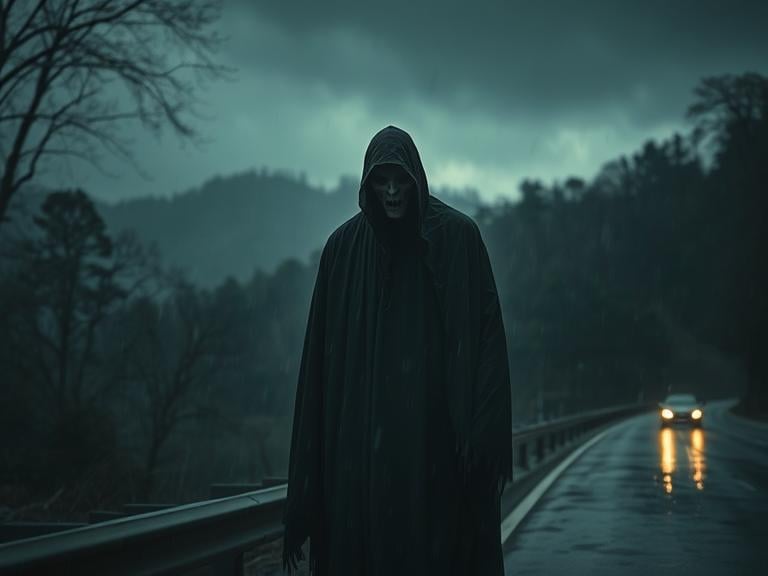
According to an account Ayers related to Deitz, a state trooper once picked up a young man walking along the Turnpike. When the officer later turned to look at his passenger, the young man was gone.
Ayers said travelers also reported a phantom hitchhiker near the old Glass House, the former travel plaza at Beckley. Another story involved a trooper refueling his patrol car late at night. The officer reportedly felt two cold hands suddenly grasp the back of his neck.
No one was there. Startled, the trooper drove away so quickly that he forgot the gasoline nozzle was still attached to the patrol car, Ayers told Deitz. Whether the incident happened precisely as remembered cannot now be established. Its survival, however, illustrates how Turnpike workers themselves became part of the road’s folklore.
Strange lights over Mossy
Ghosts weren’t the only unexplained phenomena Deitz encountered while collecting stories from the Paint Creek region. Bill Treadway, who had lived near Mossy, described several unusual aerial sightings from roughly the late 1970s to the early 1980s.
In one account, Treadway said he and his brother saw several bright lights apparently moving toward each other in the sky without colliding or making a sound. The lights eventually disappeared behind the timber toward Plum Orchard Lake.
He described another object as a bright silver disk that emerged from behind a cloud, appeared to flip, and then disappeared. On another occasion, Treadway recalled seeing a glowing, copper-colored object roughly the size of a basketball, followed by a striped object with brilliant colors that descended and vanished.
Deitz recorded these accounts as unexplained sightings. Their nature was never established. Placed alongside Roberts’ account of the glittering object above Nuckolls, however, they added another category to the unusual stories associated with the Turnpike corridor: not ghosts, but mysterious lights in the mountain sky.
The history behind the legends
Deitz believed the timing of the stories was significant. He wrote that many began around the time the Turnpike was constructed and seemed to diminish roughly two decades later.
The road passed through a region that had experienced profound disruption long before automobiles arrived. Paint Creek and Cabin Creek were major coal-producing valleys, and the Paint Creek-Cabin Creek strike of 1912-13 became one of the defining conflicts of the West Virginia Mine Wars. Miners, mine guards, and law-enforcement authorities clashed in a struggle that helped shape the state’s labor history.
The valleys also experienced deadly mining accidents and catastrophic floods. Deitz, who interviewed survivors while researching the region’s history, wondered whether the Turnpike’s construction through this landscape—and the disturbance of burial places he said accompanied it—had somehow triggered the stories.
There is no way to establish a supernatural connection between those events and what witnesses later reported.

Folklore and landscape, however, are closely linked. Places associated with death, displacement, abandoned communities, or dramatic change frequently accumulate stories that attempt to explain why a place feels different or unsettling. The old Turnpike had all of those ingredients.
The Sand Branch Lights
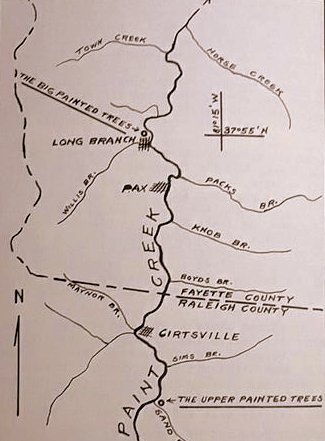
Another tradition associated with the Turnpike country involves mysterious lights reportedly seen around Sand Branch. Stories of unexplained lights are common throughout Appalachian folklore and are variously described as lanterns, headlights, glowing orbs, or distant lights that move in ways witnesses find difficult to explain.
As with the Turnpike accounts, explanations range from atmospheric effects and distant vehicles to misperception, embellishment, and the supernatural. What matters to folklorists is not necessarily proving that a ghost or unexplained object existed.
The story’s persistence can reveal something about the people and places where it is told. Along the West Virginia Turnpike, darkness, isolation, and generations of local history provide an unusually effective setting.
The highway changed, but the stories survived
The Turnpike that Roberts and Ayers knew has largely disappeared. The original two-lane highway was widened, curves straightened, bridges built, and portions of the roadway relocated as the Turnpike became a modern interstate highway.
Today, I-64 and I-77 carry millions of motorists through the mountains between Charleston and Princeton. Modern travel plazas, four-lane pavement, and constant interstate traffic bear little resemblance to the lonely highway of the 1950s and 1960s.
But Deitz preserved the voices of people who remembered that earlier road. That’s what makes the Turnpike stories more interesting than an ordinary collection of anonymous ghost tales. We know who at least some witnesses were, where they worked, and roughly where they said the encounters occurred.

We just don’t know what they experienced. Perhaps Ayers’ invisible foxhounds have an ordinary explanation. Perhaps Roberts saw an aircraft or an atmospheric phenomenon above the mountains. Perhaps the phantom hitchhiker is simply West Virginia’s version of a legend told along highways around the world.
Deitz left those questions largely to his readers. More than three decades after he collected the accounts, the old Turnpike has changed almost beyond recognition. The strange stories told by the people who traveled it have proved considerably harder to erase.
I love these stories, whether true or fabricated. Honestly I DO believe in ghosts.
Love these stories. I am not sure whether I believe in ghosts or not even though I have had an interesting experience.
I am not sure whether I believe in ghosts or not even though I have had an interesting experience. Love these stories
We travel the turnpike a lot. Unaware of these stories. Thanks so much for sharing.
I was raised there coon hunting we called it bobcat alley the dogs went silent never leaving us walking around with their hackles up the old indian camp was on the ridge we usrd to find arrow heads there buy night time was different
I am a believer in ghosts. I lived in the last house on the right on N. Sand Branch Road in 1975. The house is still there , a two story white house right before you reach the R.R. tracks. The house has had work done and a new paint job. I had to leave after two months as I was too terrified to stay there any longer.
I remember hearing the version of the Phantom Hitchhiker story involving a trooper on the Turnpike in elementary school about 1970. Of course, that’s a famous story trope, so the Turnpike being a long, lonely road would be a natural setting for a supernatural story.
The old Turnpike was a very dangerous road, too. It went from divided highway to undivided highway and out-of-staters didn’t always understand that.
My brother Dave had a summer job as a teen-ager painting guardrails on the Turnpike, in maybe 1969 or 1970. He came home from his first day dog tired, sunburned, and spattered with red primer paint. My mom saw him painfully getting out of her 1965 Mustang, spattered with what she assumed was dried blood. She thought he’d been in, or been near a terrible accident.