
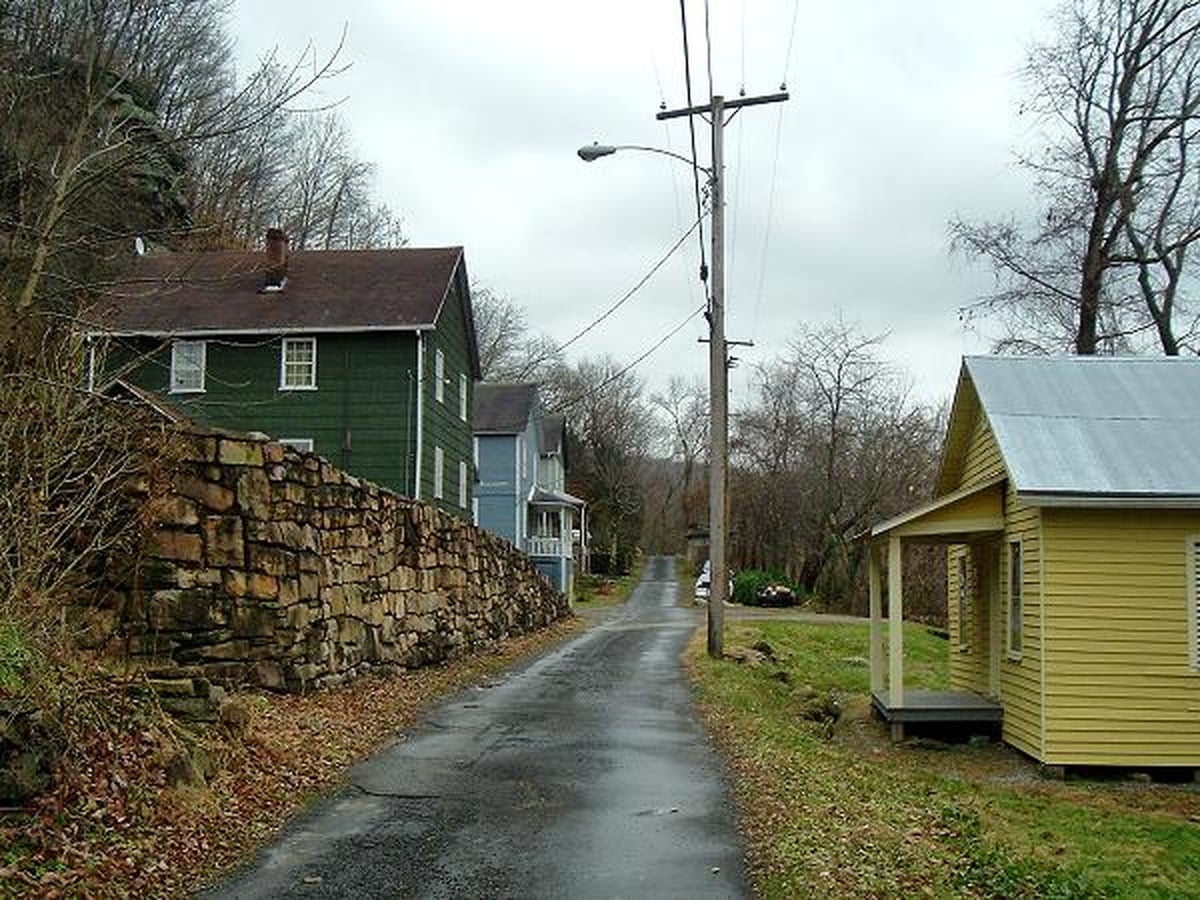
THURMOND, W.Va. — The Town of Thurmond and the New River Gorge Historical Society have filed a federal lawsuit seeking to halt the National Park Service’s planned demolition of historic buildings in and near the former railroad and coalfield community in southern West Virginia.

Filed in the U.S. District Court for the Southern District of West Virginia, the lawsuit seeks to suspend the demolitions while the federal agency completes a preservation review and the community explores alternatives to destroying the buildings, according to the plaintiffs.
The filing follows months of legal preparations involving residents, preservation advocates, and attorneys with Bailey & Glasser LLP. Attorney Benjamin Bailey agreed in September to represent the town pro bono.
Located deep in the New River Gorge National Park and Preserve, Thurmond was once a prosperous center of the region’s coal industry and an important hub on the Chesapeake & Ohio Railway. The town now has four residents, and the federal government owns much of its historic architecture.
Town seeks time to pursue preservation alternatives
In a prepared statement announcing the litigation, the town said families had sold their properties to the federal government with the understanding that the buildings would be preserved and used to interpret the community’s history.
“For more than thirty years, the National Park Service told residents it would preserve, rehabilitate, and reuse Thurmond’s historic buildings so the town could welcome visitors as a gateway to the Park,” the statement said. “Families sold their homes believing those buildings would be kept to tell Thurmond’s story.”
The plaintiffs emphasized that they are seeking time to develop preservation alternatives rather than asking the court to determine the permanent disposition of the properties.
“We are not asking the court to decide these buildings’ final fate. We are asking for a pause so the Park Service can finish the review it agreed to and our community has a fair chance to bring partners to the table. A pause can be lifted. A demolition cannot.”
Filing the lawsuit does not itself prevent the National Park Service from proceeding with demolition. Such a suspension would require action by the court or the agency.
Demolitions scheduled to begin this month
The lawsuit comes less than two weeks before temporary public closures are scheduled to take effect around demolition sites in the national park. As reported last week by West Virginia Explorer, the closures are scheduled to begin Nov. 30 and extend into spring 2027.
The National Park Service authorized the demolitions on July 18, 2025, following an environmental assessment and public comment period. Officials cited deteriorating building conditions, public safety concerns, maintenance costs, and limited reuse potential.
In its announcement, the agency agreed to retain three structures previously considered for demolition: the Marilyn Brown House, Thurmond Ice House, and Dun Glen Ark. It also identified three other properties that could be retained if viable leasing proposals were submitted.
The agency acknowledged that removing historic buildings would diminish the integrity of the Thurmond Historic District but concluded that the district would remain eligible for listing on the National Register of Historic Places.
The demolitions are part of a larger investment financed through the Great American Outdoors Act that also includes infrastructure improvements and the rehabilitation and stabilization of selected historic properties.
However, a 2022 survey commissioned by the Park Service found that most of the contributing structures examined in Thurmond retained their historic integrity and recommended maintenance or preservation measures.
Opposition to the demolition program has extended beyond the town. On Oct. 28, the Fayette County Commission unanimously adopted a resolution urging the federal government to pursue preservation alternatives.
Historical society cites importance of surviving buildings
Dr. Jennings Berry, president of the New River Gorge Historical Society, said the buildings themselves constitute irreplaceable historical evidence of the communities that developed along the river and railroad.
Among the properties slated for demolition is the Prince Brothers General Store at Prince, several miles upstream from Thurmond. The store opened in 1872 and remained in business until 1984.
Berry noted that the building’s 1986 National Register nomination described it as “the last surviving building of the New River coal field commercial businesses located along the New River” and recorded the Park Service’s intention “to restore and interpret the building for the visiting public.”
The agency documented the store through photography and three-dimensional scanning in 2024, ahead of its proposed demolition.
“These buildings are primary historical evidence of the people who built and lived in the coalfield communities of the New River Gorge,” Berry said. “They record who lived here, how they lived, and what they built. Drawings and photographs can document a building. They cannot replace it.”
The historical society, a nonprofit based in Thurmond, works to preserve and interpret the New River Gorge’s history.
Generations of families remain connected to Thurmond
For Thurmond resident and town council member Tighe Bullock, whose parents both served as mayors, the litigation carries particular personal significance.
“Speaking for myself personally, I do this for my parents, both former Mayors of Thurmond. And I do this for my neighbors, my community, and the people who lived, worked, and died in Thurmond,” Bullock said. “Our blood, sweat, tears, and bones are here.”
During the first two decades of the 20th century, Thurmond was the largest revenue generator on the Chesapeake & Ohio Railway, according to the National Park Service’s history of the community. Its railroad depot accommodated as many as 75,000 passengers annually, and its banks ranked among the wealthiest in West Virginia.
Bullock emphasized the contribution that the region’s coal and coke industries made to the industrial development of the United States.
“Walk around in downtown New York City, and you will see the steel-framed buildings that our coke built,” he said. “This town and its people helped build this country, and our story, every story here, deserves to be preserved.”
Bullock’s father was a geologist who mined coal in the region, and his mother was a schoolteacher. His family is among those that have maintained a presence in Thurmond as its population declined and much of the town passed into federal ownership.
“We, and the remaining families, are stewards of this town and its history,” he said. “This town belongs to posterity, and we intend to bequeath it to the next generation.”

Documentary chronicles Thurmond’s uncertain future
The preservation dispute is also the subject of a feature-length documentary, Almost Ghost Town, by filmmaker Jillian Carney Howell. In production since January 2024, the film chronicles the lives of Thurmond’s remaining residents and their relationship with the National Park Service.
“The town of Thurmond has survived for 123 years, while so many others in the New River Gorge have fallen,” Howell told West Virginia Explorer. “It comes as no surprise to me that the grit of its four people is now carrying it into a new historic chapter in which I hope Thurmond can flourish.”
Listed on the National Register of Historic Places in 1984, the Thurmond Historic District encompasses surviving residential, commercial, and railroad architecture. The National Park Service restored the town’s railroad depot in 1995, and it continues to serve as a seasonal visitor center.
Documents pertaining to the demolition program and its environmental and historic preservation reviews are available through the National Park Service’s planning website. Information about local preservation efforts is available through Preservation Thurmond.
Editor’s note: David Sibray, publisher of West Virginia Explorer, serves on the board of directors of the New River Gorge Historical Society, one of the plaintiffs in the lawsuit.