






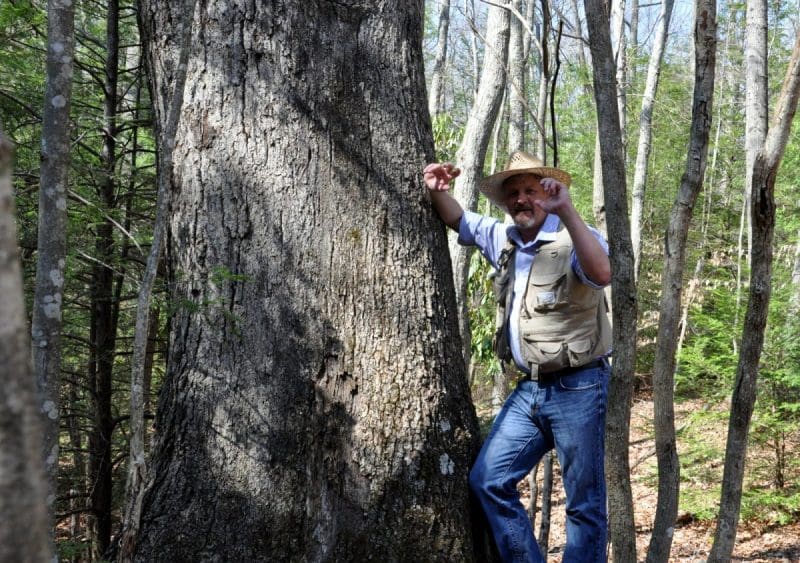
Hikers exploring lost trails of the New River Gorge
In 2014, without much fanfare, the National Park Service opened a new access point for two of the most remote trails within the New River Gorge National Park and Preserve. So far, only the most die-hard hikers seem to have noticed.

The Kates Plateau Trail and Polls Plateau Trail were once practically rumors. They appeared on park maps, but few people hiked them. I still haven’t spoken with many park rangers who have hiked the Polls Plateau Trail, the more remote of the two. Why? Access!
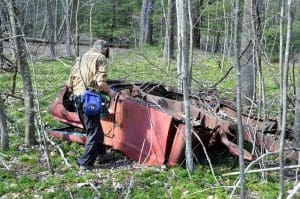
A vehicle was abandoned in a remote farmstead area on Polls Plateau Trail.
Until the access opened, most hikers would have been required to trek six miles over the park’s Glade Creek Trail to reach the Kates Plateau Trail and then another five miles on that trail to reach the Polls Plateau Trail. Most of those miles are uphill, too, and some of them are steep. Whatever then awaited discovery on the trails, it was too distant for most people to attempt to reach. Hunters, in particular, knew the trails, but few others had ever seen them.
All that changed when the park service quietly completed an agreement with property owners and opened a tidy little access area with a gravel parking lot. The access had been opened before, but an agreement that accommodated the parking area had not been reached, as I understand it, and, so, the park service simply did not promote the access.
But what of the trails themselves? I had the opportunity to hike four miles of the Kates Branch Trail in preparation for this article, and I have much to report.
These trails are unlike any others in the park. In the first place, they haven’t seen any of the foot traffic that other park trails have witnessed, and so staying on track could be difficult. I wouldn’t recommend either of these trails to the newbie. Drifts of leaves and fallen trees sometimes obscure the trail, and though markers appear at trail junctions, the trails aren’t blazed. I highly recommend using a good park service map or geologic survey map or employing a smartphone. I found it absolutely necessary to use the maps there to keep myself oriented.
The two trails are also unique in that they wander upland areas far from the steep terrain and cliff-walls for which park trails in the New River region are better known. The trails are long (both are 5.1 miles) but are not otherwise strenuous. In some cases, you’ll be required to leap across puddles, but most of the trails are quite level and follow old logging roads with shallow grades. Historians may be particularly interested in the cuts and grades that remain as evidence of the logging industry that cleared the plateaus in the 1920s.
Here and there the remains of timbers used to support rails are in evidence, though if nothing else these trails embody solitude, and the memory of any industry here is difficult to sustain. The second-growth forest here is quite dense, though the Polls Plateau Trail crosses old farm fields and the remnants of long-forgotten homesteads.
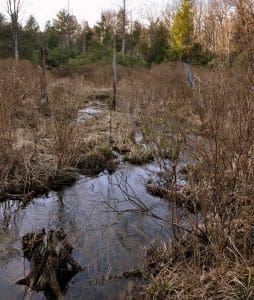
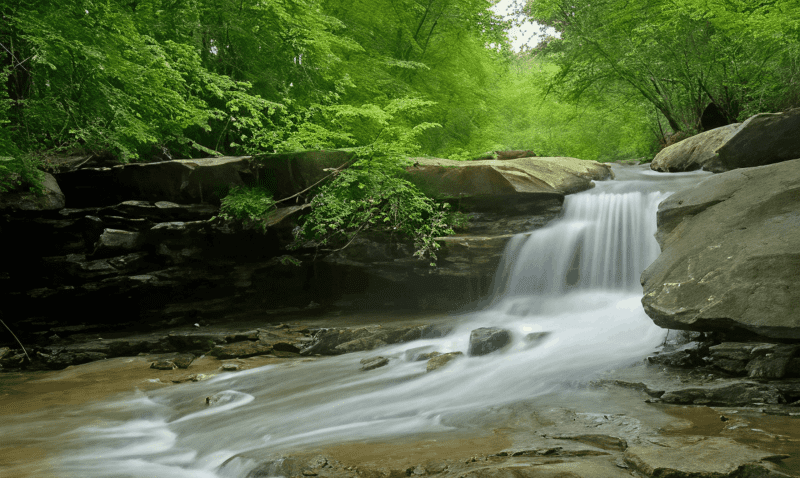
Kates Branch wanders through a wetland, home to a rare orchid.
If I might recommend any must-see aspect of the trail network, it would be the wetland along the upper reach of Kates Branch, accessible along the southern section of the loop on the Kates Branch Trail. Though not a large wetland, it’s notably the home of a rare species of orchid identified by botanist Osbra Eye. The orchid caused the route of Interstate 64 to be shifted south of the wetlands while it was being built in the 1980s.
Now that the trails are more accessible, I think they’re likely to see more foot traffic, though I don’t expect either to enjoy the popularity of other nearby trails such as those at Grandview and Sandstone Falls or at Little Beaver State Park.
I think the plateau trails are ideally suited for overnight hikes, and this spring, I intend to hike both trails and the Glade Creek trail as part of a single 16-mile trek.
Directions: The new trailhead is easy to find and only a mile-and-a-half from the Bragg exit (133) on I-64. From the exit, follow Plumley Mountain Road (CR-27) approximately one mile to a left turn onto Polls Branch Road. Follow the latter approximately one-half mile to the trailhead. The trailhead is a drive of approximately 40 minutes west of Lewisburg and 20 minutes east of Beckley.

Inside Appalachian Escapes: Themed rentals, escape rooms, and a love letter to West Virginia
West Virginia bottler wins silver award at international water competition
BERKELEY SPRINGS, W.Va. — Le Sage Natural Water, of Lesage, has been awarded a silver medal for its purified water at the 36th annual Berkeley...
West Virginia uniquely prepared to dominate 21st-century outdoor economy
CHARLESTON, W.Va. — West Virginia is uniquely prepared to dominate in the 21st-century outdoor economy of the U.S., thanks to its unmatched...
Flood risk outpaces warnings, advocates say, as W.Va. considers changes to resiliency fund
CHARLESTON, W.Va. — As the W.Va. House of Delegates considers changes to Senate Bill 390, the West Virginia Rivers Coalition warns that the state...
We asked AI how its own data centers could pollute West Virginia. Here’s what it had to say
(The following article was generated partly by ChatGPT in response to a prompt about how data centers pollute. As ChatGPT is powered by data...
Inaugural W.Va. Outdoor Economy Summit to unite leaders around $2.1 billion growth
CHARLESTON, W.Va. — West Virginia’s outdoors are more than a scenic backdrop. They’re a strategic economic asset. That message will take...
West Virginia State Parks Foundation launches online merchandise store
HURRICANE, W.Va. — The West Virginia State Parks Foundation has launched an official online merchandise store, offering supporters a new way to...
West Virginia Travel Safety: What it means for residents and visitors in 2026
CHARLESTON, W.Va. — Travel safety in West Virginia is shaped less by headline-grabbing crime and more by geography, weather, and the realities of...
Did Abraham Lincoln and Jefferson Davis secretly meet in West Virginia?
PHILIPPI, W.Va. — Did Abraham Lincoln and Jefferson Davis secretly meet in what is now West Virginia just days after the first land battle of the...
Study finds WVU and its health system account for 17% of West Virginia’s economy
MORGANTOWN, W.Va. — West Virginia University and the WVU Health System together generate $14.3 billion in annual economic impact in West Virginia,...