
PARKERSBURG, W.Va. — The duel between Aaron Burr and Alexander Hamilton remains a defining episode in early American history. Even those with only a passing knowledge of the nation’s founding may remember how the sitting vice president fatally shot Hamilton in 1804, ending the life of one of America’s foremost statesmen and bringing Burr’s own political career crashing down.

What many Americans don’t know is that the famous duel was only the beginning of Burr’s story. Within two years, the disgraced former vice president had become the central figure in a mysterious western enterprise that President Thomas Jefferson believed threatened the very survival of the young republic.
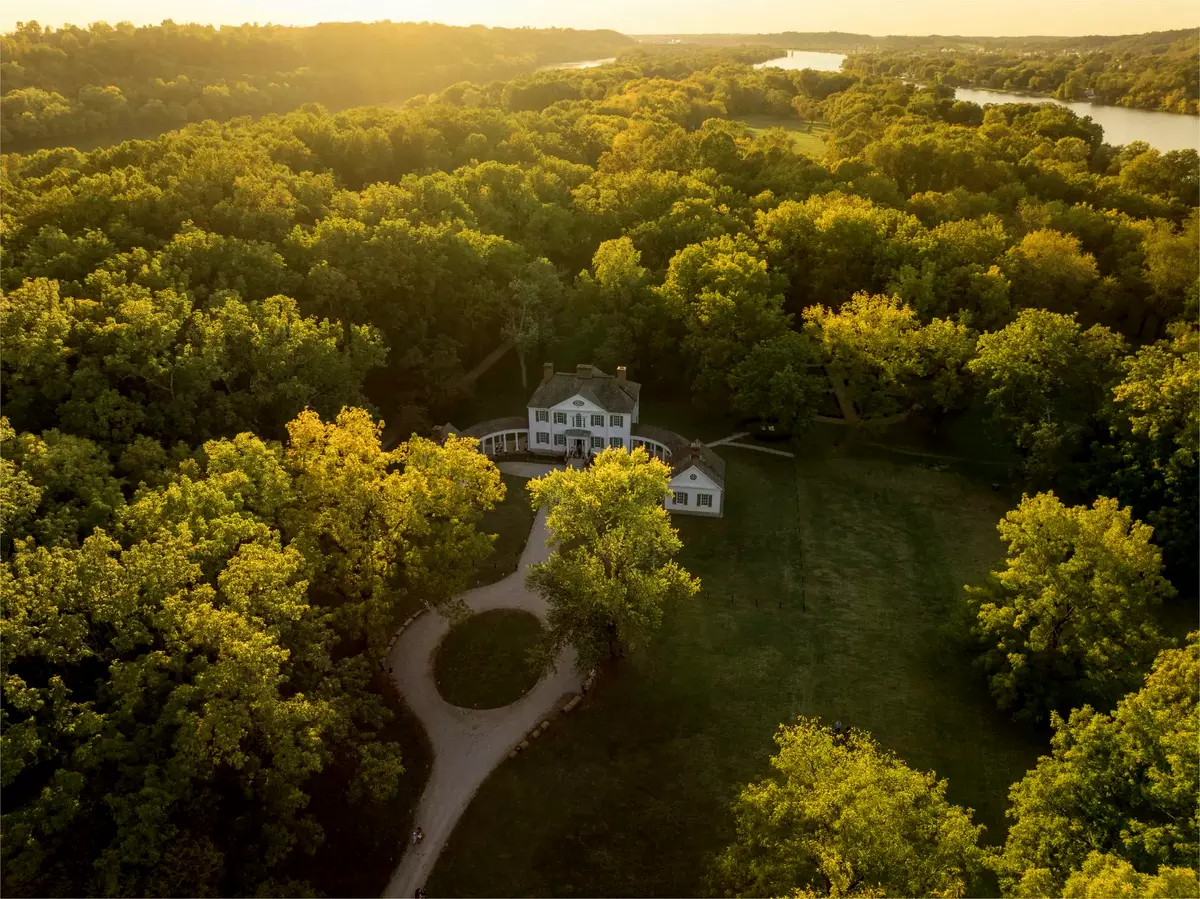
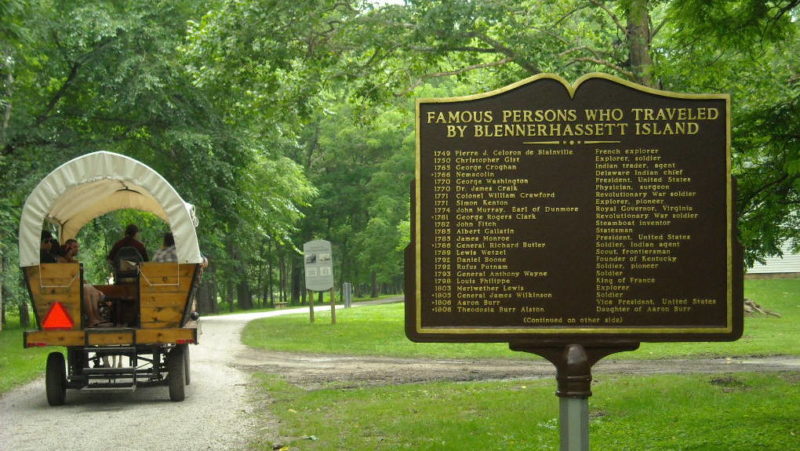
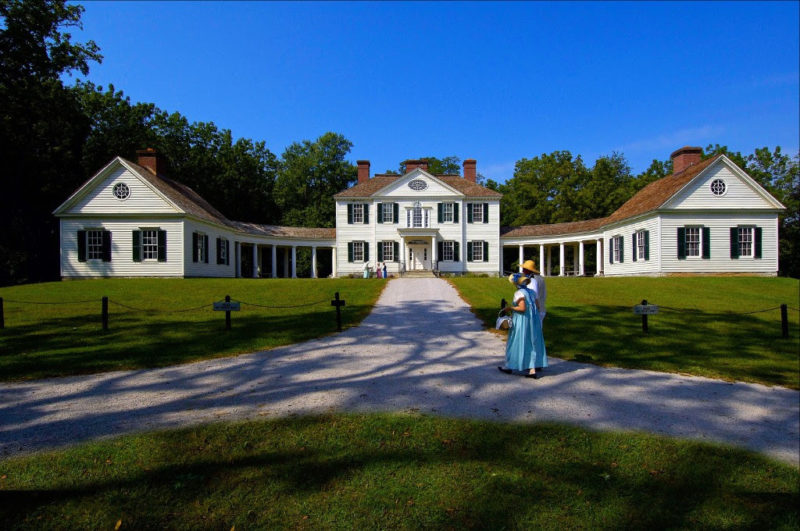
At the center of that drama stood an elegant mansion on a wooded island in the Ohio River near what is now Parkersburg, West Virginia. Today, that island is preserved as Blennerhassett Island Historical State Park, where visitors arrive aboard a sternwheel riverboat to tour a reconstructed mansion, ride horse-drawn wagons beneath towering sycamores, and explore one of the nation’s most intriguing historic landscapes.
Until they reach the island and begin to study its history, few visitors realize they are walking the grounds where one of America’s greatest political mysteries unfolded.
An island with a much older story
Long before it became associated with Aaron Burr, Blennerhassett Island had already witnessed centuries of human history. Geologists believe the island formed sometime after A.D. 1300, when the Ohio River carved a second channel around what had once been part of the Virginia shoreline.
Stretching nearly four miles in length and encompassing 381 acres, it became one of the largest islands in the Ohio River and offered rich farmland, abundant wildlife, and easy transportation along one of eastern North America’s great waterways.
For centuries, Native American communities occupied the island. Archaeological excavations have revealed one of the richest prehistoric sites in the upper Ohio Valley, with evidence of villages where residents cleared forests for cornfields and built homes covered with bark and woven reed mats.
By the time European traders reached the region in the eighteenth century, the island had already served generations of Indigenous peoples.
The first written reference appeared in the journal of trader George Croghan in 1765. A traveler the following year recorded the home of Delaware Chief Nemacolin, whose name the island carried for several years before becoming known as Belpre Island.
During the Ohio Valley conflicts of the 1790s, New England settlers established farms there, constructing blockhouses, floating gristmills, and trading facilities that made the island one of the frontier’s busiest commercial centers.
A frontier paradise
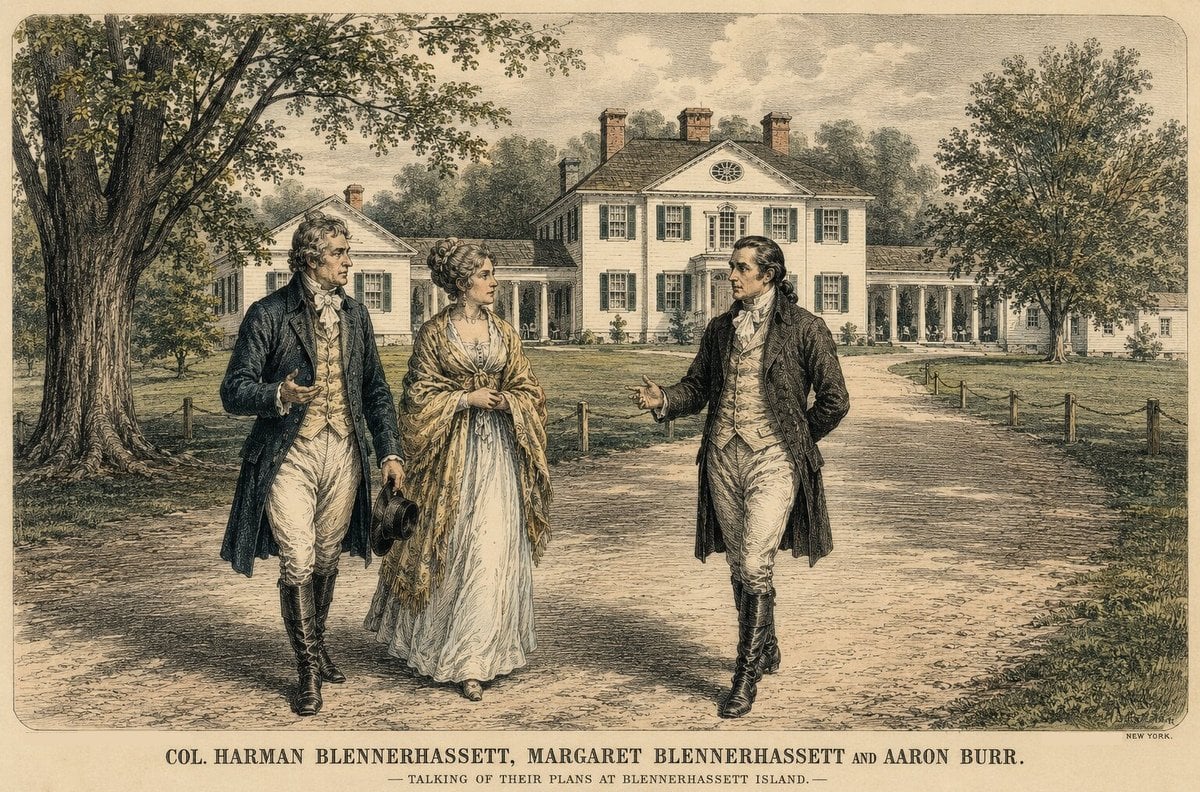
Everything changed in 1798 when Harman and Margaret Blennerhassett purchased the island. The wealthy Irish couple had left their homeland amid political unrest and personal controversy, hoping to establish a peaceful life in America. Rather than settling in Philadelphia or another eastern city, they invested their considerable fortune in what many considered an unlikely location—the wilderness along the upper Ohio River.
Over the next several years, they transformed the island into what visitors frequently described as the finest private estate west of the Allegheny Mountains.
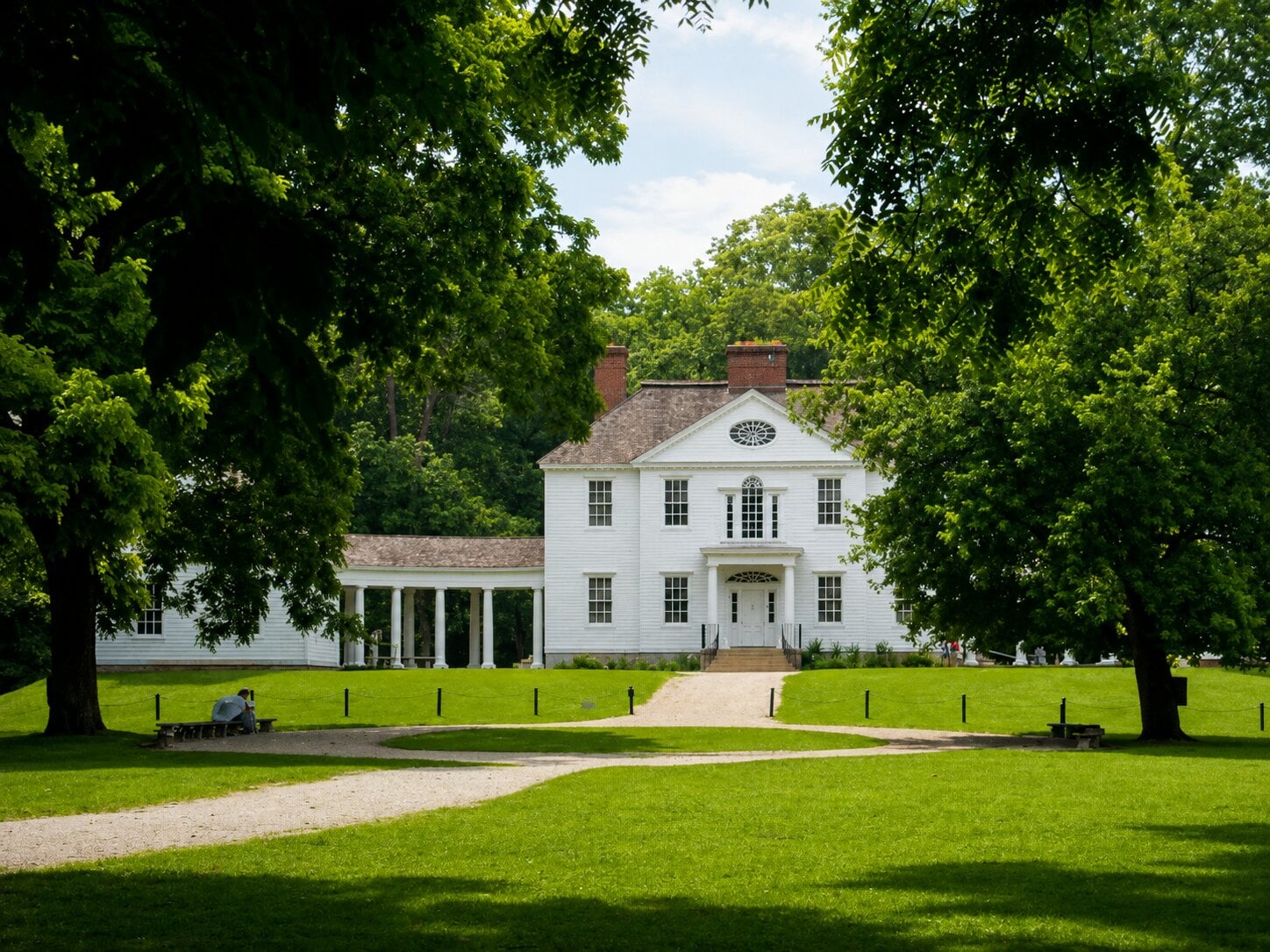
Their Palladian-style mansion overlooked carefully landscaped grounds filled with imported trees, formal gardens, orchards, greenhouses, and winding walks. Travelers marveled that such refinement could exist so deep within what was still regarded as the American frontier.
Politicians, military officers, artists, scientists, and explorers became regular guests, while evenings at the mansion featured music, conversation, and elegant dinners that earned the estate a reputation as the social center of the Ohio Valley. One visitor who found the island especially appealing was Aaron Burr.
The conspiracy begins
Following the Hamilton duel, Burr found himself politically isolated. Indicted for murder in both New York and New Jersey, he began traveling through the expanding American frontier and eventually down the Ohio River to Blennerhassett Island, where Harman was away from home, and Margaret welcomed the distinguished visitor.
From there, Burr continued to Louisville, Nashville, and New Orleans, meeting influential political and military leaders along the way, including Andrew Jackson and Gen. James Wilkinson, the commanding general of the U.S. Army and governor of the Louisiana Territory.
Exactly what Burr intended remains one of the most debated questions in early American history. Some historians believe he hoped to invade Spanish territory in Texas or Mexico while Spain’s empire appeared vulnerable. Others concluded that he intended to separate the western territories from the United States and establish an independent nation with New Orleans as its capital.
Contemporary accounts even suggested Burr envisioned himself as the ruler of such a nation, though he consistently denied any intention to commit treason. Whatever Burr’s ultimate goal, Harman Blennerhassett became one of his most enthusiastic supporters.
Blennerhassett’s costly mistake
Believing he was assisting an enterprise that would benefit the United States, Blennerhassett committed both his fortune and his reputation to Burr’s cause.
According to contemporary accounts, Burr used Blennerhassett’s financial backing to purchase approximately 400,000 acres along Louisiana’s Washita River. Blennerhassett also financed the construction of a flotilla of 15 large bateaux upstream of Parkersburg near the mouth of the Muskingum River, vessels reportedly capable of transporting some 500 men together with their equipment and supplies.
Meanwhile, Burr traveled extensively through Ohio, Kentucky, and Tennessee, recruiting followers with his remarkable charisma and persuasive speaking ability. His correspondence with Wilkinson, often written in cipher, suggested a carefully organized enterprise whose true objectives remained known only to a handful of participants. By late 1806, however, secrecy had begun to unravel.
President Jefferson intervenes
Burr apparently became overconfident, discussing elements of his plans with individuals who quickly alerted federal authorities. Newspapers throughout the frontier soon began publishing reports of the mysterious expedition, while President Jefferson received increasingly alarming information from trusted sources in the West.
The decisive blow came when Wilkinson abruptly abandoned Burr and informed Jefferson of the alleged conspiracy. Jefferson responded by declaring the expedition illegal and ordering federal officials to stop it before the flotilla could depart.
Militia forces descended upon Blennerhassett Island, seizing the boats assembled near the Muskingum River and searching the estate. Soldiers badly damaged the mansion and destroyed many of the family’s valuable furnishings, artwork, and possessions.
Harman and Margaret escaped down the Ohio River, never again returning to the magnificent home they had created. Burr also fled but was eventually captured near Natchez after a reward was offered for his arrest.
The trial that captivated America
Burr’s trial in Richmond during the summer of 1807 became one of the nation’s earliest legal spectacles. Presided over by Chief Justice John Marshall, the proceedings examined whether Burr had committed treason against the United States. Although Jefferson remained convinced Burr had plotted against the nation, prosecutors could not demonstrate that he had committed the constitutionally required overt act of war.
Marshall therefore instructed the jury to acquit him. The verdict effectively ended the government’s prosecution not only of Burr but also of Harman Blennerhassett and many of the other alleged conspirators. Legally vindicated but politically destroyed, Burr soon departed for Europe.
The Blennerhassetts spent the remainder of their lives struggling with financial hardship brought about by their association with the failed enterprise. Their elegant mansion, abandoned after their flight, was destroyed by fire in 1811.
From conspiracy to state park
Although forever linked to Aaron Burr, Blennerhassett Island continued writing new chapters of history. The fertile island returned to agriculture throughout much of the nineteenth century before becoming home to an amusement park between 1886 and 1912.

During those years, visitors watched exhibitions by the Cincinnati Reds, Pittsburgh Pirates, and Brooklyn Dodgers, while heavyweight boxing champion Gentleman Jim Corbett also appeared there. During Prohibition, the island briefly became a center of moonshining before returning once again to a quieter agricultural existence.
Today, visitors experience a remarkably different atmosphere. Seasonal sternwheel excursions depart regularly from Point Park in downtown Parkersburg, carrying passengers across the Ohio River much as travelers arrived more than two centuries ago.
Guided tours of the reconstructed mansion, horse-drawn wagon rides, bicycle rentals, shaded walking trails, and the restored Putnam-Houser House allow visitors to experience both the beauty of the island and the extraordinary history that unfolded there.
Standing on the broad lawn overlooking the Ohio River, it is difficult to imagine that this peaceful landscape once served as the headquarters of a conspiracy that alarmed President Thomas Jefferson and nearly altered the course of American history. That remarkable contrast between tranquility and turmoil continues to make Blennerhassett Island one of the most compelling historic destinations in the United States.
For more information on visiting Parkersburg, Wood County, and Blennerhassett Island, contact the Greater Parkersburg Convention and Visitors Bureau.
Great article learned a few things never knew .