
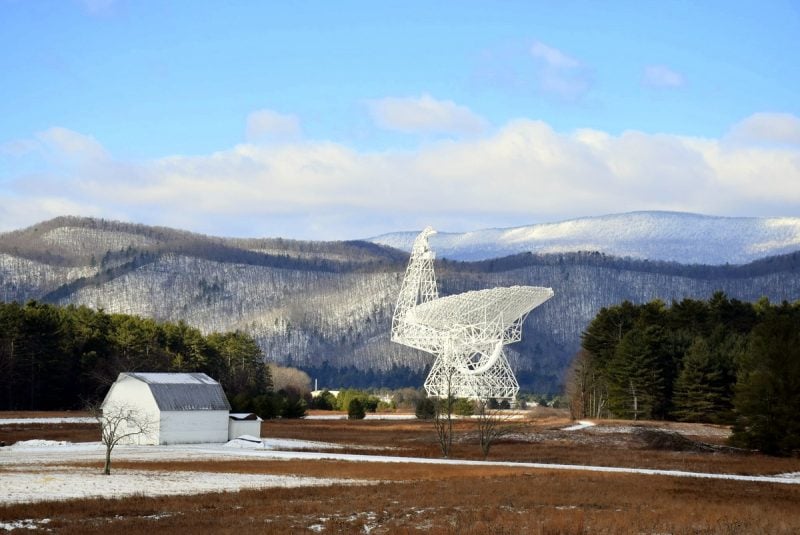
GREEN BANK, W.Va. — The universe whispers in radio waves, and if we listen carefully, we can hear its stories, but to listen, we must remain very quiet.

One of the quietest places on Earth, Green Bank provided scientists the silence they needed to conduct their experiments, to listen.
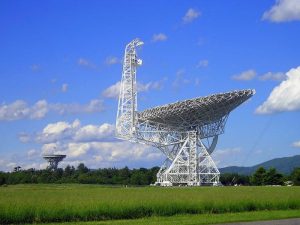
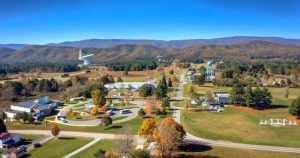
Green Bank, West Virginia, is home to the National Radio Astronomy Observatory, and to the crown jewel of radio astronomy—the Robert C. Byrd Green Bank Telescope.
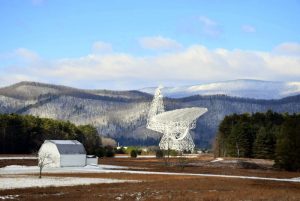
Completed in 2000, the Green Bank Telescope (often referred to as the GBT) is the world’s largest fully steerable radio telescope. Its massive dish measures 100 meters by 110 meters, stretching wider than a city block. Despite its size, it moves with surprising grace, rotating and tilting to track objects across the sky with exquisite precision.
The telescope is so sensitive that it can detect a signal weaker than a trillionth of a watt. Under the right conditions, the GBT could detect the energy released when a single snowflake hits the ground.
Its surface is composed of 2,004 individual aluminum panels, each mounted on actuators that continuously adjust their positions to maintain a perfectly smooth, reflective surface. The allowable deviation is less than the width of a human hair.
This is not just a machine. It is a work of art. A feat of engineering. A philosophical instrument designed for one purpose—to listen.
But such extraordinary sensitivity comes at a cost.
Enter the Zone
A radio telescope can only listen as well as its surroundings allow. And the modern world is loud.
Cell phones murmur constantly. Bluetooth devices chatter back and forth. Wi-fi routers pulse. Microwave ovens hum. Power lines crackle. Heaters cycle. Digital cameras blink. Fitness trackers quietly report their data.
Even the brief ionization that occurs inside a single spark plug—just one tiny flash of combustion!—is enough to contaminate reams of astronomical data.
A few questions emerge: How do you protect silence in a world that no longer knows how to be quiet? How do you hush the clamor of modern life long enough to hear the universe breathe?
The answer lies not in stronger instruments, but in restraint. In a place deliberately set aside for listening…
Welcome to the National Radio Quiet Zone.
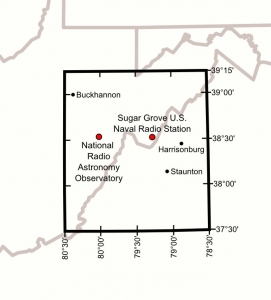
Established in 1958, the zone spans approximately 13,000 square miles across West Virginia and parts of Virginia. Most of it lies within Pocahontas and Pendleton counties, with extensions into Randolph, Tucker, and Barbour counties.
Within its boundaries, radio transmissions are heavily restricted, monitored, and regulated. Not eliminated entirely, but carefully managed to preserve one of the quietest electromagnetic environments left in the industrialized world.
Sugar Grove NSA Station
The Quiet Zone serves not only science but also national security.
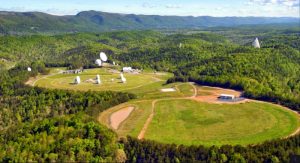
Hidden in the mountains of nearby Pendleton County, the Sugar Grove NSA Station, a former naval facility, was taken over by the National Security Agency in 2015.
Originally constructed during the Cold War, the Sugar Grove station was designed to intercept Soviet radar and radio signals reflected off the moon, a technique known as “moon bounce.” Today, the site is believed to be part of the ECHELON global surveillance network, which processes electronic communications intercepted around the world.
The same silence that benefits astronomers benefits intelligence analysts.
The Quiet Zone, it turns out, listens in more ways than one.
The Restrictions
Life inside the Quiet Zone comes with trade-offs.
Fixed radio transmitters, such as broadcast towers and cellular infrastructure, are tightly controlled. Any new transmitter must be reviewed and approved by the observatory, the FCC, and the National Telecommunications and Information Administration.
Many everyday technologies are restricted or heavily limited, including:
- Cell phones
- Cordless phones
- Microwave ovens
- Wifi routers
- Bluetooth devices
- Baby monitors
- Spark-ignition vehicles
Violators may receive a visit. Not from law enforcement, but from technicians carrying spectrum analyzers.
Sometimes, those visits end with an unusual exchange: older appliances replaced with newer, shielded models at no cost, simply to reduce interference.
It’s not about punishment. It’s about preservation.
The Zonies
Fewer than 150 people live in the village of Green Bank itself, though thousands more reside throughout the Quiet Zone. They are a diverse and often misunderstood group.
Multi-Generational Roots
Many residents are simply locals, families who lived in these mountains long before the Quiet Zone existed. The regulations formalized an isolation that geography had already imposed. For them, life changed less than outsiders might expect.
Observatory Staff
Scientists, engineers, and technicians make up another significant portion of the population. They live a curious hybrid lifestyle, unplugged at home / hyper-connected at work. Many voluntarily comply with restrictions out of pride and respect for the mission.
Electromagnetic Hypersensitivity Community
Then there are those who arrive seeking relief. A small but visible community of people who believe they suffer from electromagnetic hypersensitivity (often called EHS) have relocated to the Quiet Zone in search of peace.
Stephen Kurczy, award-winning journalist and author of THE QUIET ZONE, explains:
“In the past twenty years or so, there’s been a growing number of people who believe they can actually feel, and are harmed by, those invisible radio signals that are all around us. The Quiet Zone is a place where they can feel themselves again.”
Believers describe headaches, fatigue, nausea, and even a type of cognitive fog caused by exposure to everyday electronics.
Kurczy poses the question simply:
“Where’s the one place in the entire world you can go and live in a community if you believe this is happening to you?”
The Future of Quiet
What lies ahead for the Quiet Zone remains uncertain.
Will new technologies make radio astronomy possible without such restrictions? Will intelligence needs evolve beyond remote listening posts? Will the next generation tolerate life without constant connectivity?
For now, the zone persists as a living compromise between science and society, connection and restraint, progress and patience.
And perhaps that is its greatest lesson.
On Peace and Quiet
How important is silence?
Is it something the human heart instinctively craves? Or is it merely a relic of a slower world?
Kurczy offers a caution:
“A lot of people come to the Quiet Zone seeking the perfect life. But like anywhere else, it has its conflicts and problems.”

Quiet does not guarantee peace. But it creates space.
Space to listen. Space to reflect. Space to remember that the universe is still speaking, softly, patiently, endlessly….
And sometimes, the most profound thing we can do is stop talking long enough to hear it.
National Radio Quiet Zone: Green Bank, West Virginia
Getting there: Green Bank, West Virginia, is remote by design, tucked deep in the mountains of Pocahontas County. Reaching it requires a deliberate car journey. Its address is 155 Observatory Road, Green Bank, WV 24944.
From the north: Travelers arriving from Elkins and Morgantown typically follow U.S. Route 33 east to Elkins, then continue southeast on West Virginia Routes 28 and 92, which wind through forested valleys and small mountain communities before reaching Green Bank.
From the south: Those approaching from Lewisburg, Beckley, or Interstate 64 usually travel north on U.S. Route 219 through Marlinton, then connect with Routes 28 and 92 toward Green Bank. From either direction, visitors turn onto Observatory Road to reach the Green Bank Observatory.
Because Green Bank lies within the National Radio Quiet Zone, cell phone service is limited or nonexistent; travelers are advised to download maps or carry printed directions before entering the area.
Quick Facts: The National Radio Quiet Zone
• Location: Pocahontas County, West Virginia, with extensions into Virginia
• Established: 1958
• Size: About 13,000 square miles
• Purpose: Protects radio astronomy from human-made interference
• Home to: Green Bank Observatory and the Robert C. Byrd Green Bank Telescope
• Why it matters: Allows scientists to detect extremely faint radio signals from distant galaxies, pulsars, and molecular clouds
• Restrictions include: Cell towers, Wi-Fi routers, microwave ovens, and unshielded electronics
• Enforcement: Radio interference is monitored; technicians may track down and reduce offending signals
• Also supports: U.S. national security operations at Sugar Grove NSA Station
• Unique fact: One of the quietest electromagnetic environments on Earth.
• More information: Green Bank Observatory
You don’t mention the negative, dangerous, harmful impact this causes to Fire, EMS, and Police radio systems in Pendleton, Pocahontas, and other counties. The NRQZ is an unfunded federal mandate on our counties.