
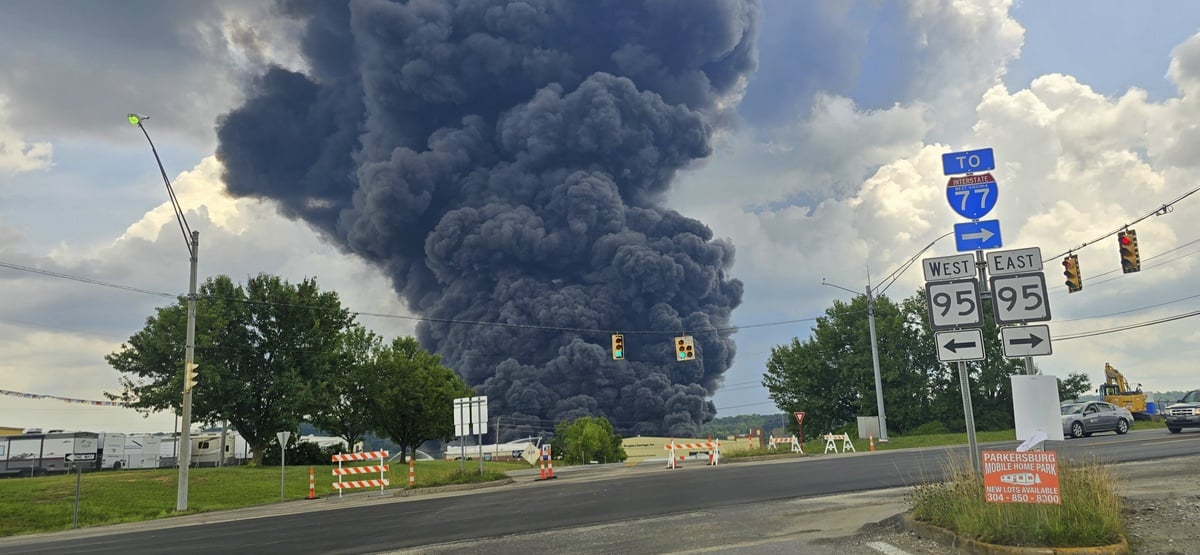
PARKERSBURG, W.Va. — Environmental testing following the massive July warehouse fire in Parkersburg has detected low concentrations of contaminants in some soil, produce, vegetation and honey samples, although state officials say results received so far have not reached federal action levels or warranted additional protective measures.

The findings are part of an ongoing investigation and cleanup following the July 4-5 fire at the Peoples Cartage warehouse complex on Camden Avenue, where flames involving large quantities of plastic materials sent a towering plume of black smoke across the Parkersburg area. The fire prompted a state of emergency in Wood County and shelter-in-place warnings for nearby residents.
Peoples Cartage and the W.Va. Department of Environmental Protection are analyzing samples for more than 90 parameters commonly evaluated after structure fires and associated with building materials, plastics, resins and combustion, according to an update released by state environmental officials.
Results received to date have not identified concentrations that require additional response or protective measures beyond cleanup, monitoring and remediation already underway, according to the state.
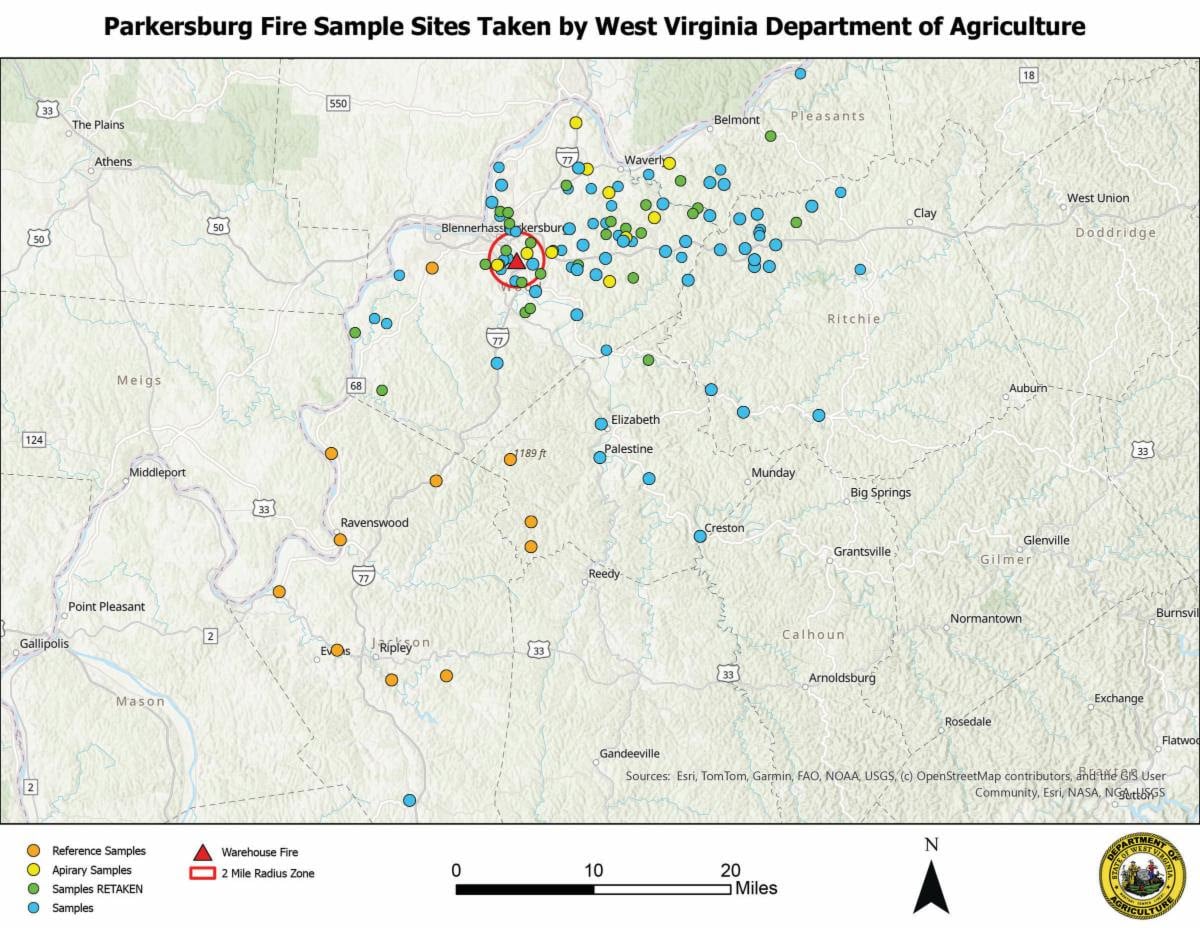
Meanwhile, the W.Va. Department of Agriculture collected approximately 200 water and soil samples from agricultural and residential properties where owners requested testing. The samples were analyzed by the U.S. Environmental Protection Agency’s Region 3 Mobile Lab for substances associated with combustion, smoke, ash and fire debris, while the agriculture department tested for heavy metals.
No compounds analyzed were detected in residential water samples reported to date. Low concentrations of some compounds were found in soil samples; however, some results were above West Virginia’s de minimis screening levels. State officials said none exceeded federal action levels.
The agriculture department’s public sampling page similarly reports that results received so far have produced either no detections or low-level findings, with no samples exceeding federal action levels.
Produce, vegetation, and honey also tested
Testing has extended beyond soil and water because smoke and ash from the sprawling fire traveled beyond the Camden Avenue property.
Agriculture officials collected samples of produce, vegetation and honey and worked with a third-party laboratory to test them for semi-volatile compounds. Residual concentrations of some contaminants were detected in certain samples, according to the state, but officials said the concentrations were well below levels considered a health concern.
Among the substances evaluated are polycyclic aromatic hydrocarbons, or PAHs, a class of chemicals that can form when materials including wood, fuel, plastics and other organic matter are burned.
Because PAHs can originate from numerous combustion sources—including vehicle exhaust, wood burning and wildfires—their presence alone does not establish that the Parkersburg warehouse fire was their source. The compounds are routinely among those evaluated following fires.
The agriculture department has published its sampling information, including links to EPA soil and water results and a map of sampling locations, online.
Cleanup continues under state enforcement order
The environmental investigation is continuing as Peoples Cartage works under an enforcement order issued by WVDEP following the fire.
The order requires the company to develop and carry out plans addressing debris removal and disposal, characterization and sampling of the property, and remediation of areas where contamination is found above applicable regulatory limits. The company also must maintain stormwater controls intended to prevent runoff from affecting nearby waterways and conduct continued sampling.
Concerns about runoff emerged almost immediately after the fire as crews used large quantities of water to battle the sprawling blaze near the Little Kanawha River. WVDEP subsequently conducted dye testing at the property to determine how water drains from the site and identify potential discharge points that need to be controlled.

The fire initially began July 4 and was believed to have been extinguished before reigniting early July 5. It eventually spread through three connected warehouses as firefighters from departments across West Virginia and Ohio worked to contain it. Because plastic-based materials were burning, emergency officials warned residents to avoid the smoke and issued shelter-in-place precautions for a broad area of Parkersburg.
Gov. Patrick Morrisey declared a state of emergency in Wood County as state and federal agencies joined the response. The fire was fully extinguished July 7 after burning for several days. No employees or other people at the facility were reported injured.
The cause of the fire and its rekindling remained under investigation following the incident.
State environmental and agricultural officials say sampling and remediation will continue as the Camden Avenue property is cleaned up. Residents with questions about agricultural sampling may contact the West Virginia Department of Agriculture at 304-558-3200.