
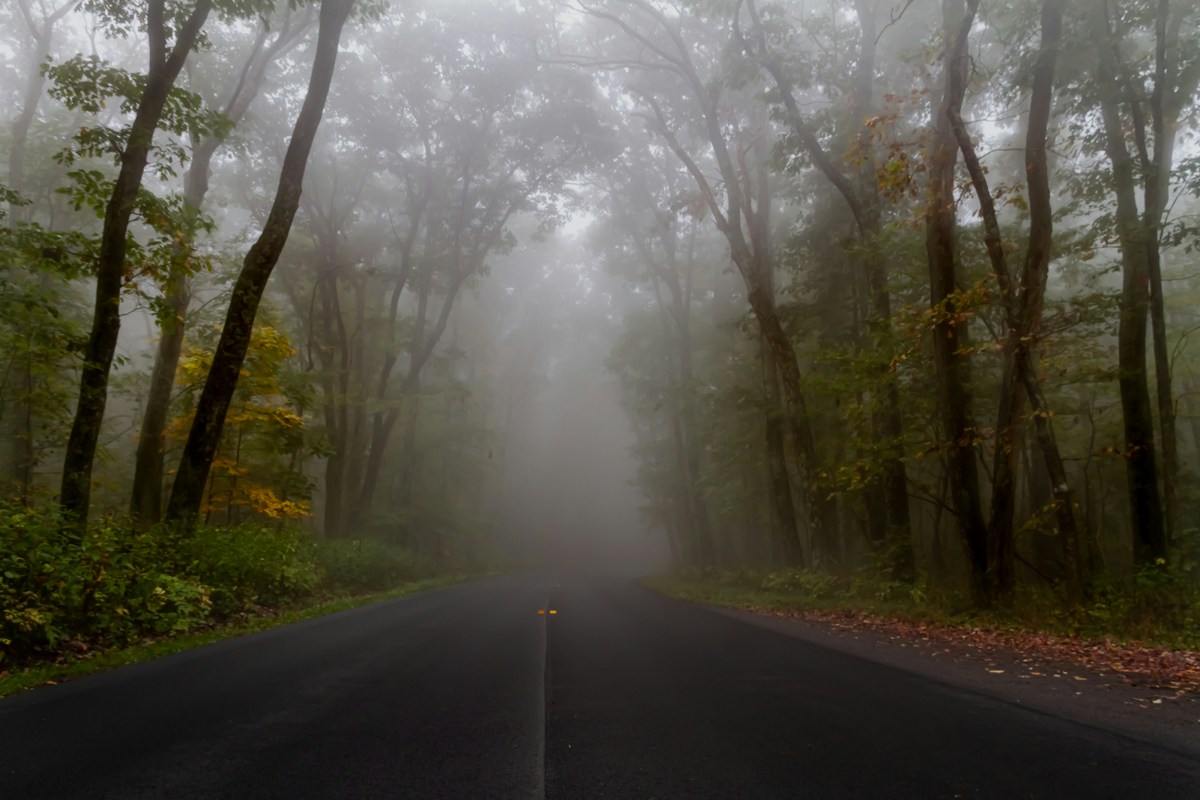
PAX, W.Va. — On lonely roads across West Virginia, the same unsettling scene has played out again and again in the state’s folklore: A driver rounds a bend late at night and sees someone—or something—that should not be there.

A woman and child appear beside a Putnam County road. A sinister stranger confronts motorists on an old Logan County mining road. Near Shady Spring, a phantom automobile is said to travel through the darkness. Along a hollow near Cabin Creek, a newspaper carrier encounters an angry presence before dawn.
Roads, perhaps as much as old houses and abandoned buildings, have become one of the characteristic settings of West Virginia ghostlore. Jonathan Moore, publisher of the long-running West Virginia Ghosts website, found that four of the 10 most popular accounts submitted to his collection involved roadside encounters.
Moore has published first-person accounts of alleged supernatural experiences submitted by readers since 1999, building a collection of hundreds of stories from across the Mountain State. He said interest in West Virginia hauntings began growing markedly in the early 2000s, as television programs helped move paranormal subjects into popular culture.
“Talk of hauntings in West Virginia picked up around 2004,” Moore said. “Before that, folks would talk about hauntings, but their discussions were under the radar. Television began to bring talk of ghosts into the mainstream, and soon afterward, West Virginia was making the news regularly.”
The prominence of roadside encounters in the collection is consistent with a much older tradition documented by West Virginia folklorists. The West Virginia Encyclopedia identifies the “unrested spirit”—a person believed to have died suddenly or tragically and remained attached to a person or place—as one of three principal forms of ghostlore found in the state. One familiar variation is the vanishing hitchhiker, in which a driver encounters a mysterious traveler who disappears before reaching a destination.
The late Ruth Ann Musick, one of West Virginia’s foremost folklorists, collected and studied such stories for decades and believed social and historical circumstances helped account for the richness of the state’s ghost tradition. Her work documented tales associated not only with houses but with mines, railroad tracks, rivers, bridges and other places where travelers could find themselves isolated.
In West Virginia, that often means a road through the mountains.
Why the road makes such a good place for a ghost story
A roadside encounter has qualities that distinguish it from the traditional haunted-house story. The witness is usually moving, often alone, and may see something for only seconds. Darkness limits the field of vision to the headlights. Mountain curves make objects appear suddenly and disappear just as quickly, while fog, rain and steep terrain can further obscure what a traveler sees.
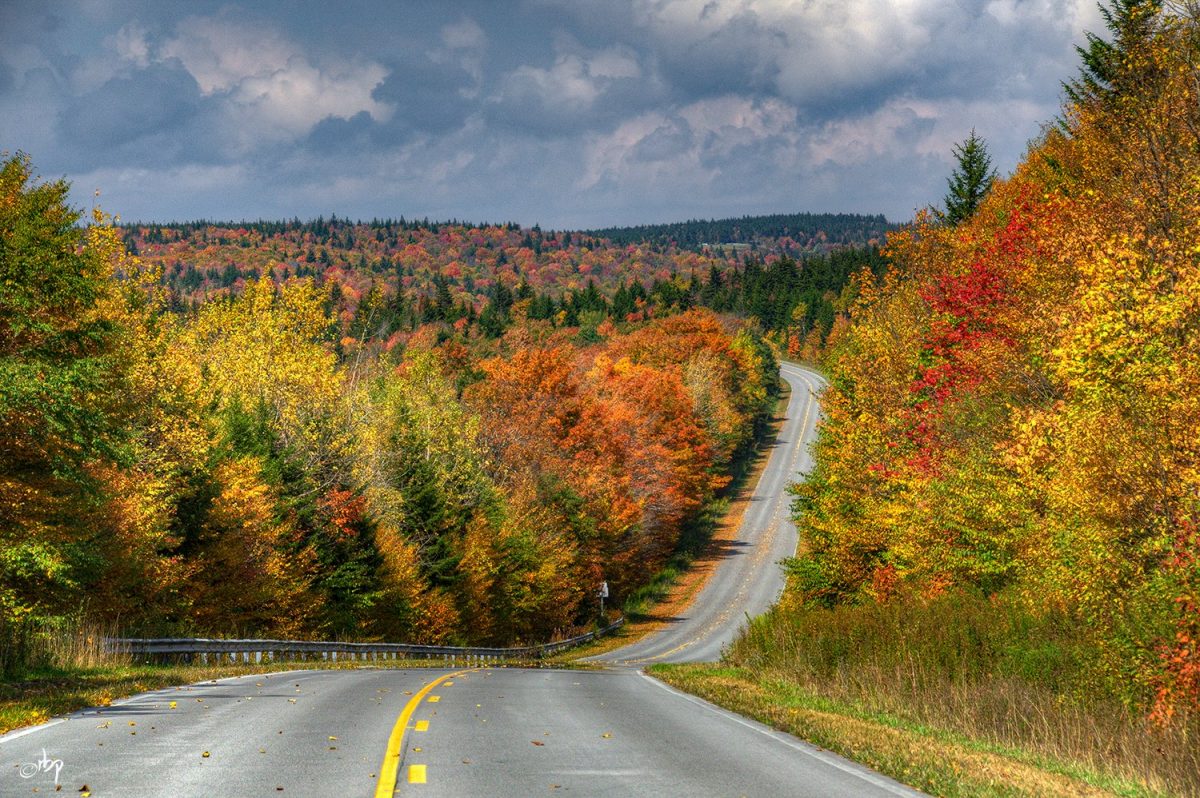
West Virginia’s settlement history also places modern roads remarkably close to the past. Highways pass abandoned mine openings, former coal camps, family cemeteries, old railroad grades and communities that have largely disappeared. A motorist can travel a modern highway while remaining only yards from landscapes associated with generations of older stories.
None of those circumstances demonstrates that an apparition is supernatural. They do, however, provide an unusually effective setting for the kinds of stories folklorists have documented for generations: the wandering spirit, the mysterious traveler and the figure glimpsed momentarily before disappearing.
Four stories in Moore’s collection illustrate how persistent that pattern has become.
A woman and child on Hurricane Creek Road
One of the most-read roadside accounts Moore collected concerns two teenagers traveling along Hurricane Creek Road in Putnam County near the Kanawha River.
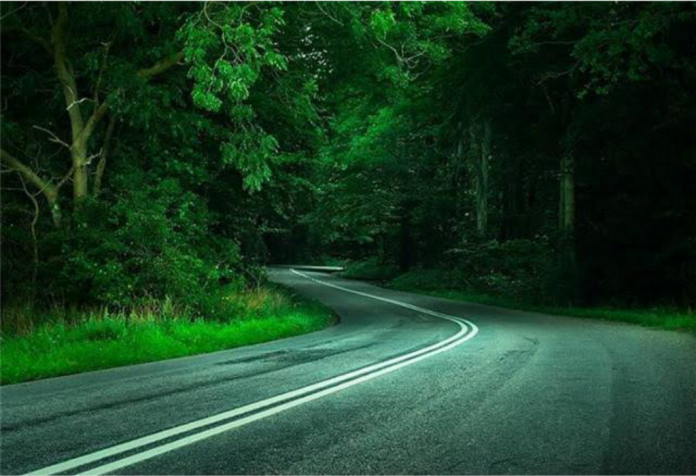
According to accounts submitted to the website, the teenagers encountered what appeared to be a woman and a child along the road. Like many roadside apparition stories, its power lies in the encounter’s brevity and the uncertainty that follows. People appear in the roadway when witnesses do not expect anyone, leaving travelers to question afterward exactly what they saw.
The story belongs to a much larger family of West Virginia tales in which apparently ordinary people encountered along a road become inexplicable only after the traveler has passed them. In folklore, such accounts overlap with the vanishing-hitchhiker tradition documented across the United States and identified by West Virginia folklorists as a variation of the unrested-spirit story.
Something waiting on 22 Mine Road
The second story is set on 22 Mine Road near Holden in Logan County, where folklore and documented history have become unusually intertwined.
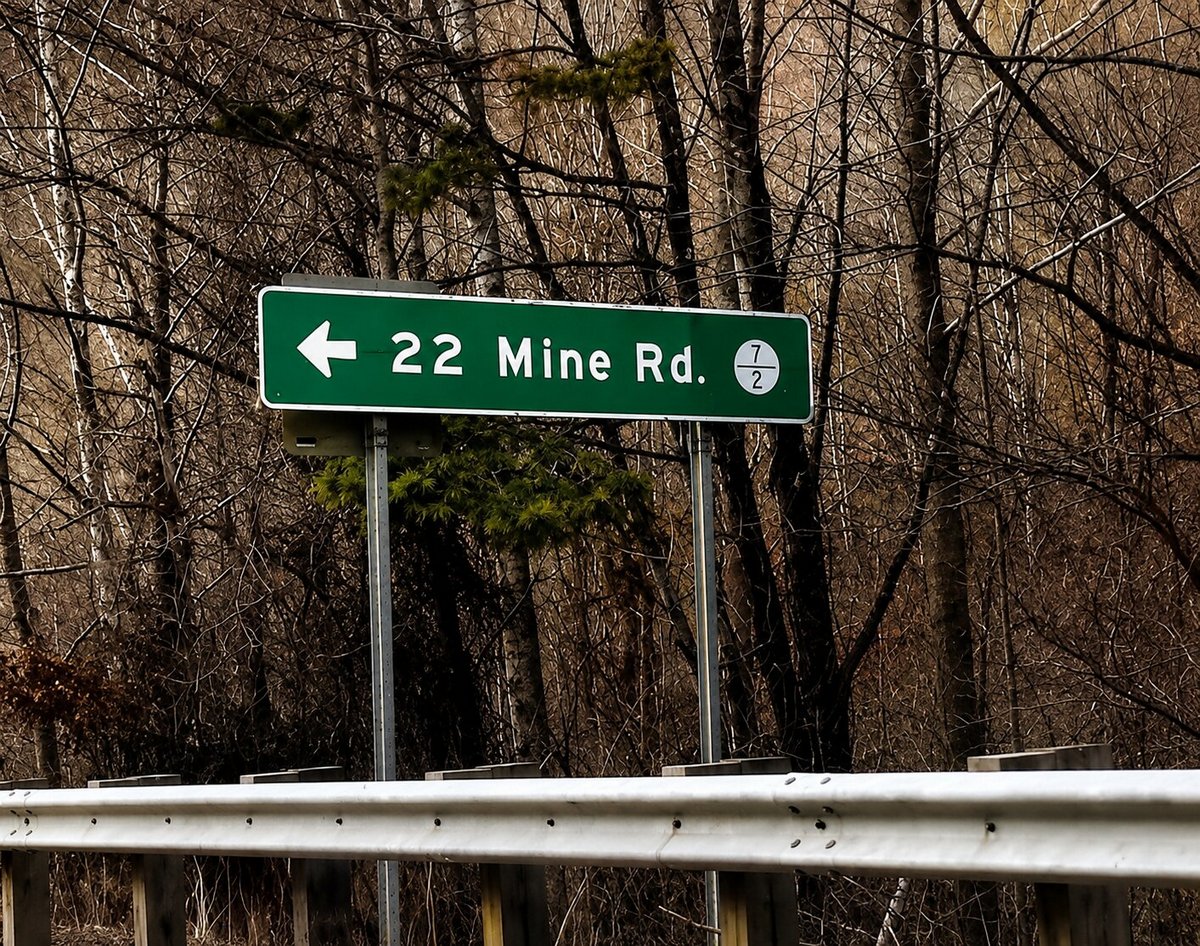
A husband and wife traveling the old mine road encountered a tall stranger dressed in clothing that seemed to belong to another era. After passing him, the driver reached an open area where the man seemed to have nowhere to go, yet he had disappeared.
The witness linked the encounter to generations of laborers who worked around the old Island Creek Coal Company mine. But 22 Mine Road has another, much better-documented ghost tradition—one connected with the 1932 murder of Mamie Thurman.
Thurman was a Logan County woman whose body was discovered on Trace Mountain on June 22, 1932. Clarence Stephenson was convicted of her murder, though questions about the case and his culpability persisted long afterward. Over succeeding decades, local folklore came to hold that Thurman herself still wanders the mountain near the place where her body was found.
That tradition became significant enough that the West Virginia Humanities Council and William G. Pomeroy Foundation recognized it through the Legends & Lore Roadside Marker Program in 2021. The marker at Verdunville recounts the tradition that Thurman’s ghost is said to roam Trace Mountain near the place where her body was found.
The Humanities Council emphasizes that its Legends & Lore program commemorates folklore as cultural heritage, whether a story is historically verifiable, fictional, or somewhere in between. In the case of Mamie Thurman, a documented murder, decades of questions surrounding the crime, and an enduring ghost tradition have become inseparable parts of the story of the mountain.
The phantom car at Cherry Creek Dip
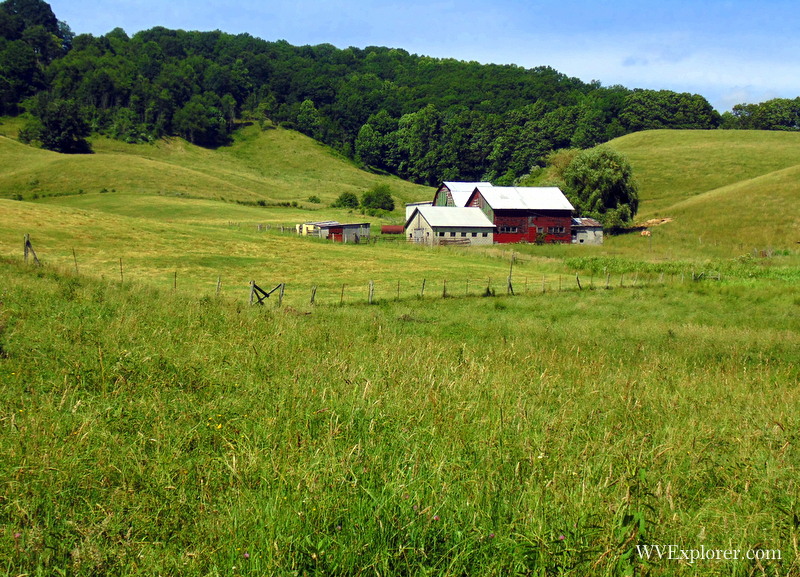
Near Shady Spring in Raleigh County, this apparition is not a person at all but a car or car headlights.
A legend long associated with Cherry Creek Dip on U.S. 19 south of Beckley. By most accounts, a young couple was killed on the highway in a head-on collision while traveling in a white Pontiac Trans Am. The legend says motorists who drive through the dip at midnight on the anniversary of the crash may see a ghostly white Trans Am pass through and disappear.
The person who submitted the story did not claim to have witnessed the phantom automobile personally; instead, she described it as a story she heard growing up and said an older brother claimed to have seen it. That distinction is important: Unlike a documented historical account, the story survives in the collection as local oral tradition.
Ghostly vehicles are a modern variation on a very old idea. Where earlier generations told of mysterious riders, wagons, or travelers appearing along isolated routes, automobile-era folklore moved those encounters onto highways. The machinery changed; the basic setting—a traveler alone on a road confronting something inexplicable—did not. Nearby on Plumley Mountain, people said they heard galloping hooves in the early 1900s.
An angry presence in Ohley Hollow
Another of the collection’s most popular stories unfolds near Cabin Creek in Kanawha County, where a newspaper deliveryman reported an unnerving encounter in Ohley Hollow during the early morning hours.
The setting follows the classic pattern of a roadside ghost account—darkness, isolation, and a person whose work required him to travel while most of the surrounding community slept. The witness described encountering an angry entity while traveling through the hollow.
Like the Hurricane Creek and Cherry Creek stories, the presence in Ohley Hollow story is best understood as a personal supernatural account preserved in West Virginia’s contemporary folklore. Such stories are not historical proof of paranormal events, but their repetition and preservation can reveal what West Virginians find mysterious and how stories become attached to landscapes.
West Virginia’s highways have produced other strange stories
The four accounts are hardly alone. Some of the state’s most remarkable roadside stories were collected along its most heavily traveled mountain highway.

Folklorist Dennis Deitz interviewed West Virginia State Police officers, highway employees, and residents about unusual experiences along the West Virginia Turnpike. Their accounts included phantom hitchhikers, unexplained lights, and an antique military ambulance that a Turnpike maintenance supervisor said appeared near railroad tracks and then vanished.
One employee who insisted he did not believe in ghosts nevertheless recalled hearing foxhounds apparently circling him in fresh snow, though he found no tracks. State troopers related other encounters from the years when the original two-lane Turnpike twisted through the mountains between Charleston and Princeton.
These stories differ from traditional legends because Deitz preserved accounts from identifiable people associated with the highway, yet they occupy the same landscape as the older folklore—a traveler, a mountain road, and an event that cannot readily be explained by the person who experienced it.
West Virginia storyteller Susanna Connelly Holstein has similarly spent years researching the history behind traditional Mountain State ghost stories, visiting locations and studying how the tales changed as they were handed down. Her work shows that a ghost story’s value need not depend on proving the existence of ghosts. Folklore can preserve memories of people, tragedies, communities and landscapes long after other details have disappeared.
The roads change, but the stories remain
Moore believes interest in West Virginia’s paranormal traditions will keep growing as more travelers discover the state and former residents maintain ties to home.
“I think we’ll see interest grow as the population of the eastern U.S. discovers us,” he said. “The interest in West Virginia overall seems to be growing. Paranormal sites such as the penitentiary at Moundsville and the asylum at Weston are only the tip of the iceberg.”
Roadside stories may be especially durable because the places where they occur remain accessible. A haunted house can be demolished. A mine can close and disappear into the forest. A community can vanish. Yet people may continue driving the same route through the same hollow for generations.
The pavement may be widened, and the automobiles may change, but after dark, a bend in a West Virginia mountain road can still look much as it did decades ago. And as long as travelers continue to pass through those dark places, the state’s old roadside stories have somewhere to live.