
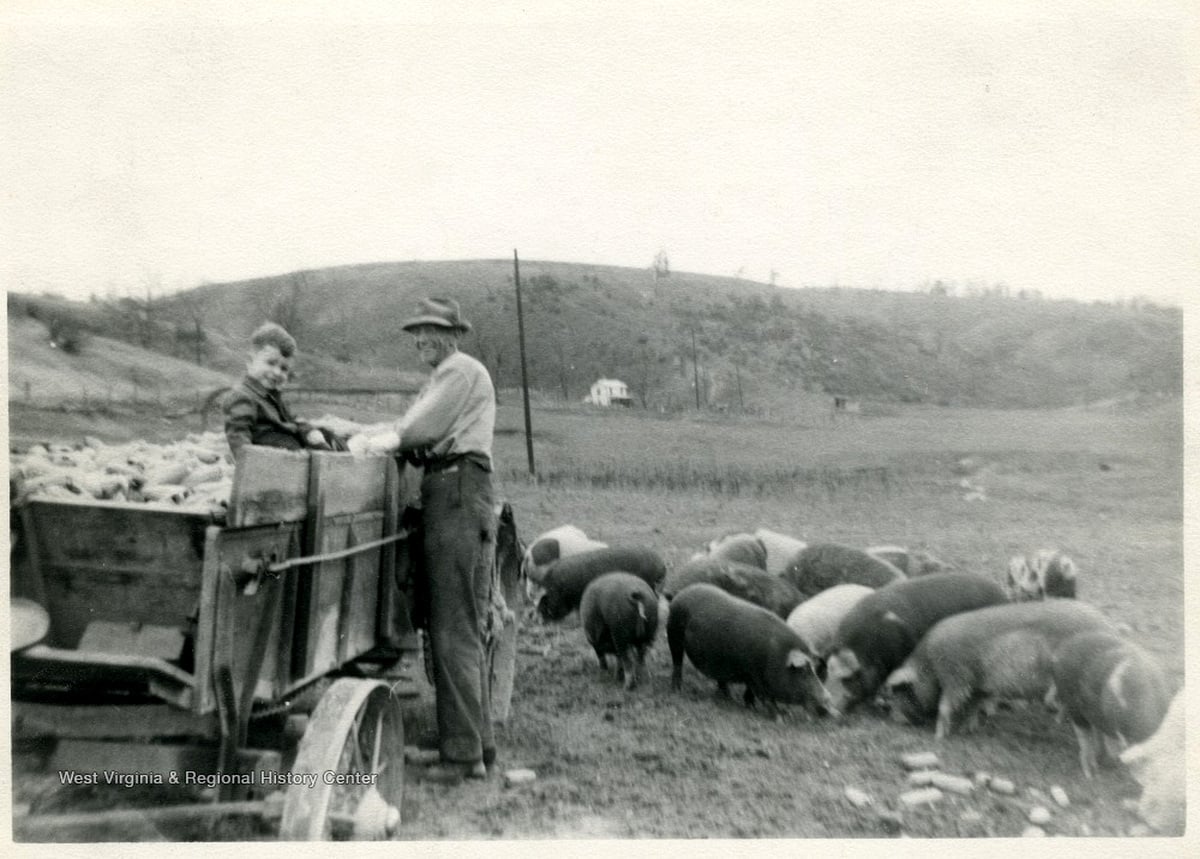
RICHWOOD, W.Va. — As temperatures fall across West Virginia in late autumn and early winter, an old Appalachian tradition comes to mind— hog killing. For generations, mountain families depended on the cold to slaughter the hogs they had raised, preserving enough pork to feed their households through the winter.
Historian and publisher Jim Comstock documented the practice in his 1974 West Virginia Heritage Encyclopedia, describing a seasonal undertaking that brought families and neighbors together for days of difficult work. Before refrigeration became commonplace, cold weather helped preserve freshly butchered meat while families prepared hams, bacon, sausage, and lard for storage.
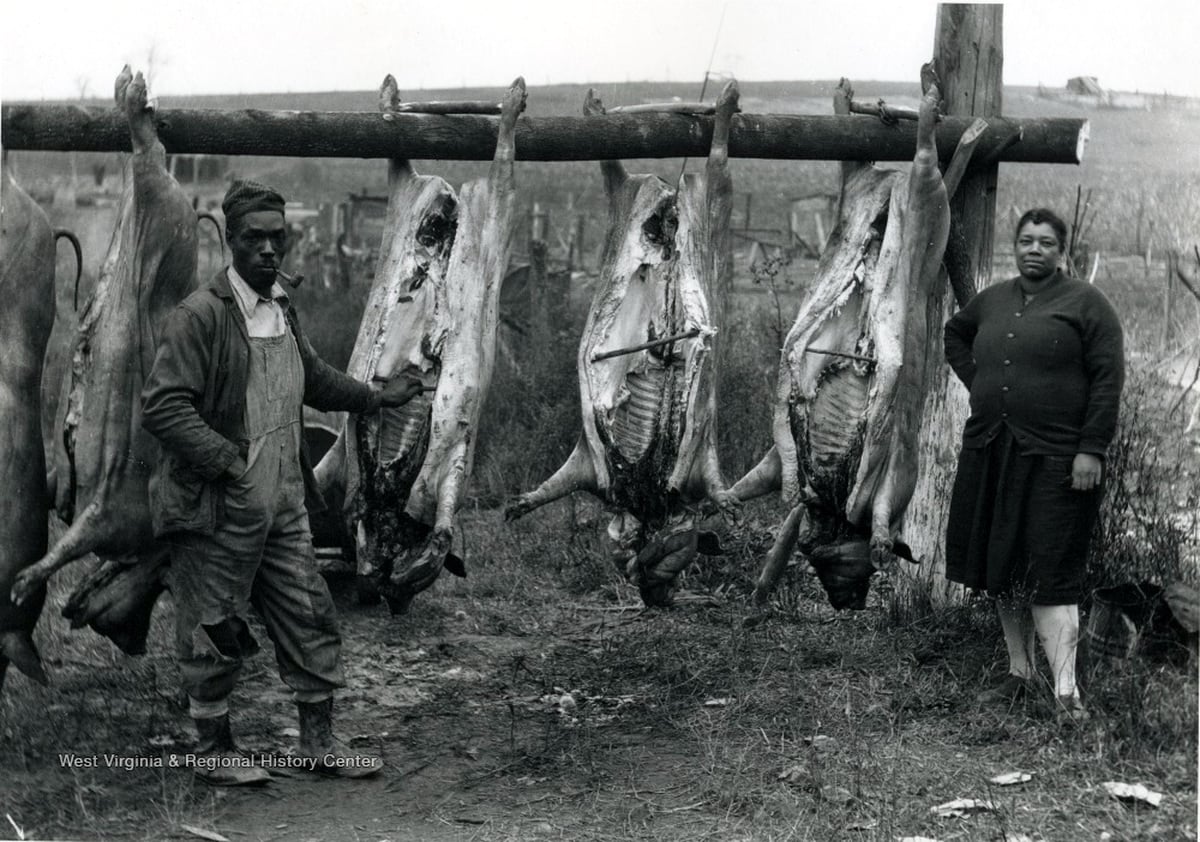
Comstock recorded the methods mountain families used to slaughter and butcher hogs, including techniques handed down through generations. He also described an intriguing belief: that hogs should be killed just before the full moon because the moon’s phase could influence how much the meat shrank and whether the lard rendered properly.
The account preserves a picture of rural life when families raised much of their own food and neighbors shared the labor of preparing it. Hog killing was an important seasonal event, often followed by a meal and an understanding that the family receiving help would return the favor when another household’s hogs were ready for slaughter.
Hog Killing
“No one knows how many people in the mountains still slaughter the hogs, which they raise for their family’s sustenance, but there are many, and the way in which the slaughtering is done has changed little over the years. In the old days, of course, hogs were not kept in pens and fed on grain. Rather, they were allowed to root at will in the woods for mast; acorns, chestnuts, and other nourishing products of the forest.
“Hogs were, and still are, usually killed in the late autumn, when the weather is cold enough to keep the meat from spoiling. A day is chosen just before the full moon, because the meat will shrink if the animal is slaughtered when the moon is waning. It is claimed that the meat will swell and the lard will not fry out if the hog is killed on the new moon, a time to be avoided at any cost.
“The first step is to heat to scalding a large quantity of water. Some farmers have large cast-iron kettles for this purpose, others use an oil drum, and still others simply heat large pots of water on the cook stove or outside over an open fire. The hot water is used to loosen the hair or bristles, and sometimes ashes are added to make a weak lye solution that seems to facilitate the process.
“The hog is killed by a blow with an axe or rock, or by shooting it in the back of the head or between the eyes with a small-caliber rifle. As soon as the animal is down, someone cuts the jugular vein with a knife and lets the hog bleed, working the hind legs if necessary to make as much blood as possible come out.
Read also: Herds of wild hog once roamed the hills and mountains of West Virginia
“When the bleeding stops, the hog is raised with a block and tackle, or by hand, and dipped into the kettle or drum of hot water. Alternately, burlap feed sacks may be placed over the carcass and the hot water poured on them. When the hog has been scalded for a few minutes, it is removed from the water, or the sacks are stripped off, and members of the family scrape the hide with dull knives or wooden scrapers. The process is repeated until most of the hair is gone. It is important not to allow the carcass to stay in the hot water too long, or the hair becomes almost impossible to get off. (There have been cases where the hair proved so stubborn that a straight razor was called for and the carcass was shaved.)
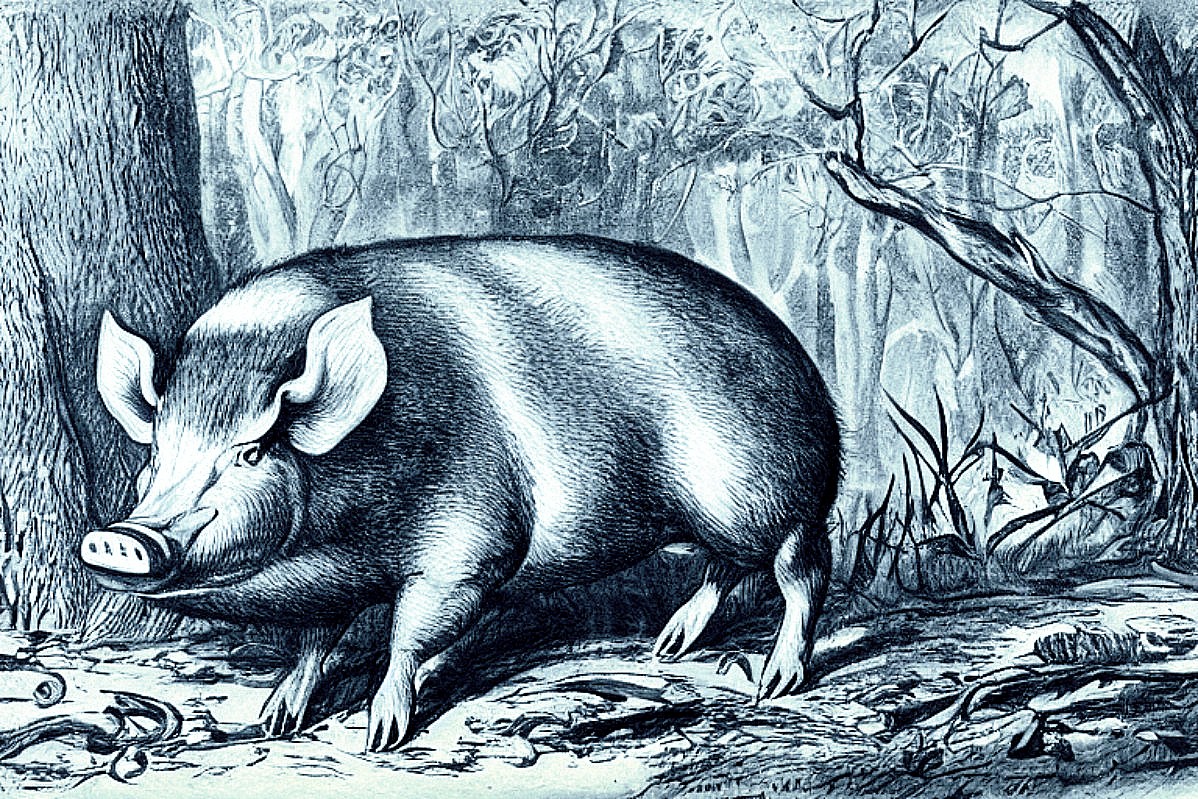
“The next step is to cut between the bone and the tendon of the lower rear legs and expose the hamstring. A stick, pointed on each end, is stuck through the holes thus created and the animal is raised, on a scaffold constructed for the purpose and left intact season after season, or on a strong pole placed in the crotches of two trees. The stick, by the way, is known as a “gamble,” or a “gamblin’ stick.”
“The head is removed by first cutting around the neck with a sharp knife to the bone, then twisting it until it comes loose. There is considerable meat on a hog’s head, and a thrifty mountain housewife can find numerous uses for it, including cured jowl, which is considered to be as much or more of a treat than country bacon.
“The animal is then gutted. First the belly cavity is opened by cutting from the crotch to the chin, then the entrails are pulled out and allowed to drop into a basin or a washtub. The liver is cut free, the gall bladder removed, and the liver set aside for some good eating later. The intestines, lungs, heart, and kidneys are also saved, demonstrating that mountain people knew about using every part of the pig “except the squeal” long before a meat packer in Chicago made it an advertising slogan.
“The leaf lard is removed from the intestines when the carcass is still hanging, and is set aside to be rendered. The carcass is then taken down and laid on a table while someone cuts along both sides of the backbone, with an axe, from one side of the carcass to the other. The spine is then lifted out, and the carcass lies spread in two pieces. The tenderloin is removed first, then the fatback, after which the ribs and the middlin’ meat are separated and removed. What is left is the joints, hams and shoulders, which are cured along with the middlin’ (see sugar cured pork).
“Hog killing was formerly something of a community affair. Farmers would gather at the home of one who had a hog to be killed and would assist in all phases of the slaughtering, including a feast of hog meat when the job was done. A few days later it would be another’s turn to have his hogs done up, and everyone would gather at his house. In this way, a back-breaking and messy job could be accomplished in good company and with a minimum of hard work. This trend is now dying rapidly in the mountains.”
Does the moon really affect the meat?
Among the traditions Jim Comstock documented was the belief that hogs should be slaughtered just before the full moon. Mountain families believed that meat butchered during a waning moon would shrink, while meat from hogs killed during a new moon would swell and produce lard that would not render properly.
Such beliefs were part of a broader tradition of consulting the moon’s phases when planting crops, harvesting vegetables, cutting timber, and performing other seasonal work. The Library of Congress stresses the importance of oral storytelling in Appalachian culture, while a historical study titled The Roman Farmer and the Moon traces agricultural beliefs about lunar phases back to antiquity.
However, no established scientific evidence shows that the moon’s phases affect pork shrinkage or lard rendering. Those outcomes depend on factors such as the animal’s fat content, the meat’s temperature, moisture loss, and processing methods.
Cold weather, by contrast, had a practical foundation. Before mechanical refrigeration, low temperatures slowed bacterial growth and gave families more time to butcher, salt, and safely preserve their pork. For mountain households, winter made hog killing both a seasonal tradition and a practical necessity.