
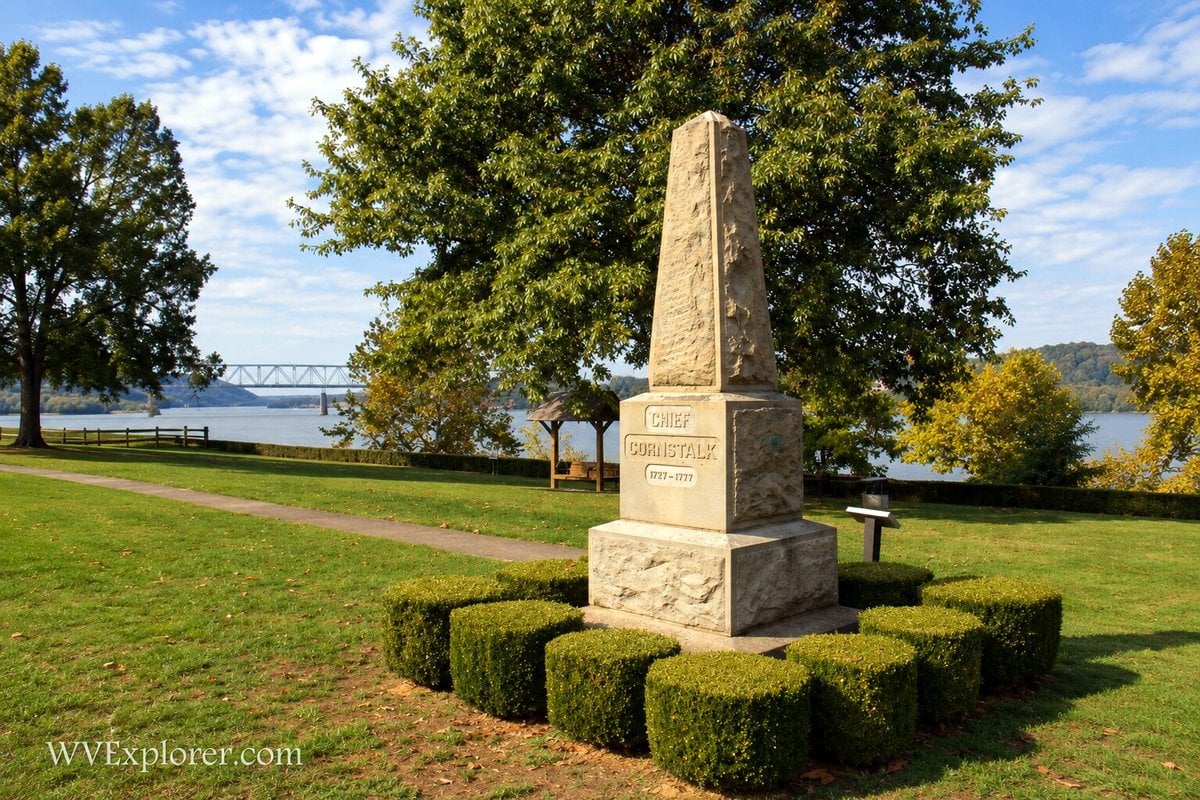
POINT PLEASANT, W.Va. — During the American Revolution, Native nations faced a difficult choice as Britain and the United States fought for control of territory that included their homelands. Some Native leaders saw an alliance with Britain as a way to resist American settlement, while others sought to keep their communities out of the fighting.
Among those advocating neutrality was Cornstalk, a Shawnee leader who traveled to an American fort in 1777 to warn that Native communities were considering joining the British. American officers detained him as a hostage, and militiamen subsequently murdered him, his son, and two other Native prisoners.
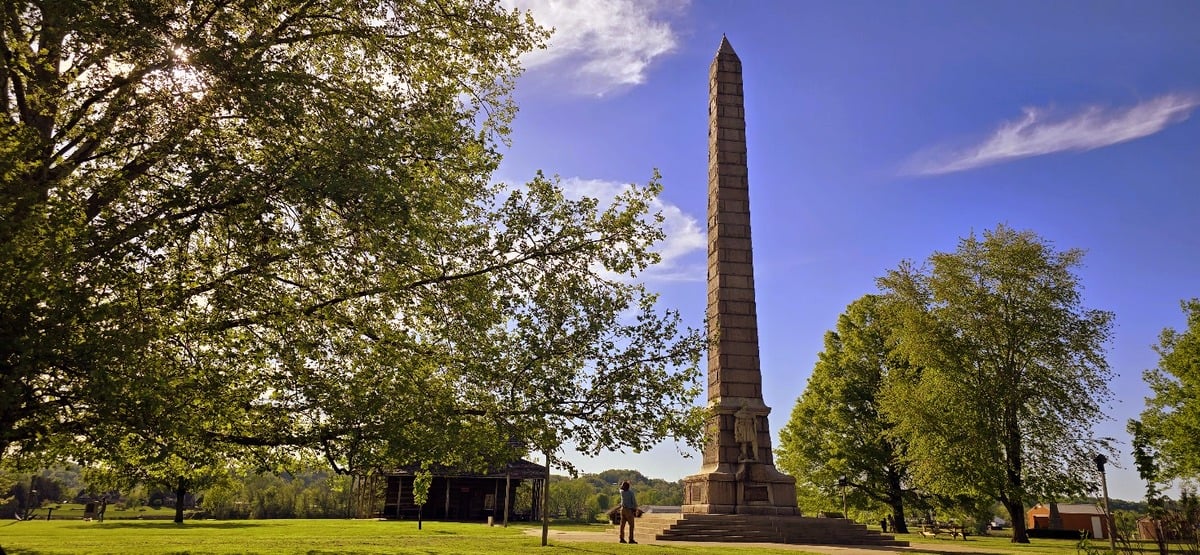
The killings occurred November 10, 1777, at Fort Randolph, in present-day Point Pleasant, West Virginia. Virginia Governor Patrick Henry later condemned the murders and offered rewards for the arrest of five suspects, but no one was convicted.
Cornstalk warned of a widening war
Cornstalk was already familiar to Virginia military officers when he arrived at Fort Randolph. Three years earlier, he had commanded Native forces against Virginia militia at the Battle of Point Pleasant, fought near the same location.
After the battle, Cornstalk negotiated peace with Virginia’s royal governor, Lord Dunmore, and continued advocating peaceful relations as the American Revolution spread into the Ohio Valley.
Captain John Stuart, a Virginia officer stationed at Fort Randolph, later recalled that Cornstalk warned American commanders that Native communities were increasingly inclined to support the British. Although he opposed entering the war, Cornstalk acknowledged that his own followers might eventually have to “run with the Stream.”
The Shawnee were not governed by a single chief with authority over every community, and Cornstalk could not guarantee that other leaders would follow his position. Some favored an alliance with Britain because they believed it offered a means of resisting American settlement.
The warning came as American officers were preparing a campaign against Shawnee towns. Brigadier General Edward Hand was expected to assemble troops at Fort Pitt and join Virginia volunteers at Point Pleasant for an expedition into Native territory, but the campaign did not proceed as planned.
Captain Matthew Arbuckle, who commanded Fort Randolph, detained Cornstalk and two companions as hostages. One of the prisoners, Red Hawk, was Delaware, or Lenape, according to the Library of Virginia’s biography of Cornstalk.
Military correspondence reproduced in Frontier Defense on the Upper Ohio, 1777–1778 documents Arbuckle’s detention of Native representatives. In a November 7 letter to Hand, he reported holding Cornstalk and two other prisoners and asked for instructions on their confinement.
Cornstalk had previously experienced imprisonment during negotiations. In November 1764, British Colonel Henry Bouquet held him and five other Native representatives hostage at Fort Pitt. Cornstalk subsequently escaped, according to the Library of Virginia.
His son arrived at Fort Randolph
Cornstalk’s son, Elinipsico, arrived at Fort Randolph while his father was being held. Stuart described their reunion in a retrospective account preserved by the West Virginia Archives and History.
Stuart recalled that Cornstalk was drawing a map of the country between the Shawnee towns and the Mississippi River with chalk on the floor when he heard his son calling from the opposite bank of the Kanawha River.
Cornstalk recognized the voice and answered. Elinipsico crossed the river, and the two “embraced each other in the most tender and affectionate Manner,” Stuart wrote. The younger man had come to learn whether his father was alive.
Stuart placed the reunion on the day before the murders. Around that time, two Virginia militiamen, Hamilton and Gilmore, were returning from hunting across the Kanawha when unidentified Native attackers opened fire. Gilmore was killed, and Hamilton escaped.
Gilmore belonged to a company commanded by Captain John Hall. Members of the company crossed the river, recovered his body and brought it toward the fort.
Stuart warned Arbuckle that the soldiers might seek revenge against the Native prisoners. Arbuckle believed the men would not attack captives who were “in no wise accessory to the murder of Gilmore,” but the soldiers demanded their deaths as they returned.
According to Stuart, Hall led the armed men toward the fort, where Arbuckle and Stuart attempted to stop them. The soldiers threatened the officers and entered the garrison.
An interpreter’s wife warned Cornstalk and his companions that the men were coming. Elinipsico denied an accusation that he had brought the attackers responsible for Gilmore’s death.
Stuart reported that Cornstalk stood to face the soldiers and was struck by several bullets. Elinipsico was shot while seated, Red Hawk was killed while attempting to escape through a chimney, and the fourth prisoner also died.
The name of the fourth victim is not established in the contemporary records examined for this article. Stuart’s detailed account of the killings was published decades after the events.
A sworn deposition taken November 10, 1777, by John Anderson, William Ward and Richard Thomas confirms that four prisoners were killed and that Arbuckle attempted unsuccessfully to protect them. The witnesses reported that armed men entered the fort and that the commander was unable to prevent the killings, although their testimony does not identify the individual shooters.
Cornstalk’s diplomacy reflected the struggle over Native lands
Cornstalk’s attempts to maintain peace followed years of conflict over the Ohio Valley, where Native communities faced increasing pressure from colonial settlement. The Shawnee occupied towns along the Scioto River in present-day Ohio, while Virginia and Pennsylvania claimed western lands that Native peoples occupied and used.
In April 1774, settlers killed several Mingo people at Yellow Creek on the Ohio River, contributing to retaliatory violence and a military campaign led by Lord Dunmore. According to the Library of Virginia, Cornstalk initially tried to restrain warriors who favored fighting, but the conflict continued.
On October 10, 1774, Cornstalk commanded a combined Native force against the Virginia militia under Colonel Andrew Lewis at the Battle of Point Pleasant. The Virginians held the battlefield after hours of fighting, and Cornstalk’s warriors withdrew.
He subsequently negotiated with Dunmore at Camp Charlotte, where the Shawnee agreed to return prisoners and property and relinquish hunting rights in Kentucky. Cornstalk also maintained that Virginians shared responsibility for the violence that had led to the war.
The agreement did not resolve the territorial disputes. When the American Revolution began, some Native leaders believed an alliance with Britain offered a better prospect of limiting American expansion, while Cornstalk continued to advocate neutrality.
The Ohio Department of Natural Resources reports that Cornstalk warned colonial officials in 1775 that Native people feared losing their entire country. His diplomatic efforts reflected the danger that another war posed to Shawnee communities.
American officials condemned the murders
The killings alarmed American commanders who feared they would undermine efforts to maintain peace with the Shawnee. In a December 2, 1777, letter to Colonel William Fleming, Virginia officer William Preston condemned the deaths as having occurred “in cold Blood.”

Brigadier General Edward Hand, who commanded American forces at Fort Pitt, also expressed concern about the consequences. In December correspondence, he warned that reconciliation with the Shawnee had become unlikely.
The Ohio Department of Natural Resources reports that Cornstalk’s death affected the Shawnee community of Calaakafi on the Scioto River. During the winter of 1777, residents relocated to the Little Miami River under Chief Blackfish amid increasing violence. The department does not attribute the move solely to Cornstalk’s murder.
Virginia Governor Patrick Henry issued a proclamation on March 27, 1778, demanding that those responsible for the killings be brought to justice. Published in the Virginia Gazette on April 3, the proclamation condemned the murder of prisoners who had been under the protection of an American garrison.
Henry declared that “a deep wound has been given to the honor and faith of this country.” He warned that the murders violated Virginia law and endangered frontier residents by provoking further violence.
The governor identified five suspects: James Hall, Hugh Galbreath, Malcolm McCown, William Roane and Adam Barnes. He offered rewards ranging from $100 to $200 for their apprehension.
Four of the accused subsequently appeared separately before the Rockbridge County Court for examination in the spring of 1778. According to the Library of Virginia, no witnesses appeared against them, and the court found all four men not guilty. The available proceedings do not establish that Barnes faced a comparable examination.
One week after his acquittal, Hall took the oath of office as a captain in Rockbridge County