
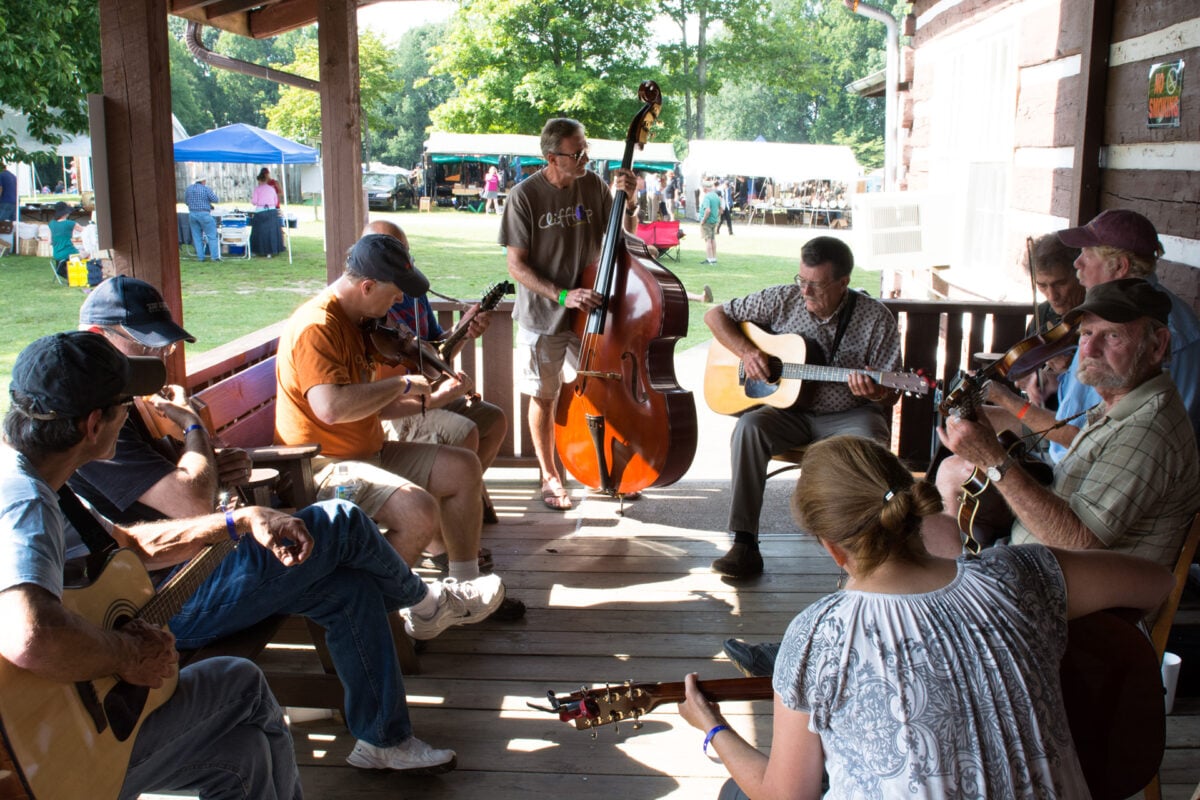
CLIFFTOP, W.Va. — Every summer, thousands of musicians carrying fiddles, banjos, guitars, mandolins, and dulcimers wind their way up a narrow mountain road in southern West Virginia. They come from nearly every corner of the United States and from countries as far away as Japan, Australia, England, Germany, and Sweden.

Few are household names, and most aren’t here to perform for an audience; they’re here to play with one another.
For five days each year, the Appalachian String Band Music Festival transforms Camp Washington-Carver near Clifftop into what many musicians call “the center of the old-time music world.”
Across the campground, jam sessions spring up beneath shade trees, inside tents, along gravel roads, and around campfires, continuing well into the early morning hours. At any given moment, dozens of circles of musicians may be playing simultaneously, inviting newcomers to pull up a chair and join in.
For visitors unfamiliar with Appalachian music, the scene can be astonishing. Unlike most music festivals, where audiences gather before a stage, nearly everyone at Clifftop is both performer and listener. The festival is less about watching concerts than about participating in a living musical tradition passed down for generations.
What is old-time music?
Old-time music is the direct ancestor of bluegrass, country music, and much of American folk music. Long before bluegrass pioneer Bill Monroe developed his signature style in the 1940s, families throughout Appalachia gathered for dances accompanied by fiddles, banjos, and simple string bands. Those traditions blended influences from the British Isles with African American banjo traditions, creating one of America’s earliest distinctly rural musical forms.
While bluegrass often features virtuosic solos and polished stage performances, old-time music emphasizes rhythm, melody, and community. Musicians play together rather than taking turns in the spotlight, creating the steady pulse that once accompanied square dances throughout the mountains.
A festival where everyone plays
That spirit explains why Clifftop has become far more than another summer music festival. Since its founding in 1990, the Appalachian String Band Music Festival has grown into one of the world’s most respected gatherings devoted to old-time music.
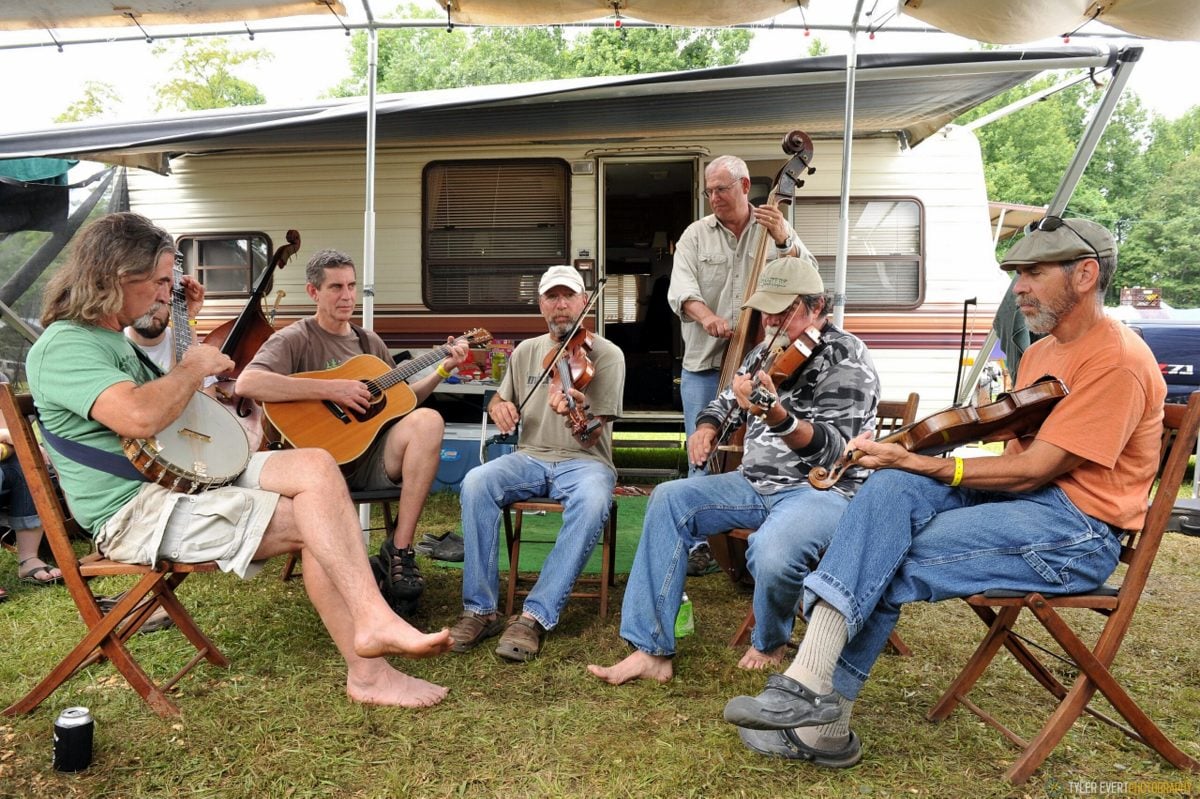
Thousands of participants now travel to Fayette County each year, many planning family vacations around the event and returning annually as if attending a reunion. Musicians often refer to it simply as “Clifftop,” a name that has become synonymous with old-time music itself.
For many, attending the festival is almost a rite of passage. Young musicians arrive hoping to learn tunes directly from legendary fiddlers they’ve admired for years. Veteran players come to reconnect with friends they’ve made over decades of attendance. Families introduce children to traditions that grandparents once passed along on front porches and in community halls.
The campground itself becomes the classroom. Rather than formal instruction, knowledge is shared organically. Someone hears a tune drifting through the trees, walks over with an instrument, and joins the circle. A melody learned from an elderly fiddler in North Carolina may soon be played by a college student from Oregon before finding its way home with musicians from Europe or Australia.
In that way, Clifftop continues one of Appalachia’s oldest traditions—teaching music by listening, watching, and playing alongside others.
Why Clifftop became a global destination
Although contests remain an important part of the festival, they are only one piece of the experience. Competitions recognize excellence in fiddle, banjo, band performance, and dance while also encouraging younger musicians to master traditional styles. The popular Neo-Traditional Band Contest celebrates groups that respectfully expand old-time music into new directions without losing its roots.
The location itself is meaningful. Camp Washington-Carver has long served as one of West Virginia’s centers for preserving Appalachian arts and culture. Holding the festival there reflects the state’s continuing commitment to safeguarding traditions that have shaped mountain communities for generations. Today, the event is presented by the West Virginia Department of Arts, Culture and History, ensuring that the music remains accessible to both longtime participants and curious newcomers.
More than preserving the past
The festival also serves as an important reminder that Appalachia continues to shape American culture in ways many people don’t realize.
Songs first played in mountain hollows eventually influenced bluegrass, country, folk, and even modern popular music. Tunes preserved by generations of Appalachian families now travel around the world, carried by musicians who first learned them at gatherings like Clifftop.
Visitors expecting a typical music festival often leave with a different understanding of both West Virginia and Appalachian culture. They discover that old-time music isn’t a museum exhibit or a historical reenactment. It’s a living tradition that continues to evolve each time musicians gather to share another tune.
Why this West Virginia tradition matters
As evening settles over the mountain, lanterns glow between the campsites and fiddles echo once again through the trees. Nearby, someone starts a familiar melody, another banjo joins in, and a circle slowly forms around the music.
For one week each summer, that quiet mountaintop in West Virginia becomes one of the few places on Earth where centuries of Appalachian musical tradition are still passed from hand to hand, bow to string, and generation to generation.
For the musicians who make the journey each year, there is no place quite like Clifftop, and that is precisely why they keep coming back.
Read also: Classic old-time music from the Smithsonian’s Folkways
David Sibray perfectly encapsulated Appalachian Music and the Clifftop experience. I was so fortunate to have been exposed to this tradition very late in life. The friends that I have made are so dear and close. We play the same tune in the same key and tempo. It is infectious and joyful. The old tunes we play are like visiting a rediscovered friend. Also, I’m so proud that I was able to share it with my great nephew who will carry on the tradition.
Good article, well-written, yes! I learned traditional music here in WV on my autoharp at Augusta Heritage Workshops back in, I think, its second year, 1976. These circle jams and the people who continue them shaped my musical ear–and heart. One missing item, when? First weekend in August? Last weekend in July. I moved back to WV two years ago after almost 50 years of absence. The mountains and the music called me back. I’ll look it up. Hopefully haven’t missed this year’s.
Pickn’ in Parsons is Aug. 4-8 at the campground.
Have fun!!!
The festival officially starts today. But thousand plus of us have been here since last week.
When what day dose it begain Clifftop?”
I have been to every Clifftop since it started in 1990, and David Sibray’s description is the best I have seen in the popular press. Well done!