
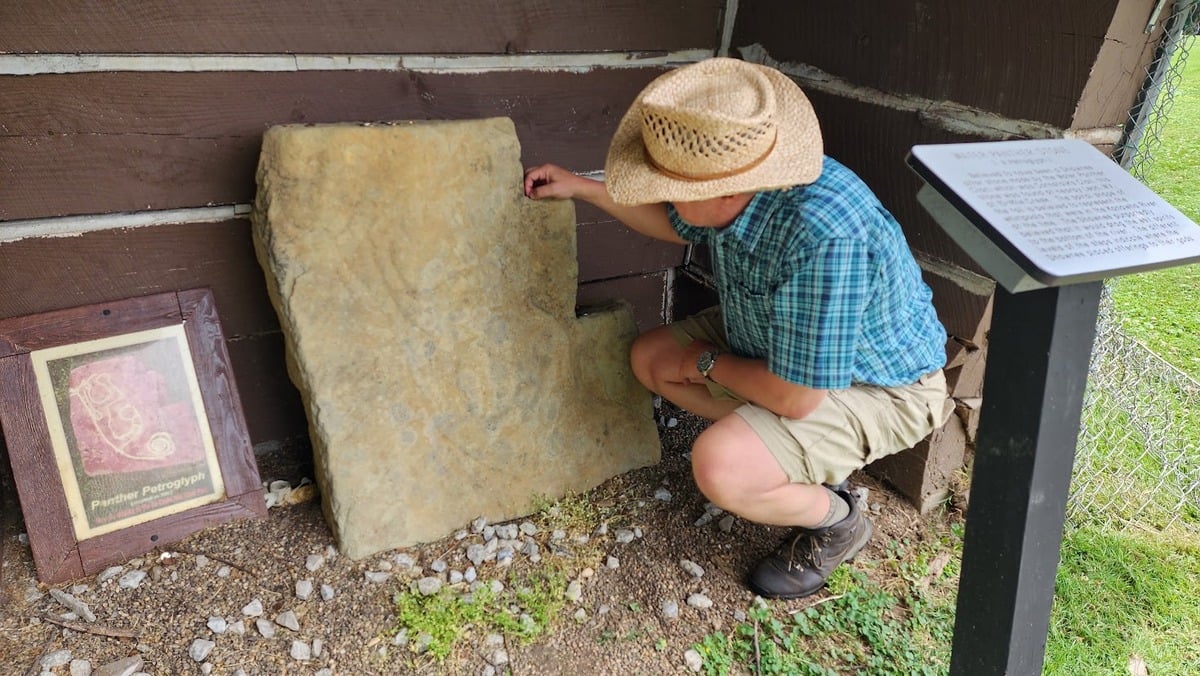
POINT PLEASANT, W.Va. — Sheltered near where the Kanawha River empties into the Ohio, one of West Virginia’s most unusual surviving pieces of prehistoric art stands.
Carved into a large stone is the outline of a four-legged creature with a long body and an enormous tail curling inward upon itself. Known today as the Panther Petroglyph or Water Panther Stone, the carving has been interpreted as an Underwater Panther, a powerful being whose imagery appears in Indigenous traditions across parts of eastern North America.
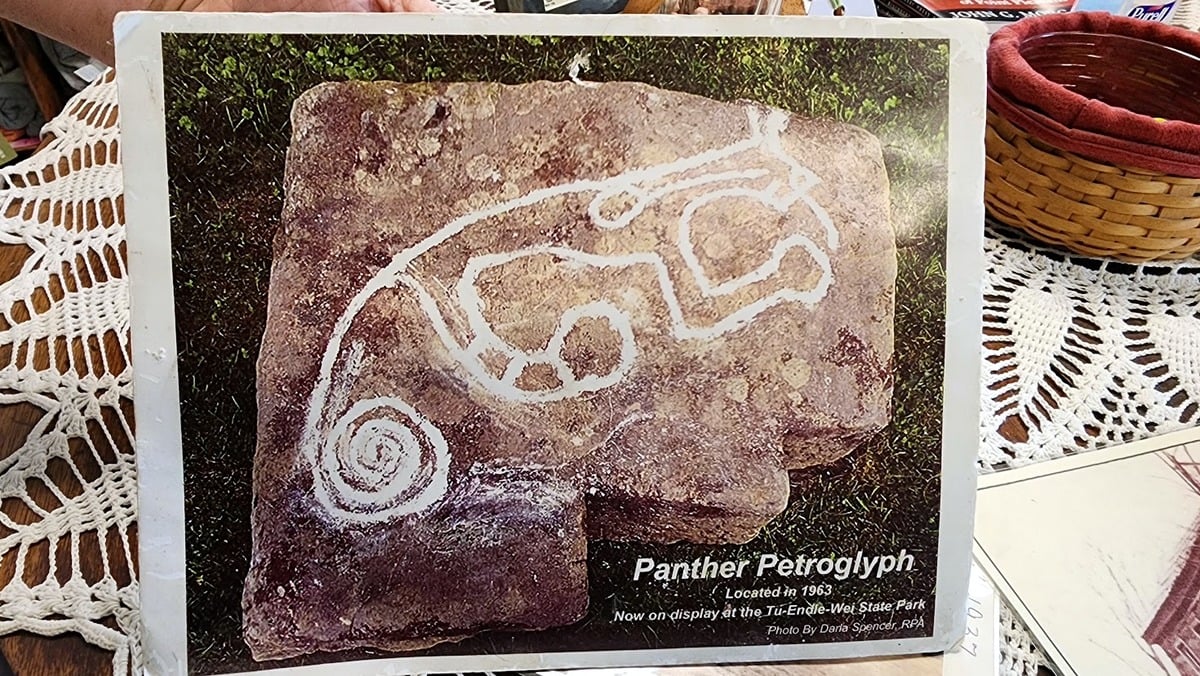
The stone was discovered near Leon in Mason County, about 13 miles up the Kanawha River from Point Pleasant, and was later moved to Tu-Endie-Wei State Park for preservation. It now stands protected beneath a shelter, only a short distance from the confluence of two of the Ohio Valley’s great rivers.
The underwater panther in West Virginia archaeology
Archaeologist Robert F. Maslowski, writing in the West Virginia Encyclopedia, reports that archaeologists have recorded 27 Indigenous petroglyph sites and two pictograph sites in West Virginia. Petroglyphs are images carved or pecked into rock, while pictographs are painted on rock.
Recurring forms at sites scattered across the state, including locations in Cabell, Hancock, Monongalia, Ohio, Wayne, Harrison and Wyoming counties, include human figures, animals, animal tracks and geometric designs.
Most of West Virginia’s known petroglyphs are believed to date to the Late Prehistoric or Protohistoric periods, approximately A.D. 1200 to 1690, according to Maslowski. However, that range should not be taken as a specific date for the Panther Stone itself.
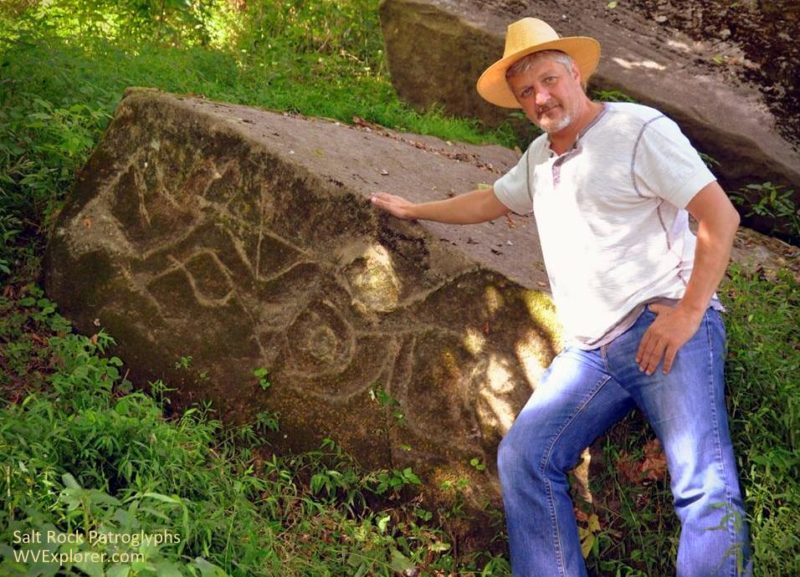
Only one known West Virginia petroglyph has been dated with greater precision. A roughly six-foot figure at Salt Rock in Cabell County, interpreted as a shaman bearing a weeping-eye mask, has been dated to approximately A.D. 1600 based on similarities between its mask and artifacts recovered from protohistoric village sites.
Professional archaeologists believe several Ohio Valley petroglyphs were carved by Algonquian peoples, Maslowski writes, and some designs appear to reflect elements of Ojibwa and other Algonquian ideology and mythology.
Among the designs he identifies are underwater panthers, thunderers, serpents, tracks, and what archaeologists describe as “power lines.” Maslowski notes that these elements appear in both West Virginia petroglyphs and Ojibwa mnemonic birch-bark scrolls.
This comparison places some of West Virginia’s prehistoric rock art within a much broader Indigenous symbolic tradition rather than treating the carvings as isolated curiosities.
A powerful creature associated with water
Often described in English as an Underwater Panther or Water Panther, the being appears in various forms and traditions among Indigenous peoples, particularly around the Great Lakes.
Known as Mishipeshu or Mishibizhiw in Ojibwa tradition, the being can combine characteristics modern observers associate with different animals. Feline features may be paired with an elongated or serpentine body, horns, scales, or an unusually long tail.
The creature was associated with the powerful and potentially dangerous world beneath the water and, in some traditions, stood in opposition to equally powerful sky beings commonly described in English as Thunderbirds or thunderers.
Care is necessary when applying those traditions directly to the West Virginia carving. Indigenous peoples maintained distinct cultures and beliefs, and similar imagery does not mean every representation had the same meaning or was created by the same people.
Maslowski’s work nevertheless provides important context for the Mason County stone: The underwater panther is a recognized element of West Virginia petroglyph imagery, with parallels in the traditions of other Algonquian peoples.
What the person who carved this particular animal intended it to mean is unknown.
A stone surrounded by traditions
An interpretive marker at the Water Panther Stone offers a more specific account.
According to the marker, the stone is believed to have been a Shawnee altar associated with a Water Panther Clan, identified there as the clan of Shawnee leader Cornstalk. It further interprets the animal’s spiral tail as representing whirlpools once found in the Kanawha River and says the stone’s stepped surfaces were used for offerings.
These assertions should be understood as the park’s interpretation rather than conclusions established by Maslowski’s broader archaeological discussion of West Virginia petroglyphs.
Even without assigning those specific meanings to the carving, its relationship to the region’s rivers is striking. The stone was found near Leon in Mason County, along the Kanawha watershed. Today it is preserved downstream at Point Pleasant, where the Kanawha meets the Ohio.
Its present location therefore places an ancient image associated in broader Indigenous traditions with the power of water beside one of the most consequential river confluences in the central Appalachian region.
An ancient image at Point Pleasant
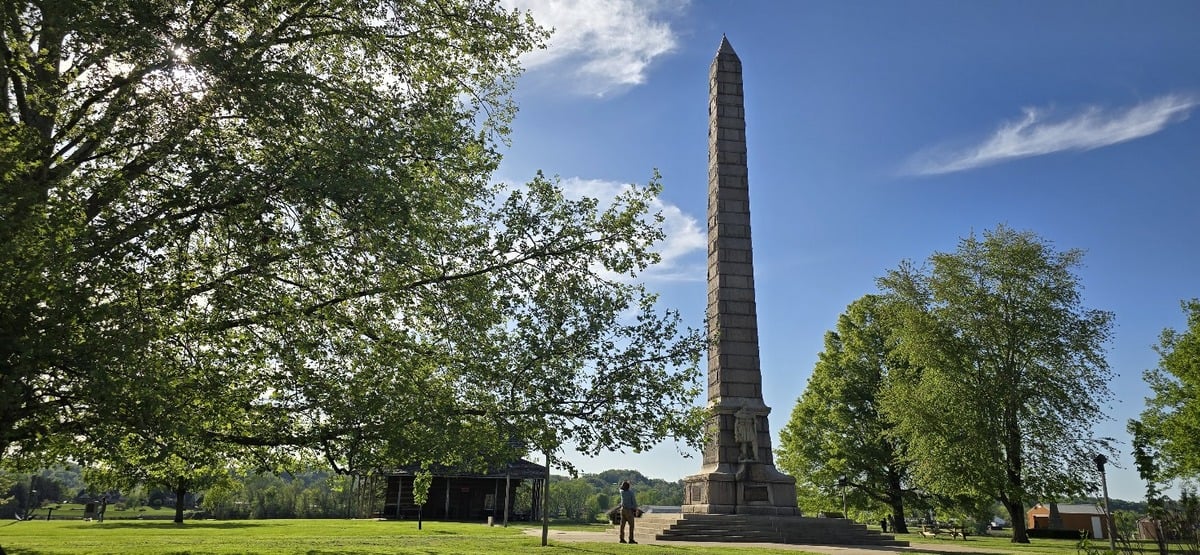
Today, the Water Panther Stone sits in a quiet corner of Tu-Endie-Wei State Park, better known as the site commemorating the 1774 Battle of Point Pleasant.

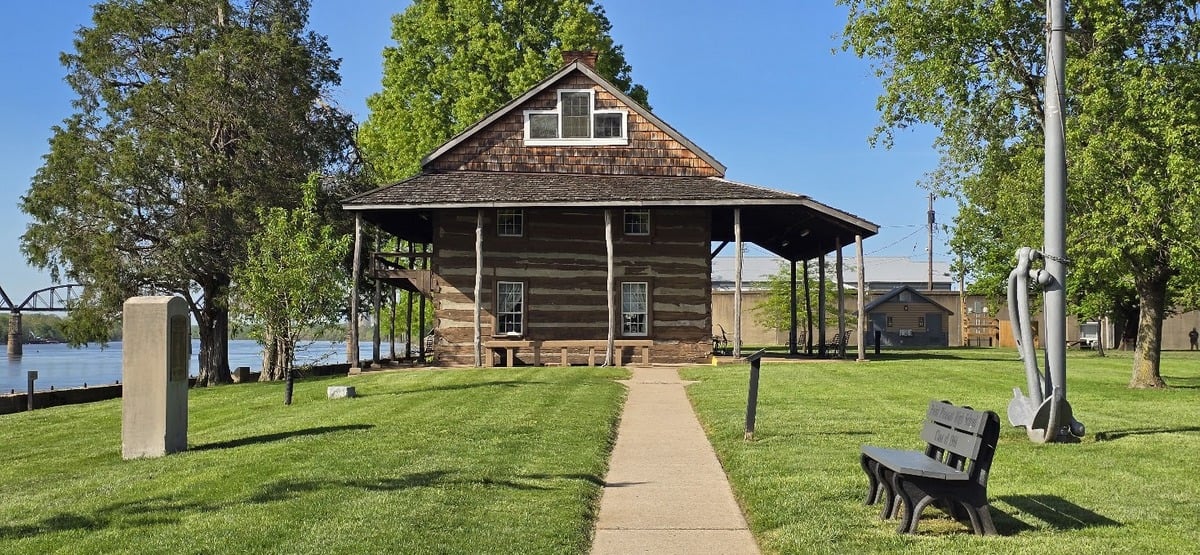
The park contains monuments associated with the battle, Cornstalk, and the colonial history of the Ohio Valley, and West Virginia State Parks lists the Water Panther Stone among the historical features visitors can see there.
But the carving reaches into a much older chapter of the region’s history.
Long before Point Pleasant became a town, before European settlement transformed the Ohio Valley, and before West Virginia existed, Indigenous people were leaving images on stone throughout the region.
The precise age, creator, and intended meaning of the Mason County carving remain uncertain. What survives is the image itself: a strange, elongated animal belonging to a class of imagery archaeologists recognize in West Virginia’s prehistoric rock art.
Centuries later, the underwater panther still curls its enormous tail across a piece of West Virginia stone.
I am writing about the history of Elk in West Virginia. I lived on the Ralph Cogar farm at the head of one of the forks of the Holly River in Webster County from 1980 to 1990. Ralph was my aunts husband.
According to West Virginia history the last Elk in West Virginia was shot on this farm and later tracked to somewhere I believe to be across the Backfork of the Elk River the farm is extremely close to the old Town of Skelt West Virginia. Ralph once showed me an old black and white picture of Skelt. It was located at the forks of Big Sugar Creek and the Backfork of Elk. The picture showed a train, post office and homes.
I implore you to research this information. I have a beautiful picture of the waterfall at this location if you are interested.
Thanks, Dana! We’d be interested in that.
Panther for my grandfather was, black panther, once one his were. Tucker County by my his …