
MORGANTOWN, W.Va. — West Virginia University is preparing engineering students for careers in the nuclear industry as state and federal officials explore a potentially much larger role for West Virginia in the nation’s nuclear fuel cycle, including power generation and manufacturing.
Earlier state documents also proposed nuclear-fuel recycling and interim storage of used nuclear fuel, although Gov. Patrick Morrisey said Sunday that West Virginia would not accept a nuclear-waste disposal role.

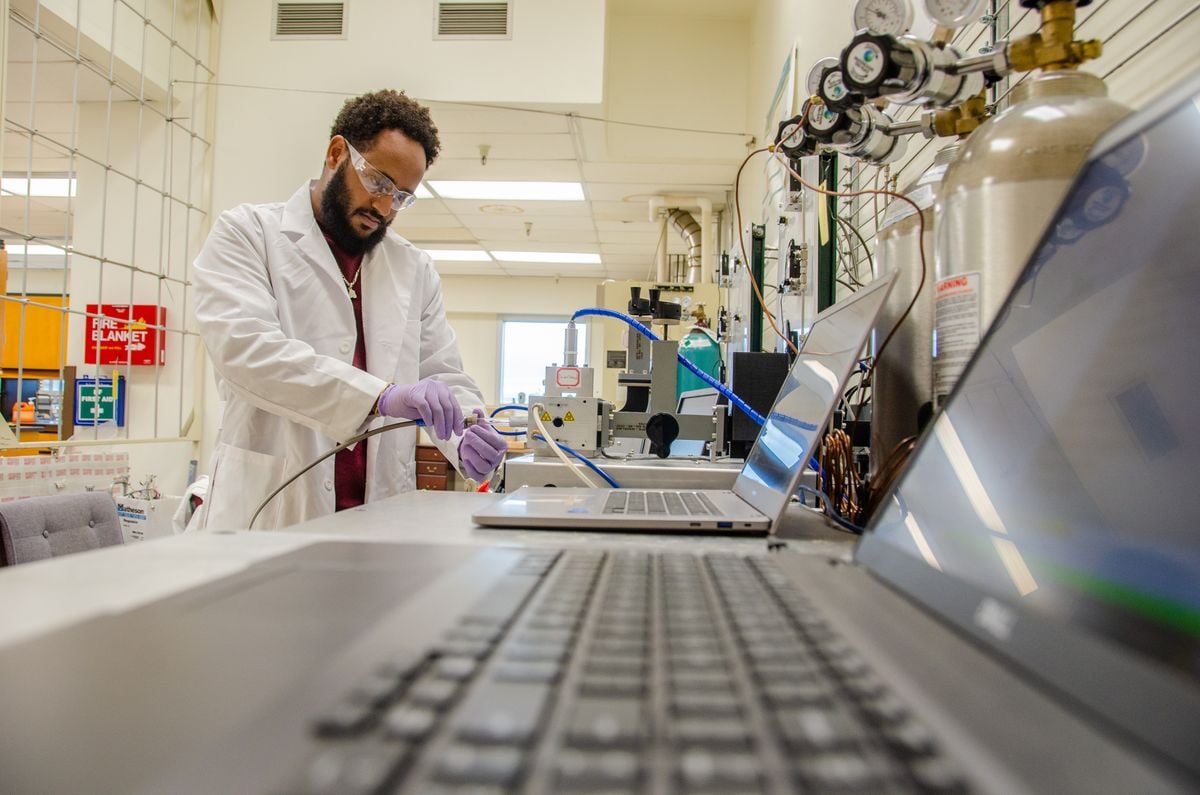
Beginning in 2027, the university’s Benjamin M. Statler College of Engineering and Mineral Resources in Morgantown plans to introduce courses establishing a nuclear engineering career pathway for eligible students across engineering disciplines.
The university says the program is intended to prepare students for work in nuclear energy, power generation, advanced reactor technologies, nuclear materials, nuclear medicine, energy systems and safety.
“Nuclear energy is poised to play an increasingly important role in meeting the nation’s energy needs, and we are determined to prepare students as essential contributors to this important field,” said Pedro Mago, dean of the Statler College.
The announcement follows West Virginia’s inclusion this month in the U.S. Department of Energy’s Nuclear Lifecycle Innovation Campuses initiative, an effort far broader than building nuclear power plants. DOE says the program is intended to address the nation’s full nuclear fuel cycle, which can include uranium enrichment, fuel fabrication, reprocessing of used nuclear fuel and waste disposition, as well as advanced reactors and manufacturing.
State proposed broader nuclear role
Documents obtained through a Freedom of Information Act request and reported Sunday by the Charleston Gazette-Mail provide additional details about what West Virginia previously proposed to the energy department.
In its response to the federal government, the W.Va. Office of Energy said the state proposed serving as the nation’s “central hub for nuclear fuel recycling, interim storage, and long-term materials stewardship.”

The submission ranked a consolidated interim storage facility for used nuclear fuel as its highest-priority potential function. Other proposed activities included research related to permanent disposal and long-term storage in boreholes, advanced reactor deployment, and nuclear-fuel recycling.
A consolidated interim storage facility is not a permanent nuclear-waste repository. It is a centralized facility where used nuclear fuel from operating or decommissioned reactors could be stored until another destination becomes available.
This distinction matters because the United States does not currently operate a permanent repository for commercial spent nuclear fuel. The Government Accountability Office has repeatedly identified the absence of permanent disposal as an unresolved federal policy problem.
According to the Nuclear Regulatory Commission, spent fuel can remain safely stored at reactor sites or independent storage facilities in approved systems. The commission regulates the storage and transportation of that material.
West Virginia has not been selected to operate a spent-fuel storage facility, and participation in the DOE campus initiative does not by itself authorize one.
Morrisey rejects waste-disposal role
After the state published its earlier submission, Morrisey said Sunday that West Virginia would not become a nuclear-waste dumping ground.
“West Virginia will not be a dumping ground for nuclear waste. Period,” Morrissey said.

The governor said he had directed the W.Va. Office of Energy to ensure that locations in West Virginia’s final application be considered only for nuclear generation or manufacturing.
“We are pursuing nuclear generation and manufacturing to bring high-paying jobs to West Virginia,” Morrisey said. “Nuclear waste dumps are not.”
The Office of Energy’s earlier submission and Morrisey’s statement describe different potential functions for a West Virginia nuclear campus. Additional information will be needed to determine which activities the state ultimately proposes in subsequent negotiations with DOE.
Nuclear development could extend beyond power plants
West Virginia became the sixth state to join the nuclear campuses initiative, along with Idaho, Louisiana, Oklahoma, Tennessee and Utah.
The department describes the program as an attempt to establish an integrated domestic nuclear fuel cycle while encouraging manufacturing and economic development around nuclear facilities.
The federal government says a fully developed campus could involve investment measured in tens of billions of dollars and thousands of jobs. Those figures are projections for the federal campus concept, however, and are not commitments of investment or employment in West Virginia.
Any individual project also would be subject to applicable federal licensing, environmental review, and other regulatory requirements.
The state’s earlier submission contemplated activities beyond generating electricity. Nuclear-fuel recycling and consolidated interim storage, for example, would involve receiving nuclear material produced elsewhere.
Transportation of spent nuclear fuel is regulated by the NRC and U.S. Department of Transportation. The NRC says spent fuel is transported in heavily shielded containers designed and tested to withstand severe accident conditions and that commercial shipments have occurred in the United States for decades.
If West Virginia were eventually selected for an interim storage or recycling facility, transportation routes, emergency planning, security and regulatory responsibilities would therefore become part of the development process. No such facility has been approved for West Virginia.
WVU prepares students for nuclear careers
The university’s new academic pathway is broader than any proposal state officials are currently considering.
The Statler College plans to introduce Fundamentals of Nuclear Engineering, covering basic nuclear principles, technologies, and applications, and Power Plant Systems Analysis, which will examine systems and engineering principles associated with nuclear power generation.
A new Materials and Methods in Nuclear Medicine course will introduce students to materials, technologies, and engineering applications associated with nuclear medicine. Additional courses are expected as the program develops.
The university is not announcing a separate nuclear engineering degree. Instead, the university intends to make nuclear-focused coursework available to qualifying students pursuing existing engineering disciplines.
“Our goal is not simply to create another degree program, but to provide students across all engineering disciplines with opportunities to expand their expertise and develop the specialized knowledge to meet the growing demand needed in the nuclear industry,” Mago said.
Xingbo Liu, professor in the Department of Mechanical, Materials and Aerospace Engineering and the Statler College’s associate dean for research, said participation in the federal initiative could create connections between WVU, national laboratories, federal agencies and nuclear companies.
“For our students, those connections could open pathways to federal research opportunities, industry co-ops, sponsored projects, and other hands-on experiences that connect their engineering education with emerging needs in the nuclear sector,” Liu said.
West Virginia has confronted similar economic questions before
The technologies involved in nuclear development differ substantially from the extractive industries that dominated West Virginia’s earlier economic history. The state’s experience with energy development nevertheless provides historical context for questions about ownership, employment, taxation, environmental responsibility and the distribution of economic benefits.
For generations, West Virginia supplied coal, timber, oil and natural gas to markets elsewhere in the United States. Scholars have examined why extracting valuable natural resources did not consistently translate into comparable long-term prosperity in the communities where those resources originated.
WVU College of Law professor Alison Peck has examined West Virginia through the economic concept known as the “resource curse.” Her research describes how large quantities of coal, oil, and gas wealth left West Virginia during the late 19th and early 20th centuries while weaknesses in the state’s taxation system limited its ability to capture some of that wealth.
University law professor Patrick McGinley has separately written about the environmental and economic consequences of coal development in southern West Virginia, including the relationship between high levels of energy production, declining employment as mining became more mechanized, environmental impacts, and persistent economic distress in some coalfield communities.
Those histories do not establish the economic or environmental consequences of nuclear development. Nuclear engineering, reactor development, manufacturing, fuel processing, and nuclear-waste management are different industries governed by different technologies and regulatory systems.
They do provide context for questions West Virginia policymakers and communities could confront if large-scale nuclear development proceeds: who owns the facilities, how many jobs are created and filled locally, what taxes and other revenues are generated, what public investment is required, and which entities retain financial and environmental responsibilities over the life of a project.
Those questions would become particularly long-term if spent nuclear fuel were involved because the federal government has not established a permanent operating repository for commercial spent fuel.
State cited its energy history in federal application
West Virginia’s own submission to the energy department referred to the state’s long history with energy and heavy industry.
According to the documents reported by the Gazette-Mail, the office of energy told federal officials that West Virginia’s “long-standing history of energy production and heavy industry” had created a workforce and population familiar with large energy projects.
The application cited that history while discussing the state’s ability to develop a nuclear campus. The statement does not establish how residents of any potential host community would view a particular project, and no community has yet voted on or formally accepted a Nuclear Lifecycle Innovation Campus.
That distinction could become important once specific projects and locations are proposed because public attitudes toward a nuclear power plant, manufacturing facility, fuel-recycling operation and spent-fuel storage facility may differ.
What happens next
West Virginia’s agreement with DOE does not authorize construction of a nuclear facility. The memorandum establishes a framework for further discussions, while subsequent agreements, licensing and regulatory processes would be required before individual facilities could proceed.
The precise activities West Virginia will pursue also remain unsettled publicly. The state office of energy’s earlier federal submission included interim storage and nuclear-fuel recycling among its proposed functions, while Morrisey said Sunday that the state’s final application should consider locations only for generation and manufacturing.
WVU, meanwhile, plans to begin offering its first nuclear-focused engineering courses in 2027. The university says the coursework is intended to prepare students for employment across the nuclear sector rather than for any single proposed West Virginia facility.
As the federal initiative moves forward, the distinction between the different parts of the nuclear industry will be central to understanding what is being proposed. A reactor generating electricity, a plant manufacturing reactor components, a facility recycling nuclear fuel, and a site storing used nuclear fuel involve different economic opportunities, regulatory requirements, and long-term responsibilities.
There’s too many other ways to produce safe energy . West Virginia has been destroyed by the Timber Industry in the late 1800s and most of our rivers polluted with mine drainage and Idustrial waste. With our tax money fortunately most have been cleaned up . We do not need to be the dumping ground for Nuclear waste or the Data centers that will probably be using the Nuclear energy anyway . Please wake up West Virginia!!!
I agree with the 1st post. Also, I thought WVU was working on Soler Power…hmm? Seems a state that’s been attacked by the government at Blair Mountain, deforested, polluted and basically looted every 2-4 yrs by politicians can hardly guarantee no dumpster sites. We’ve been lied to by outside interest groups before but it hurts most when it’s our own who lie to us and sell us out…Blue Dog Manchin, Justice, Morrissey, Miller, Capito…and on and on.
Bring all our nation’s nuclear waste here. We could store it on our mountain top removal sites. Perhaps this would finally make us worthless & drive out the current tourism industry which has raped our state along with the Federal Government which has taken our rivers & forests making it impossible for us to live our lives in the freedom we once had to fish & hunt & travel our hill & valleys.