
BUCKHANNON, W.Va. — West Virginia’s six independent colleges and universities generate an estimated $391.9 million in annual economic activity and support more than 3,000 jobs, according to a new study highlighting the economic importance of higher education to some of the state’s smaller communities.
“West Virginia’s independent colleges are much more than places where students earn degrees,” said Ben Beakes, executive director of West Virginia Independent Colleges & Universities, which commissioned the report. “They are employers, purchasers, builders, workforce developers and community anchors.”
The findings are especially relevant to communities such as Elkins, Bethany, and Buckhannon, where colleges have operated for generations. Their economic contributions extend to businesses that supply campus operations and serve students, employees, and visitors.
The six institutions directly employ 1,427 people, and their spending supports an estimated 1,586 additional jobs statewide. Together, they generate $147.4 million in labor earnings and $251 million in value added to the economy, according to the association.
The study examines Appalachian Bible College near Beckley, Bethany College in Bethany, Davis & Elkins College in Elkins, the University of Charleston in Charleston, West Virginia Wesleyan College in Buckhannon, and Wheeling University in Wheeling.
College spending reaches businesses beyond campus
Davis & Elkins College provides one of the clearest examples of how institutional spending extends into the surrounding economy.
The college generates an estimated $63.8 million in annual statewide economic activity and supports approximately 530 jobs, according to its findings released October 8.
Institutional operations account for the largest share, generating an estimated $33.9 million in economic output and supporting 321 jobs.

Student spending contributes another $11.5 million in estimated economic output, based on $7.1 million in direct expenditures. Spending by visitors attending college events generates an estimated $1.9 million in output, including $1.2 million in direct expenditures.
Together, student and visitor spending supports an estimated 116 jobs statewide.
Capital improvements and other facility expenditures contribute another $16.5 million in estimated output and support 93 jobs.
The findings help explain how a college can influence business activity outside its campus. Students and visitors purchase goods and services, while construction and institutional operations create demand for workers, contractors, and suppliers.
The study does not determine how much of that activity occurs specifically in downtown Elkins or Randolph County. Its estimates measure statewide effects, including spending that circulates through businesses elsewhere in West Virginia.
Wesleyan contributes $75.5 million annually
West Virginia Wesleyan College in Buckhannon generates an estimated $75.5 million in annual statewide economic output, ranking second among the six institutions studied.
The college’s operations and associated spending support about 605 jobs statewide. Its estimated economic output includes $47.3 million in direct activity, with the remainder generated through supplier purchases and household spending.
“West Virginia Wesleyan College believes that being part of a community means contributing to its success,” said college President James Moore. “For more than 130 years, our impact has extended beyond the classroom and campus, from creating and supporting jobs to driving economic activity and preparing graduates to strengthen our workforce.”
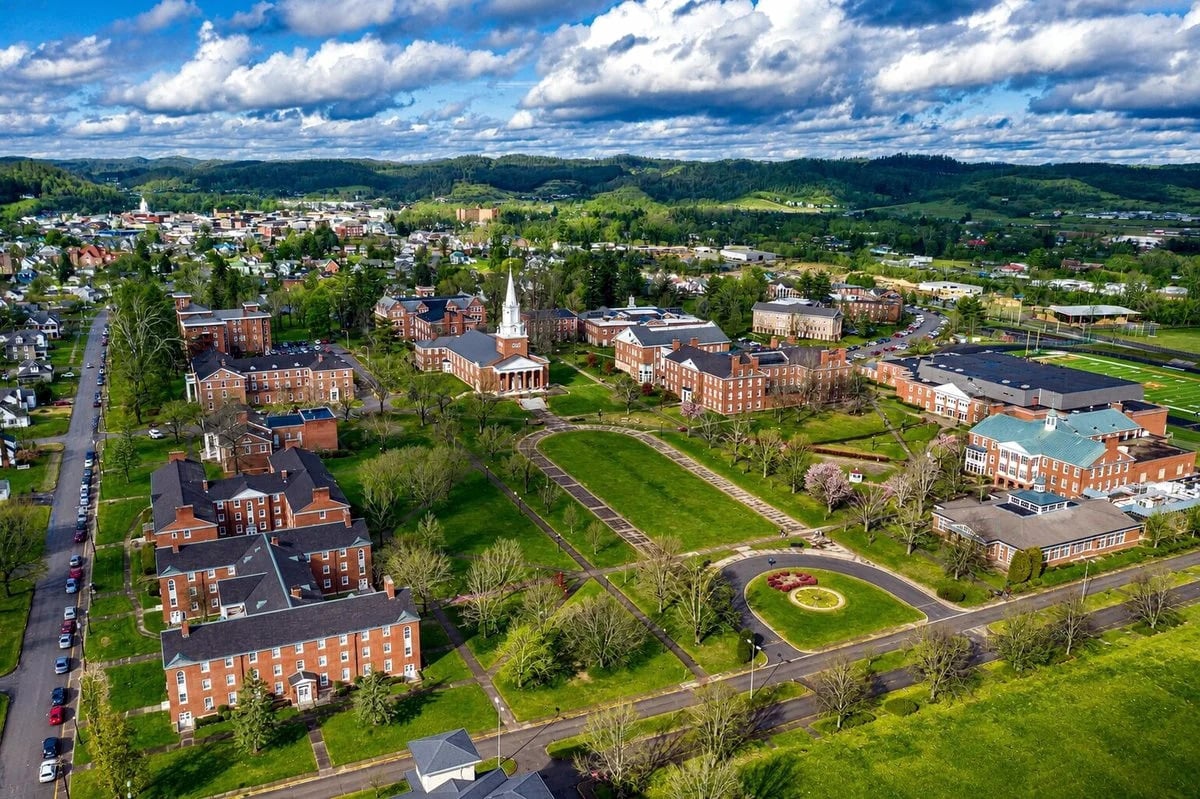
Founded in 1890, Wesleyan has been part of Buckhannon’s economy for more than a century. Its operations create demand for goods and services, while students and campus visitors contribute to spending at businesses beyond the college.
Moore said the institution takes pride in its role as an economic contributor and community partner in Buckhannon, Upshur County, and the surrounding region.
The college also reported that all its 2026 nursing graduates had found employment in West Virginia, a workforce contribution not separately valued in the economic output estimate.
University of Charleston leads in economic impact
The University of Charleston accounts for the largest estimated contribution among the six institutions, generating $118 million in annual statewide economic output.
The university’s operations, capital investments, and associated spending support an estimated 1,024 jobs and generate $44.7 million in labor earnings.
The university maintains operations in Charleston and Beckley, extending its economic activity beyond the capital city.
Collectively, the six independent institutions reported approximately $72.1 million in annual payroll, $150.2 million in operating budgets, and $37.6 million in capital improvements.
They enrolled 6,458 students in fall 2025 and awarded approximately 1,850 degrees during the 2024–25 academic year.
The association also reports that 22,941 alumni of its member institutions currently live in West Virginia.
How the economic estimates were calculated
The study used financial and operational data from the colleges for 2025–26 and the Regional Input-Output Modeling System (RIMS II), developed by the U.S. Bureau of Economic Analysis.
The model estimates how institutional expenditures generate additional economic activity through supplier purchases and employment- and earnings-linked spending.
Of the estimated $391.9 million in annual statewide output, about $244.6 million is direct activity. Another $55.8 million is indirect activity involving suppliers, and $91.5 million is induced spending associated with household income.
Economic output is not the same as revenue, profit, or tax collections. Nor does the statewide figure indicate how much money is spent in the towns where the colleges operate.
The estimates also do not show how much economic activity would disappear if an institution closed. Some expenditures could shift to other businesses or institutions.
An earlier study of the association’s member colleges estimated a $233.4 million statewide economic impact for 2021–22. However, that study used a different economic modeling system, IMPLAN, and the two totals should not be interpreted as directly comparable measures of growth.
The new findings nevertheless document the scale of economic activity associated with independent higher education in West Virginia, including employment, construction, institutional purchasing, and spending by students and visitors.
For communities such as Elkins and Buckhannon, the figures identify a significant source of economic activity, although a more localized analysis would be necessary to determine how much of that spending benefits their downtown business districts.