
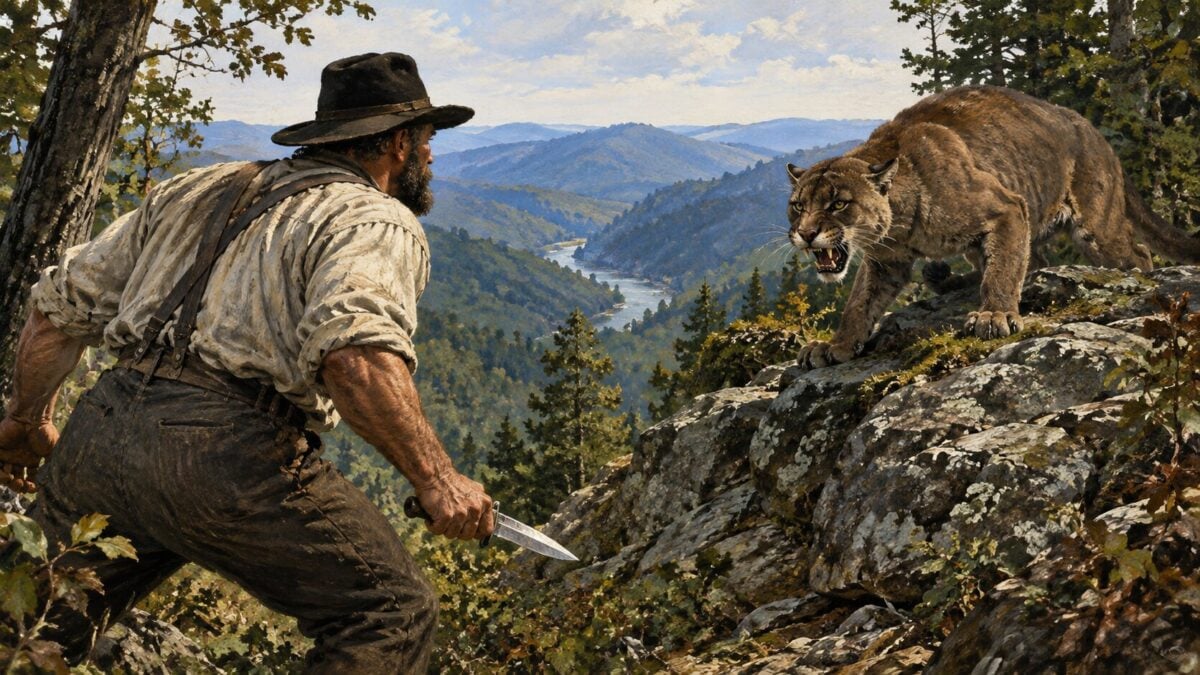
RED JACKET, W.Va. — Long before William Anderson “Devil Anse” Hatfield became one of the most famous figures in Appalachian history, another Hatfield was remembered as a mountain giant along the Tug Fork. His name was Ephraim Hatfield, though generations knew him better as “Big Eaf.”

He was the father of Devil Anse and several family members who would become associated with the Hatfield-McCoy feud, but Ephraim belonged to an earlier world, when the Hatfields were establishing farms and families along the narrow valleys of what was then southwestern Virginia. By the time the feud made the family nationally famous, Big Eaf was already dead, and his son, who became a legend, would eventually overshadow him.
The man remembered as Big Eaf
Ephraim Hatfield was born in 1812, a son of Valentine “Wall” Hatfield. He settled on Mate Creek, a tributary of the Tug Fork in what is now Mingo County, West Virginia, and raised a large family with his wife, Nancy Vance Hatfield. In a report on Hatfield cemeteries, the W.Va. Culture Center notes that ten of their children survived to adulthood, including Elias Hatfield, Ellison Hatfield, and William Anderson “Devil Anse” Hatfield.
Later accounts transformed Ephraim into a physically extraordinary figure. He became known as “Big Eaf,” and some histories have described him as standing more than seven feet tall and weighing more than 300 pounds. Those measurements should be treated cautiously, however, because the surviving accounts are not consistent enough to establish his extraordinary height as fact.
The uncertainty is itself revealing. The Hatfields became subjects of folklore while family members were still within living memory, making it difficult in some cases to determine where documentary history ends and family tradition begins. With Big Eaf, unusual size and physical strength became central to the way later generations remembered him.
The ‘Panther Killer’
Size was not the only extraordinary characteristic attributed to Ephraim. A history published during Logan County’s centennial in 1952 described him as a powerful hunter who killed a panther with a hunting knife on a rocky hilltop near what is now Red Jacket. The account calls him “Panther Killer.”
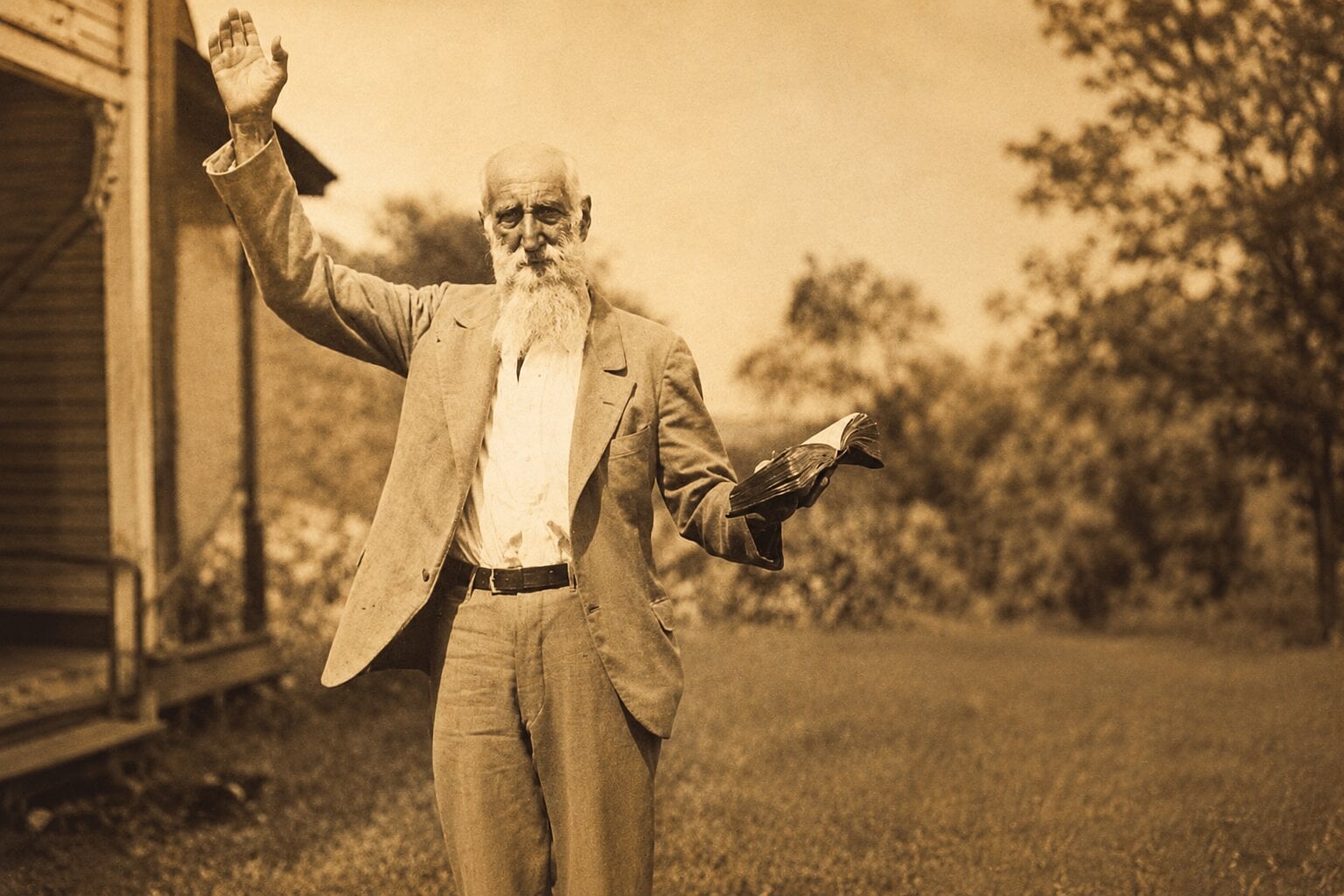
The sources examined contain no contemporary evidence for this story that establishes the panther episode as fact, so it is better understood as family or regional tradition. Its survival is nevertheless revealing. Long before Devil Anse became an archetypal figure in Appalachian folklore, his father was already being remembered in the language of frontier legend—a powerful man confronting a wild animal in the mountains with a knife.
The documentary record provides a less fantastic but more detailed picture of Ephraim as a landholder on Mate Creek. Logan County land books examined by historian Brandon Ray Kirk show that in 1880 Ephraim held tracts of 15, 20, 24, and 68 acres in the Mate Creek area. The same records show that he transferred 300 acres to his son Ellison and had earlier transferred 100 acres on Mate Creek to sons Smith and Patterson.
Other records place Ephraim in the community’s civic life. According to Kirk, an 1878 deed involving property near the mouth of Mate Creek identifies Hatfield as a justice of the peace, suggesting that Big Eaf was more than simply the larger-than-life hunter preserved in family tradition.
The son who eclipsed his father
William Anderson Hatfield was born into Ephraim and Nancy’s household in 1839 and eventually became known as Devil Anse. Popular accounts of Anse’s life often begin with violence—with the Civil War or, more commonly, with the feud that erupted between members and associates of the Hatfield and McCoy families during the decades that followed—but his story began as one son in a large family along Mate Creek.
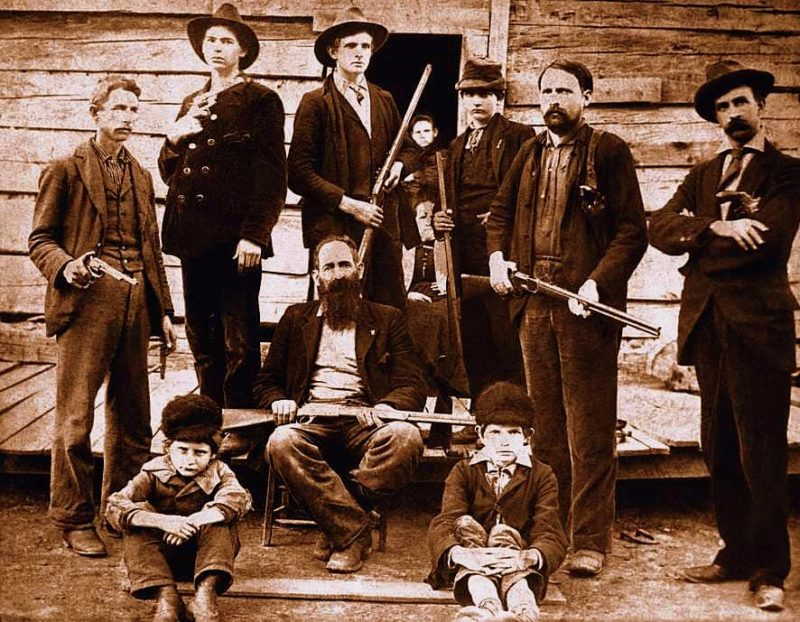
Several of Ephraim’s children would leave their own marks on regional history. Ellison’s death in 1882 following an Election Day fight became one of the pivotal episodes in the Hatfield-McCoy feud. Another son, Elias, became the father of Henry D. Hatfield, who would serve as governor of West Virginia and later as a United States senator. The National Register documentation specifically identifies Devil Anse, Ellison, and Elias among the ten Hatfield children who survived to adulthood.
Anderson, however, was the one whose reputation ultimately overwhelmed the rest of the family in popular memory. Something almost mythological about that succession. Ancient traditions often imagined an older world inhabited by giants before another generation rose to dominate the stories that followed, and while the comparison is literary rather than historical, the pattern is striking in the way the Hatfields came to be remembered.
The father was Big Eaf, remembered in family tradition as a man of exceptional size and strength and as the “Panther Killer.” His son became Devil Anse, and eventually the son’s place in American folklore grew larger than that of the supposed giant who preceded him.
The first Hatfield cemetery
The transition between those generations still traces across the mountains of southern West Virginia. Ephraim died in 1881 and was buried in the Hatfield Cemetery near Newtown on Mate Creek, one of two family burial grounds later listed together on the National Register of Historic Places. Historic-preservation documentation describes the Newtown cemetery as the older of the two and identifies Ephraim as one of the family members buried there.
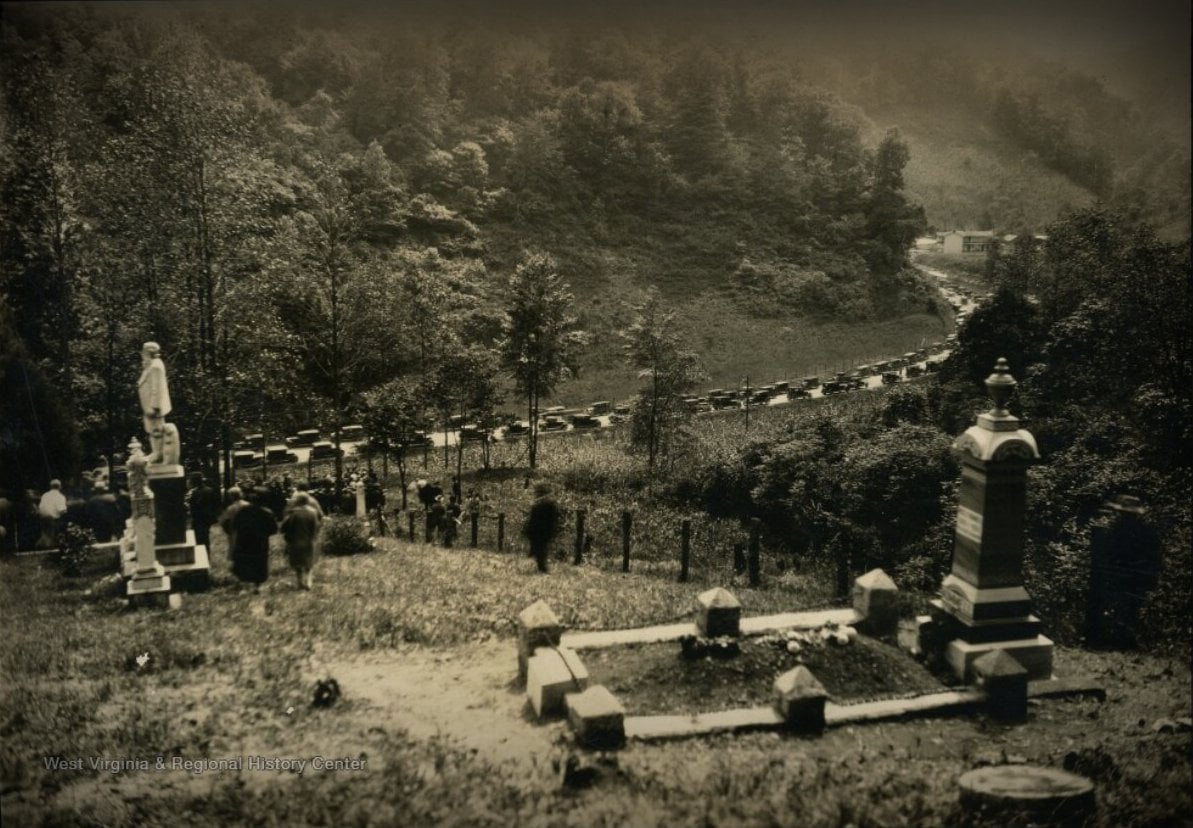
The Newtown cemetery dates to 1881 and contains the graves of Ephraim and Nancy as well as members of the next generation. Ellison Hatfield was buried there after his death in 1882, connecting the burial ground of the older Hatfield generation directly with an event that helped propel the feud into its most violent period.
Devil Anse ultimately became associated with a different family landscape. Around 1906, he moved from the Tug Fork Valley to Sarah Ann, in Logan County, where another Hatfield cemetery had already begun. After his death in 1921, they buried Anse there, and his surviving children commissioned a life-size likeness carved in Carrara marble in Italy. The statue has stood over his grave since 1926.
The two cemeteries consequently preserve different generations of the family. At Newtown lies Ephraim, buried before the feud had made the Hatfield name famous. At Sarah Ann lies Anderson, the son whose marble likeness towers above his grave and whose reputation eventually spread far beyond the mountains where both men lived.
The son is remembered around the world, while the father is comparatively obscure. But before Devil Anse became an American legend, there was Big Eaf, and somewhere between the surviving historical record and the stories generations told about him, the father became a giant.
I’m seeking facts or stories for my curiosity. I moved to Southern West Virginia in 2011.