
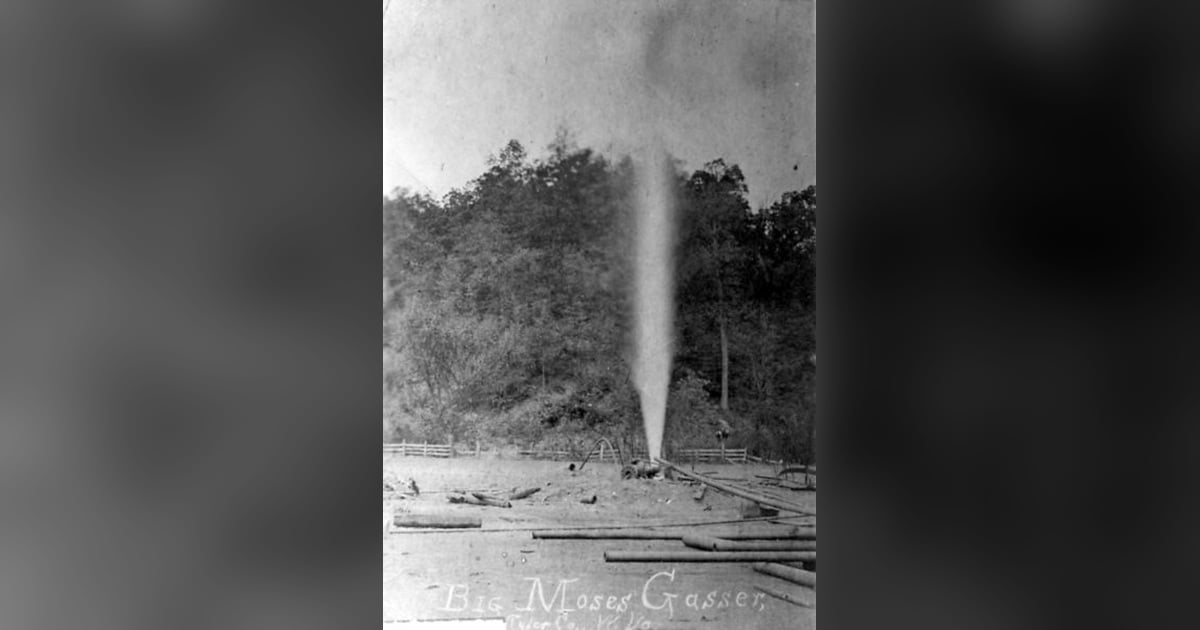
ALMA, W.Va. — When lightning struck one of the world’s most powerful gas wells in 1895, flames reportedly leaped 200 feet into the air, illuminating the rural countryside as crowds traveled to see what a Parkersburg newspaper described as a scene both “grand and awful.”

The spectacle lasted only about two hours. Gas escaped from the Big Moses well with such force that it blew out the fire, according to the Parkersburg Daily Sentinel, adding another remarkable episode to a struggle that had begun nine months earlier when drillers searching for oil instead encountered a gas deposit they could scarcely control.
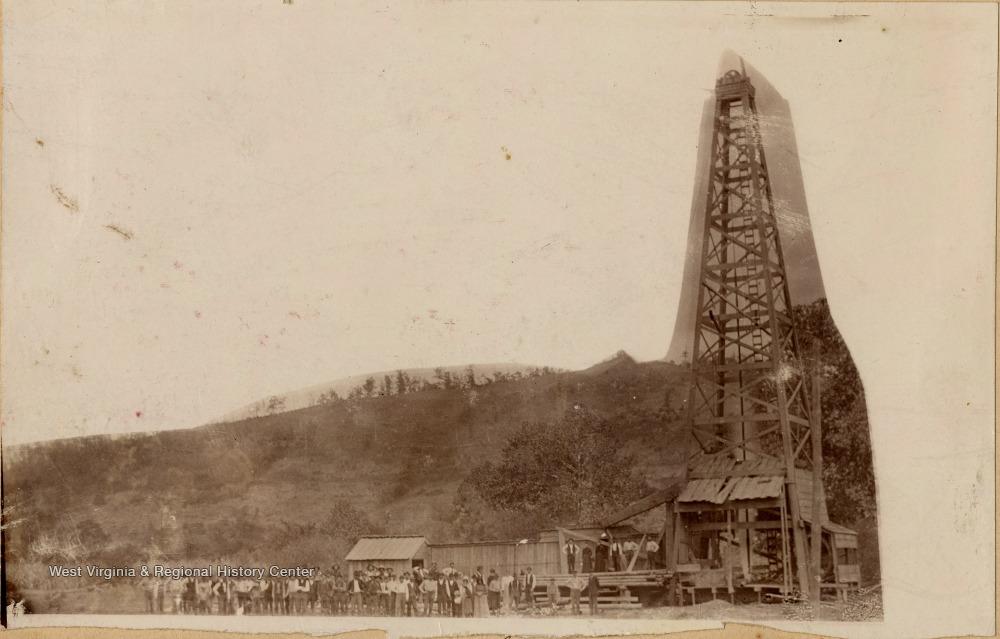
Known officially as the Moses V. Spencer No. 1 well, Big Moses was drilled on Spencer’s farm along Indian Creek in Tyler County, about 15 miles from Sistersville. Drilling began Aug. 3, 1894, during an oil boom that was transforming communities along this section of the Ohio River.
However, when the well came in on Sept. 6, drillers found gas rather than the oil they sought. The Sentinel later reported that the pressure was so great that the drilling tools were “blown entirely out of the hole and through the derrick,” leaving the owners with an enormous flow of natural gas they had no effective way to contain.
How large was Big Moses?
Estimates of the Big Moses output varied considerably. West Virginia historical sources have commonly put its initial flow at as much as 100 million cubic feet per day, a figure that helped establish its reputation as the largest gas well in the world. A federal report associated with the 1900 census later estimated its initial production at about 35 million cubic feet per day.
Contemporary reporting suggests the discrepancy may partly reflect the difficulty of measuring the well. An 1895 account published in the Pittsburgh Dispatch said no satisfactory gauge had been made and reported estimates ranging from 80 million to 120 million cubic feet per day. Whatever its precise output, the surviving accounts agree that Big Moses was exceptionally powerful.
The owners tried the methods available at the time to shut it in, but equipment placed over the well was repeatedly dislodged. Eventually, they commissioned a massive casing that weighed several tons in Pittsburgh and brought in an experienced oil and gas driller to install it.
Workers succeeded after considerable difficulty, and for a short time Big Moses seemed under control. Within days, however, sand and pebbles propelled upward by the gas had cut through the heavy casing, allowing the well to escape again.
A later effort involved pumping water continuously into the well for five days to overcome the pressure. According to the Dispatch, water instead emerged through fissures in the surrounding ground, producing dozens of small geysers, some reportedly nearly half a mile from the well.
The newspaper also described the roar as extraordinary, reporting that two people standing beside each other could not converse within half a mile and that the well could be heard as far as 12 miles away. Those descriptions cannot be verified independently, but they show how contemporary observers described the phenomenon’s scale.
Big Moses became a spectacle
Big Moses quickly attracted sightseers. A photograph preserved by West Virginia University and dated Sept. 9, 1894, only three days after the well came in, shows a large crowd gathered at the site. Another photograph made the following spring was sold commercially under the description, “The Big Moses Gasser of Indian Creek … The Largest in the World.”
The well also represented a potentially valuable resource disappearing into the atmosphere. In June 1895, the Sentinel estimated that the gas already lost was worth approximately $3 million at the time, while industrial experts reportedly traveled to Tyler County to assess whether its enormous output could somehow be put to use.
The Pittsburgh Dispatch reported that a representative of the Carnegie Gas Co. believed Big Moses, if its gas could have been captured and transported, could have supplied the fuel requirements of the Homestead industrial works. Another expert reportedly suggested the single well might have supplied Pittsburgh’s domestic gas needs.
Lightning strikes Big Moses
On June 14, 1895, a storm crossed the region, and lightning struck the column of escaping gas.
“It is now a roaring mass of flame,” the Parkersburg Daily State Journal reported the following day. The newspaper said the fire leaped and twisted high above the well, lighting the surrounding countryside for miles at night and attracting crowds of curiosity seekers to Indian Creek.

The owners appeared to have few options. “If the control of the big gasser’s output was a knotty problem before,” the State Journal observed, “it is now an enigma worthy of the attention of an Edison.” The newspaper concluded that it seemed equally impossible to shut off the gas or extinguish the fire, and that the only apparent course was to let it burn.
By the time the Parkersburg Daily Sentinel revisited the story June 18, however, Big Moses had provided an unexpected solution. The newspaper reported that the fire had burned for only about two hours before the immense force of the escaping gas extinguished flames that had been reaching an estimated 150 to 200 feet into the air.
Another contemporary account described an even stranger sight, reporting that the gas’s velocity held the bottom of the flame about 40 feet above the wellhead. If the account was accurate, observers would have seen what appeared to be a huge flame suspended above the ground while the escaping gas beneath it remained invisible.
Contemporary reports also help clarify a story that later histories confused. Some accounts have suggested that Big Moses burned for an extended period, with one later description saying it burned for more than a year. The June 18, 1895, Sentinel account makes clear that the lightning fire lasted only about two hours, although Big Moses continued releasing gas afterward and historical accounts indicate it later caught fire again.
The well’s uncontrolled flow continued into the summer before finally ending Aug. 27, 1895, as pressure declined. By then, Big Moses had been blowing for much of a year, while intensive drilling around it was tapping the same oil- and gas-rich region.
Big Moses emerged during the Sistersville oil boom
The discovery came amid one of the most consequential industrial booms in Tyler County history. The Polecat oil well near Sistersville had helped ignite the local rush in 1892, and successful wells soon attracted drillers, investors, workers, and businesses to the Ohio Valley.

Sistersville expanded dramatically during the decade, while Tyler County’s population increased from 11,962 in 1890 to 18,252 in 1900. Big Moses became one of the best-known symbols of that transformation, showing both the enormous energy resources beneath the region and the limits of an industry still developing the technology to control and transport them.
More than a century later, the story survives because contemporary newspapers documented a sequence of events that required little embellishment. Drillers looking for oil encountered an enormous flow of gas; the pressure reportedly threw their tools through the derrick; repeated attempts to contain the well failed; and sand and pebbles driven upward from underground cut through a specially made multi-ton cap.
Nine months after the well came in, lightning supplied the final spectacle. Big Moses burned above the Tyler County hills with flames reportedly reaching as high as 200 feet, drawing crowds into the countryside to watch until the force that had made the well so difficult to control extinguished the fire itself.
I love these stories, keep up the good work please