
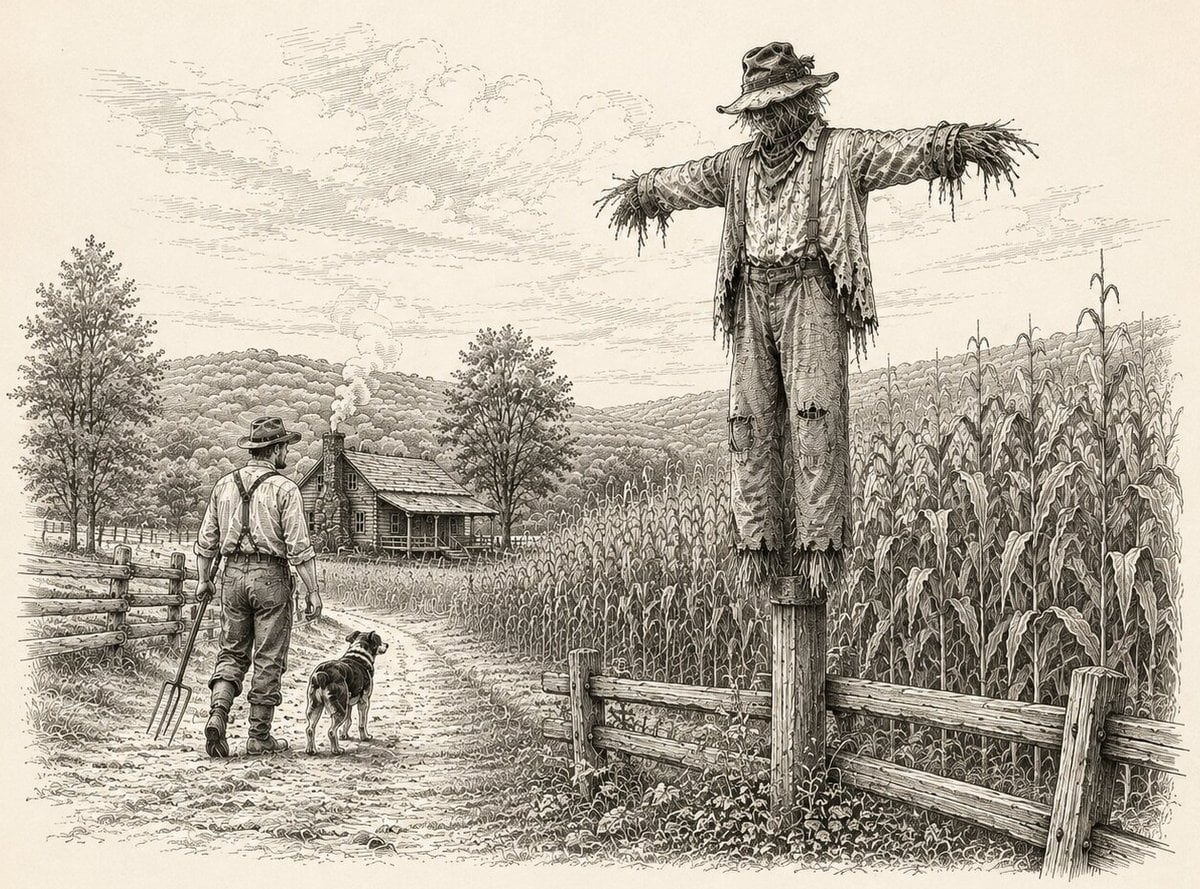
CLARKSBURG, W.Va. — Among the stories handed down from West Virginia’s frontier, few are stranger than the tale of Crock Face, an Indigenous warrior who was said to have hidden in plain sight by disguising himself as a scarecrow while waiting to ambush an early settler.
The story sounds almost tailor-made for folklore—a lonely frontier farm, a figure standing motionless in a field, a suspicious dog, and a disguise that ultimately betrays the man wearing it. Yet the legend was preserved as part of the early history of Harrison County, where generations repeated it long after the frontier that produced it had disappeared.
Whether the episode happened as later storytellers described it is much harder to establish. Like many tales from the violent and poorly documented Appalachian frontier, the story of Crock Face occupies an uncertain territory between history and folklore, preserving recognizable people, places, and conflicts while leaving the most extraordinary details beyond verification.
That uncertainty may be part of the reason the story has survived.
The strange plan that went wrong
The legend is set during the period when European-American settlers were moving into what is now north-central West Virginia, then a remote and contested part of Virginia’s western frontier.
According to versions of the story preserved in West Virginia folklore, Crock Face was an Indigenous warrior who sought revenge against an early settler named Benjamin Coplin. Rather than approaching Coplin openly, he supposedly devised an unusual way to conceal himself near the settler’s property.
He disguised himself as a scarecrow. Standing motionless in or near a field, Crock Face could supposedly watch the farm without immediately attracting attention. To anyone looking from the house or passing at a distance, the figure might have appeared to be nothing more than an ordinary object erected to frighten birds away from crops.
The deception apparently worked on the people at the farm, but not on the family dog.

According to the legend, the animal became suspicious of the supposed scarecrow and repeatedly approached or investigated it. Crock Face eventually struck or kicked the dog in an effort to drive it away, revealing that the motionless figure in the field was alive.
Once the disguise had been discovered, the attempted ambush failed. In the confrontation that followed, Crock Face was killed.
It is an extraordinary story, but extraordinary stories pose an obvious question for historians: How much of it can actually be proved?
Did Crock Face really exist?
That is where the story becomes more complicated.
The tale belongs to a large body of frontier tradition that survived for generations through oral storytelling and was recorded only after the events it purported to describe. Details repeated in later accounts therefore cannot necessarily be treated the same way as information found in contemporary military reports, correspondence, court records, or other primary documents.
There is also reason to approach early frontier accounts involving Native Americans with particular care. Stories preserved by settler families were told largely from the perspective of the communities that ultimately occupied the land, and Indigenous participants frequently appear in those accounts only as adversaries, sometimes without enough information to establish their identities independently.
Crock Face is therefore best understood as a figure of West Virginia frontier legend rather than as a historical person whose complete story can be reconstructed from surviving records.
That distinction does not make the tale meaningless. Folklore can preserve memories of genuine places, anxieties, and conflicts even when individual episodes become embellished in the telling. In the case of Crock Face, the historical world surrounding the story was anything but imaginary.
The West Virginia frontier really was dangerous
What is now West Virginia lay along a volatile frontier for much of the 18th century as European-American settlement expanded westward across the Allegheny Mountains and into lands used and contested by Indigenous peoples.
Settlements were scattered, roads were primitive or nonexistent, and isolated families could live far from military protection. Raids, killings, captivity, and retaliation became part of life along portions of the frontier, particularly during periods of open warfare.
The violence was not one-sided. Colonial expansion displaced Native peoples from their lands and hunting territories, while warfare among Indigenous nations, settlers, and colonial governments produced cycles of attack and reprisal that continued for decades.
North-central West Virginia was drawn into that larger struggle as settlement increased along the Monongahela River and its tributaries. The region that became Harrison County remained part of Virginia until West Virginia entered the Union in 1863, and many of its earliest European-American communities developed while western Virginia was still effectively frontier country.
Against that background, the central elements underlying the Crock Face legend—an isolated settler, fear of attack, and conflict between Native people and newcomers—would not have seemed fantastic to the generations that first repeated it.
The scarecrow is another matter.
Why a scarecrow made the story unforgettable
Scarecrows had been used for centuries to protect crops, but their human shape also gave them an unusual place in folklore and popular imagination. A figure deliberately constructed to resemble a person while remaining lifeless and motionless naturally lends itself to stories in which appearances cannot be trusted.
That quality is what makes the Crock Face story so effective. Without the disguise, the legend would be one among many accounts of violence preserved from the Appalachian frontier. With it, the story becomes instantly visual: a family going about its affairs while an apparently harmless figure stands nearby, watching and waiting.
The dog provides the second memorable element. People are deceived by the disguise, while an animal recognizes that something is wrong. The moment the supposed scarecrow moves against the dog, the illusion collapses.
Whether those details originated with an actual incident or became more elaborate through generations of retelling may never be known.
Fortunately for West Virginia folklore, someone eventually wrote the story down.
The newspaperman who helped preserve West Virginia’s folklore
Among the people responsible for preserving unusual stories from West Virginia’s past was Jim Comstock, the legendary newspaperman, editor and folklorist whose work helped rescue countless pieces of Mountain State history from obscurity.

Comstock, born in 1911, became one of West Virginia’s most distinctive 20th-century publishers. From Richwood, he edited The West Virginia Hillbilly, a newspaper famous for its humor, commentary and devotion to the culture and history of the state.
He was also closely associated with the monumental West Virginia Heritage Encyclopedia, an ambitious collection of historical material, biographies, folklore, anecdotes and records that remains a valuable starting point for researchers interested in obscure aspects of the state’s past.
Comstock understood that history was not preserved only in government archives and scholarly books. It also survived in family stories, local traditions, old newspaper accounts and tales repeated in communities long after their origins had become difficult to trace.
That approach preserved material that otherwise might have vanished, though it also requires modern readers to distinguish carefully between documented history and folklore.
The legend of Crock Face belongs squarely in that tradition.
A story from a vanished frontier
Today, Harrison County bears little resemblance to the isolated frontier landscape where the story was supposedly born. Clarksburg grew into one of northern West Virginia’s principal cities, transportation routes replaced wilderness trails, and the scattered settlements of western Virginia became part of a state that did not exist when the earliest versions of such stories originated.
Yet the Crock Face legend endured. Its survival speaks to how communities remember their past. Battles, treaties and political events are preserved in official records, but folklore often preserves something different—the fears, mysteries and memorable images through which people understood the world around them.
For settlers living along the Appalachian frontier, danger could emerge from the forest, along an isolated trail, or, according to one of West Virginia’s strangest legends, from something standing perfectly still in a field.

Whether a warrior ever actually disguised himself as a scarecrow may never be established with certainty, but generations of West Virginians remembered the story as if there had been.
Read also: Do three legendary monsters inhabit the Monongahela River in W.Va.?
Very interesting I have read several story’s about the early frontier life in the Simpson creek area of Harrison County. Thanks for the article 👍
Always enjoyed Jim’s stories about our state. He made Richwood famous with the Hillbilly newspaper.