
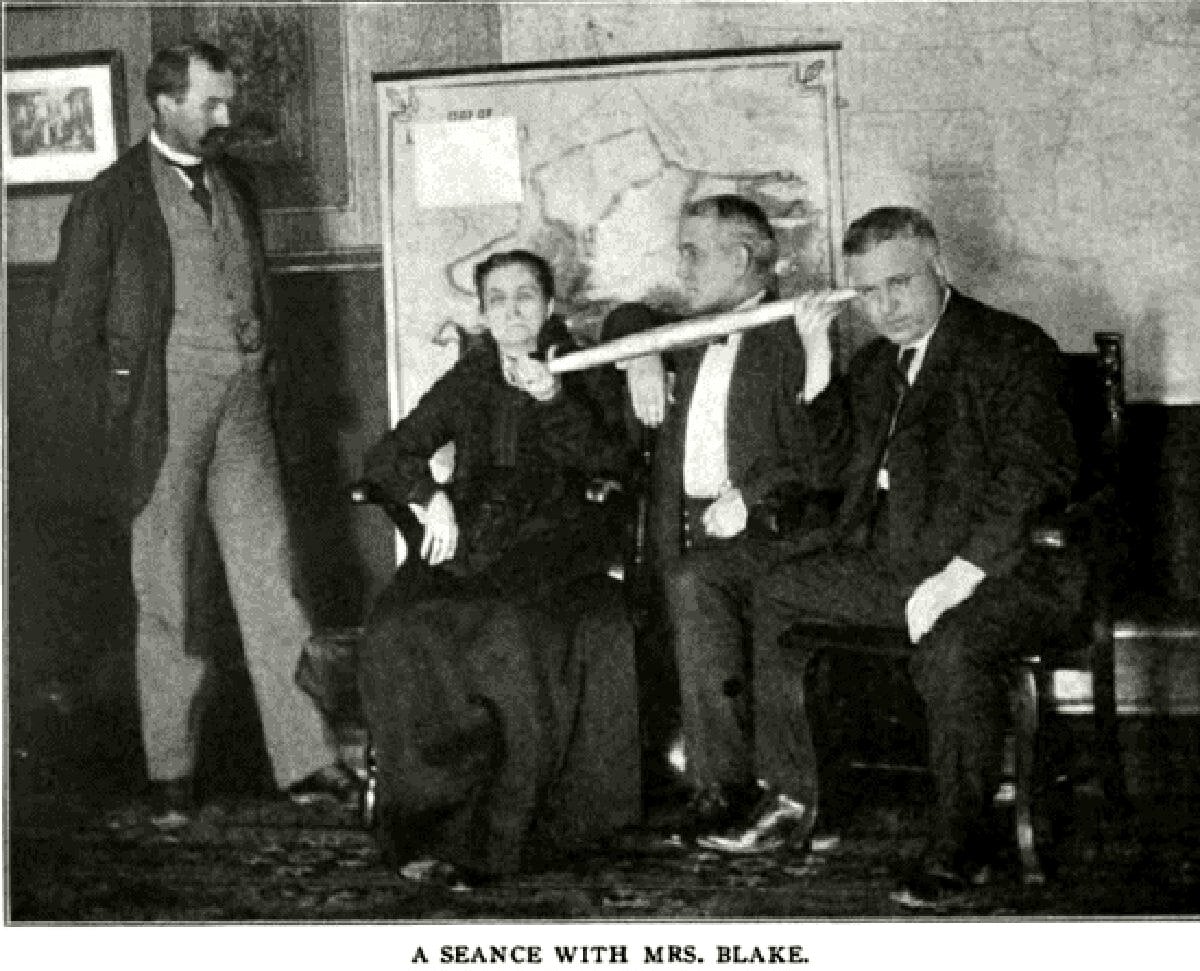
HUNTINGTON, W.Va. — In August 1906, a Huntington physician conducted an experiment to test the reputed supernatural abilities of Elizabeth Winn Blake, a spiritualist medium whose séances were drawing visitors to the Ohio River Valley.
Dr. L.V. Guthrie, superintendent of the West Virginia Asylum at Huntington, reported that a voice claiming to be his deceased father correctly identified an object concealed in a box, the contents of which even the physician did not know.
James H. Hyslop published Guthrie’s account in 1913 in the Proceedings of the American Society for Psychical Research. His investigation preserved witnesses’ accounts of purported conversations with the dead, predictions concerning illness, and experiments intended to test Blake’s abilities.
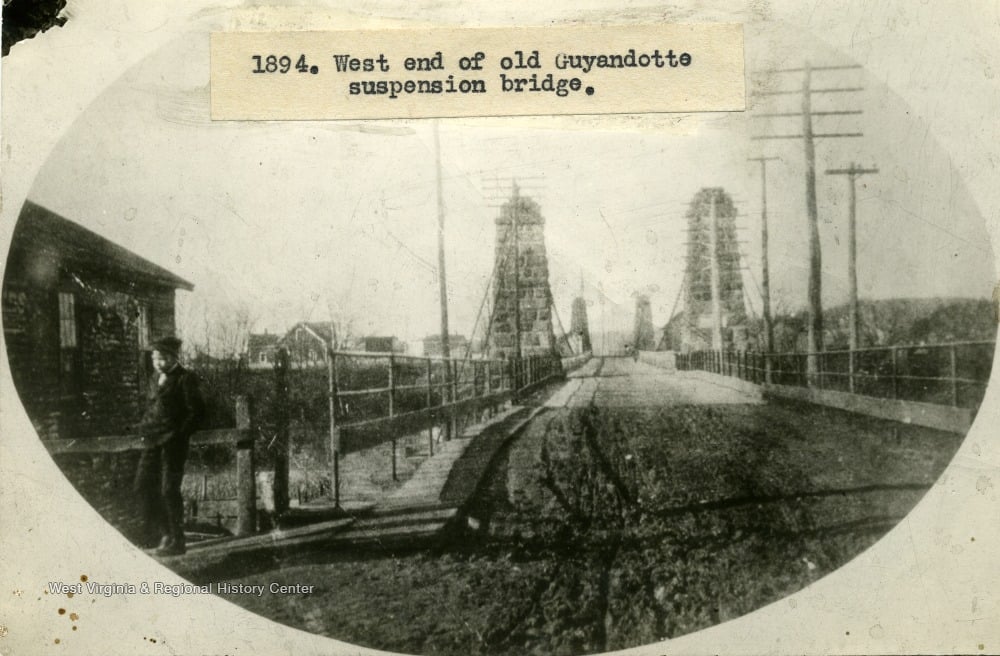
Blake lived in Bradrick, Ohio, across the river from Guyandotte, a Huntington neighborhood where she had spent part of her childhood, though her reputation eventually reached British author Arthur Conan Doyle, best known as the creator of Sherlock Holmes. Sir Doyle discussed her in his 1926 book The History of Spiritualism.
The experiment with eight boxes
According to Hyslop, Guthrie had attended approximately 25 to 30 sittings with Blake. Although some had been disappointing, Guthrie was apparently impressed by the personal information provided by voices claiming to represent deceased relatives.
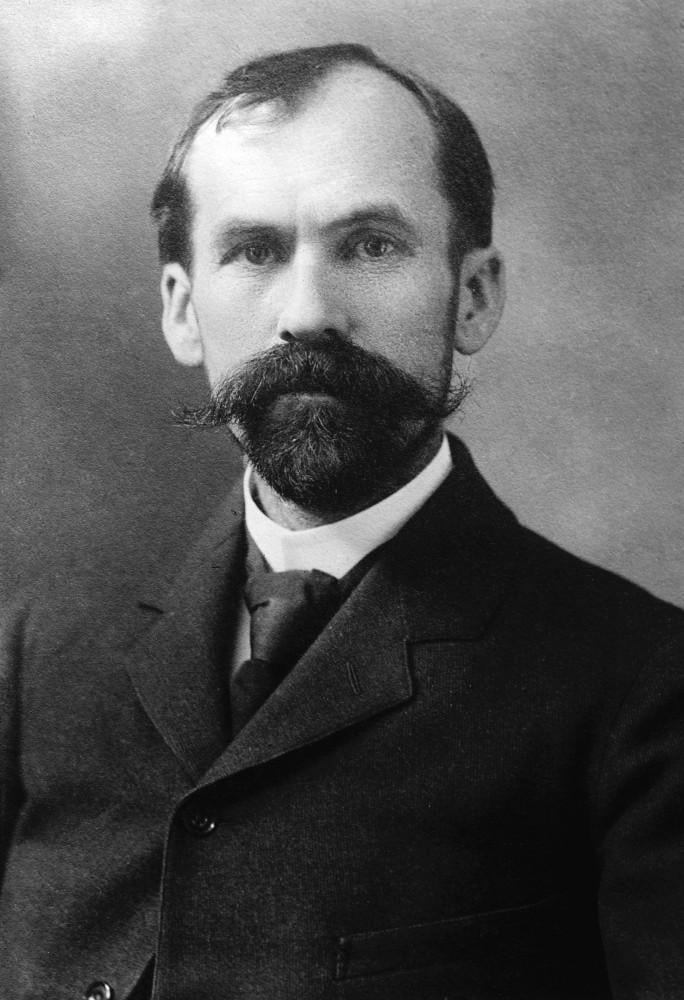
On August 19, 1906, according to Hyslop, Guthrie packed eight identical thread boxes with some of his father’s possessions, wrapped the objects in cotton, secured the lids with rubber bands, mixed the boxes, and asked a bookkeeper to select one while he turned his back.
He placed the selected box in his pocket without opening it and also brought his father’s pocketbook, handing it to L. S. English during the carriage ride to Mrs. Wood’s residence, where the séance was held.
Twelve people attended, including Guthrie’s wife, Hyslop said. The gathering began with the Lord’s Prayer and the hymn Nearer, My God, to Thee.
Guthrie reported that a voice claiming to be his father eventually addressed him, and he documented the following exchange:
“Pa, can you tell me if we have anything with us that had formerly belonged to you?
“Yes, you have.”
“What is it?”
“My pocketbook.”
“Who has your pocketbook?”
“L. S. English.”
Guthrie then explained the sealed-box experiment to his wife, who questioned the voice.
Mrs. Guthrie asked, “Judge, can you tell me the contents of the box that Lew has in his pocket?”
“Yes.”
Guthrie then said: ‘I am very anxious for you to be able to do this in order to report it to Professor Hyslop, and if you say so, I will take the lid off of the box and enable you to better see its contents.
The voice replied that Guthrie did not need to take the lid off the box; that it could see the contents with the lid on, as if it were off.
Guthrie then asked, “Well, what is in the box?”
“The pass I used to travel with.”

The sitting ended shortly afterward. Guthrie said that when the lights were restored, he opened the box and found one of his father’s railroad passes. His father had numerous annual passes but used the selected one for about 90 percent of his travel.
Hyslop subsequently asked whether Blake had handled the box. In a September 7 letter, Guthrie answered: “Mrs. Blake did not at any time handle the box or have it in her possession; in fact, the box was never out of my possession during the meeting.”
He further stated that the room had been completely dark and that he had not opened the box until the séance ended.
Another witness describes the séance
Bertha Devereaux, who attended the same sitting, supplied a separate account, according to Hyslop. She reported hearing a voice that appeared to identify itself as Marion Shipman, a friend who had died 16 years earlier. The name was initially indistinct, and Blake suggested that the speaker might be Mary.
Hyslop wrote that Devereaux recalled that an indistinct voice spoke, and she asked, “Is it, father?”
“Someone at the table said, ‘No, it is a woman’s voice.” It came indistinctly, “Marion,” but Mrs. Blake suggested “Mary,” and the voice said, “No, no,” and repeated “Marion.” I asked her where she was when she passed over, and she replied, “At your home.”
Hyslop said Devereaux then questioned the voice about Shipman’s death and their friendship.

“Did you receive proper medical attention at your last illness, or should you have passed off?”
“Yes, it was my time.”
“Marion, what did we do when we used to take walks together into the country?”
“I painted.” Then her voice grew stronger, and she said, “Bertha, praise the Lord, but I cannot talk more.”
Devereaux, Hyslop said, explained that Shipman had frequently made watercolor sketches during their walks.
A prediction concerning West Virginia’s governor
On June 15, 1908, Guthrie attended a morning séance after receiving a telephone call from General Boggs, identified as the private secretary to West Virginia’s governor, William M.O. Dawson, who served from 1905 to 1909.
The governor was expected to pass through Huntington on the 1:25 p.m. train, and Guthrie had been asked to meet him. The physician reported the following to Hyslop:
“After a few preliminary remarks with Mrs. Blake, a voice addressed me claiming to be Ludie D., the deceased wife of Governor D., and said:
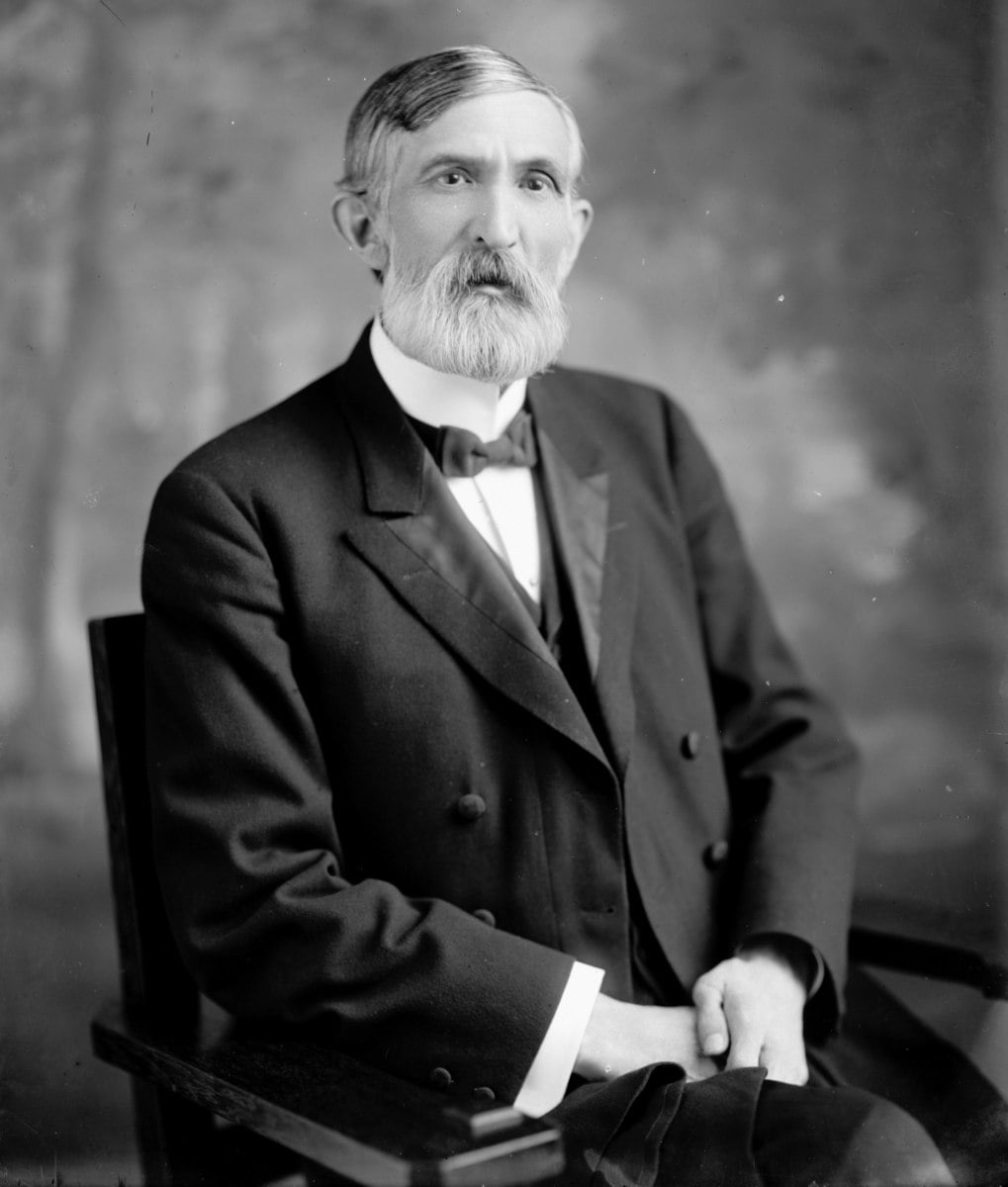
“‘Governor D. is in a very critical condition, and I want you to tell him for me that he must pray more and prepare himself for the other world, and by praying and constant effort he will be able to be in the same sphere with myself when he comes over.'”
“Mrs. D., when am I going to see the governor?”
“In two or three days.”
“Am I not going to see him today?”
“No, you will not see him today.”
Another voice, claiming to be Guthrie’s grandfather, addressed the condition of his Aunt Salina, Guthrie said.
“Another voice purporting to be that of my grandfather G. speaks, and after some commonplace remarks I asked, “Grandpa, can you tell me what is the matter with Aunt Salina?”
“Yes, your Aunt Salina is in a very critical condition, will live only a short time, and if you should ask her what the matter is, she would say ulceration of the stomach, but she has cancer of the stomach.”
Guthrie said his aunt died five days later. At her funeral in Gallipolis, Ohio, he questioned her daughter and learned that Salina had described her illness as sores in the stomach rather than cancer.
He acknowledged that he already knew she had stomach cancer but maintained that he had not known how she described it.
A voice claiming to be Guthrie’s father then addressed his mother’s health.
“Lew, I told you twelve months ago that your mother was in a very critical condition. You now realize that what I then told you was correct. She will not live very long. The operation which you had performed was only of temporary benefit, and do not operate on her any more, as nothing will do her any good.”
Guthrie reported that his mother had developed a malignant growth and was largely confined to bed. He conceded that Blake might have learned about her recent treatment.

After the séance, Guthrie returned to the asylum before meeting the governor’s train. He learned that the governor’s secretary had telephoned during his absence to report that the governor was too ill to travel and would probably make the journey in two or three days.
Guthrie wrote: “This confirmed the above information. However, on the 17th the Governor was able to make the trip, and I accompanied him as far as Cincinnati.”
The published account contains an apparent error, referring elsewhere to Governor Boggs rather than General Boggs.
A promise made by a dying physician
On October 1, 1908, Dr. A. E. Craig was dying at the West Virginia Asylum, where he had received treatment and subsequently worked as a medical intern.
Guthrie visited Craig’s room and recorded their conversation:
“Craig, is there anything that I can do for you?”
“Yes, I would like to have some lemonade. I have about finished my career and know that I am at the end of my string,” Craig replied.
“How do you feel in regard to religious matters?”
“I was formerly a Presbyterian but have taken very little interest in the church in recent years.”
“What do you think about spiritualism?”
“Lew English has talked to me about this, and there may be something in it. I would like to see Mrs. Blake.”
“If after you have passed over the Great Divide you find that there is anything in spiritualism, will you promise me that you will come back and communicate with me through Mrs. Blake?”
“Yes, I will try. I will do the best I can.”
As Guthrie prepared to leave, Craig reminded him of the lemonade. He died the following morning, according to Guthrie, who said he kept the conversation private and waited approximately ten days before attending another séance with Blake.
Late in the sitting, a weak voice began speaking. Guthrie thought its tones resembled Craig’s.
His recorded exchange follows:
“Who is it?”
“Wm. Edward.” (Repeated two or three times.)
“Did I know you?”
“Yes, you doctored me.”
“Where did you live?”
“In the country above Point Pleasant on the river.”
“How long since you lived there?”
“Ten or twelve years,” but answered indistinctly.
“Are you giving me your correct name?”
“No.”
“Please do so.”
“C-r-a.”
“What did you do while on earth?”
“I practiced.”
“Where did you practice?”
“Right there.”
“What was the last thing you asked me to do for you?”
“To get me some lemonade.”
“What was the cause of your death?”
“Consumption. Both of my lungs were gone. I am glad to talk with you tonight. I knew you would come, but I am very weak and cannot get the conditions to tell you all — wait — I am glad you understand.”
“Did we have any conversation the day before you died?”
“Yes, I told you I was about gone. I am glad you understand.”
“What else did we talk about?”
“We talked about religion and spiritualism, and I promised you I would come back and communicate with you if possible.”
The voice subsequently answered questions about Craig’s possessions, including a sealed letter found among his belongings.
Did you leave anything you wanted your people to have?
“Yes, I want my brother, Edward, to have it.”
“Have what?”
“The proposition. It is sealed.”
“Where is it?”
“It was in the office. You have it now.”
“Where?”
“In your left hand near your left side.”
“What is in the proposition?”
“I told them that I wanted Edward and Aunt Mary to have the property.”
“Where was the proposition found?”
“In the corner with my things.”
The voice also mentioned Craig’s carpenter’s tools and watch. Guthrie reported that Craig had a brother named Edward and an aunt named Mary, and that the tools were subsequently located.
But when Guthrie opened the sealed letter, the contents contradicted the voice’s account.
“Upon opening the letter, there was found no reference to Aunt Mary or to any property. The brother’s name was mentioned but not in connection with any property.”
Hyslop said the discrepancy remained unresolved. Guthrie considered whether the information might have originated through telepathy or whether another document had been overlooked.
Mrs. Blake’s connections to Huntington
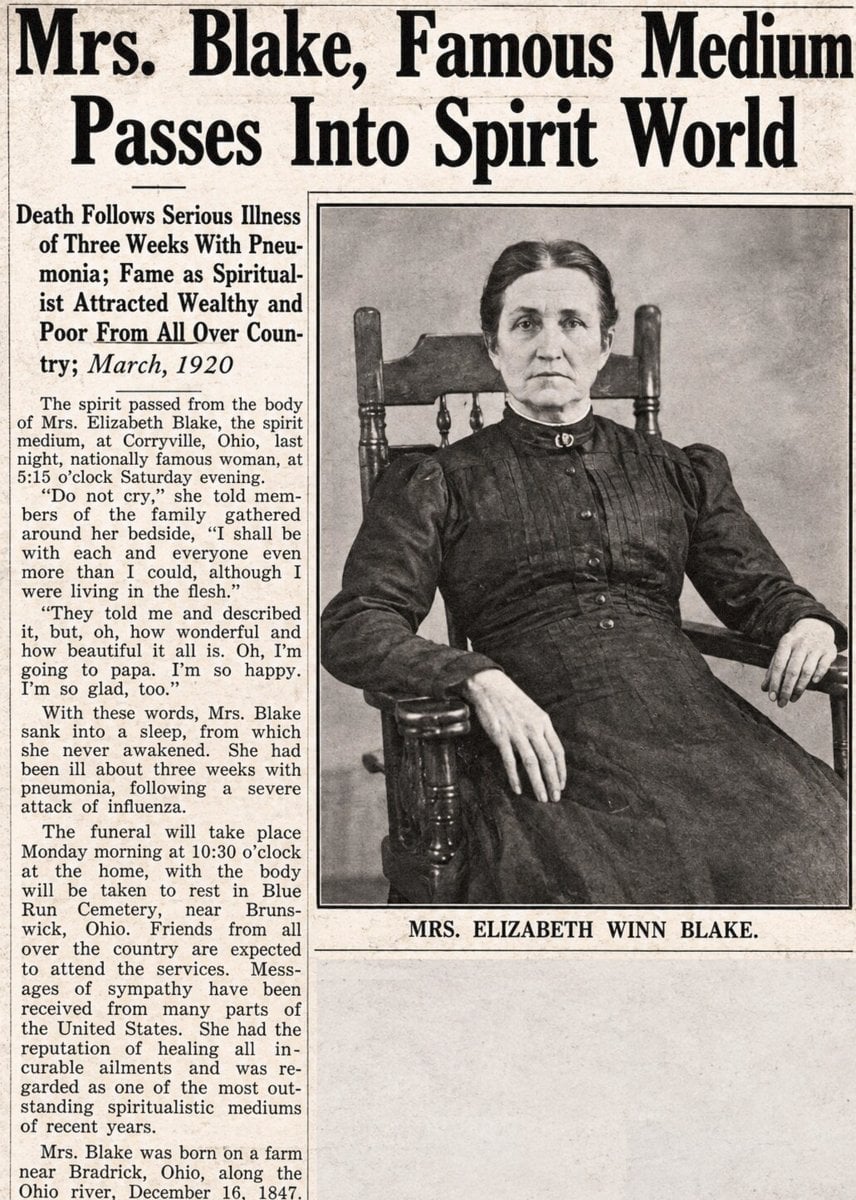
Elizabeth Winn Blake was born near Proctorville, Ohio, on July 23, 1847. Her family moved to Cabell County, then part of Virginia, when she was a child, and census research places her in Guyandotte in 1860.
She married Zachariah Blake in Lawrence County, Ohio, on March 23, 1863. Zachariah served in the Union Army during the Civil War, and the couple subsequently lived in Lawrence County.
A newspaper account published after Zachariah’s death in 1919 reported that Elizabeth had attended Marshall College when they met. Her attendance has not been independently verified.
The Blakes had a large family and experienced considerable personal loss. Census records indicate that Elizabeth bore 15 children, of whom only four were living by 1900.
Their home was in Bradrick, a small settlement on the Ohio side of the river. Hyslop described it as having only 30 or 40 inhabitants and no direct ferry connection to Huntington.
Read also: The full tale of West Virginia’s remarkable Greenbrier Ghost
Guthrie, who was Blake’s family physician, described her as practical and possessing considerable common sense despite her limited formal education.
He reported that she generally charged one dollar for a sitting but sometimes admitted grieving visitors without payment. He encouraged her to increase her fees, but she resisted because she believed higher charges would exclude people of modest means.
Blake’s séances incorporated Christian prayers and hymns, Guthrie said, and Hyslop reported that she had been raised in the Christian church but expelled because of her mediumship.
A 1914 newspaper account described a Hungarian widow traveling from Thurmond in the New River Gorge hoping Blake could provide information about the murder of her husband.
Hyslop examines the evidence
Hyslop became interested in Blake after receiving reports from David P. Abbott, an investigator familiar with professional magicians’ methods. Abbot told Hyslop that Edward A. Parsons, an experienced magician, had contacted him after describing two daylight sittings with Blake.
Parsons, Hyslop said, had reported hearing voices that appeared to emerge from metal trumpets and receiving information about deceased relatives. One voice incorrectly supplied his middle name, but Parsons considered other answers accurate and difficult to explain.
Read also: 1911 horror in central W.Va. allegedly witnessed through ESP
Hyslop wrote that he recognized that ordinary methods could reproduce the physical effects associated with séances, and his chief interest was whether Blake could supply information that she had no ordinary means of obtaining.
Unlike Guthrie’s retrospective accounts, Hyslop attempted to record incorrect answers and irrelevant remarks alongside apparent successes. His own sittings with Blake produced little that he considered conclusive, and he observed movements in Blake’s throat associated with some of the purported voices.
Guthrie had independently acknowledged that voices supposedly belonging to educated deceased relatives occasionally made grammatical mistakes resembling Blake’s speech.
Hyslop also distinguished how the voices were produced from how their information was obtained. His investigation did not establish communication with the dead or conclusively demonstrate deliberate deception.
Mrs. Elizabeth Blake’s final years
Mrs. Blake’s husband, Zachariah, died in September 1919, and after more than half a century of marriage, her health subsequently declined, and she became seriously ill the following spring.
In April 1920, newspapers reported that she had apparently died and regained consciousness hours later. According to accounts attributed to relatives, she described seeing her deceased husband and children during the episode. She died April 10, 1920, at age 72.
Principal historical sources
- James H. Hyslop, “The Case of Mrs. Blake,” Proceedings of the American Society for Psychical Research, Volume VII (1913), pp. 570–788. The testimony quoted here appears principally on pp. 615–619 and 634–639.
- Nicole Molnar, contribution to Dennis Deitz, The Greenbrier Ghost and Other Strange Stories (South Charleston, W.Va.: Mountain Memories Books, 1990), pp. 197–207.
- Martha J. Martin, “Elizabeth Blake: Medium Psychic from Bradrick, Ohio,” The Lawrence Register.
- Arthur Conan Doyle, The History of Spiritualism, Volume II (1926).