
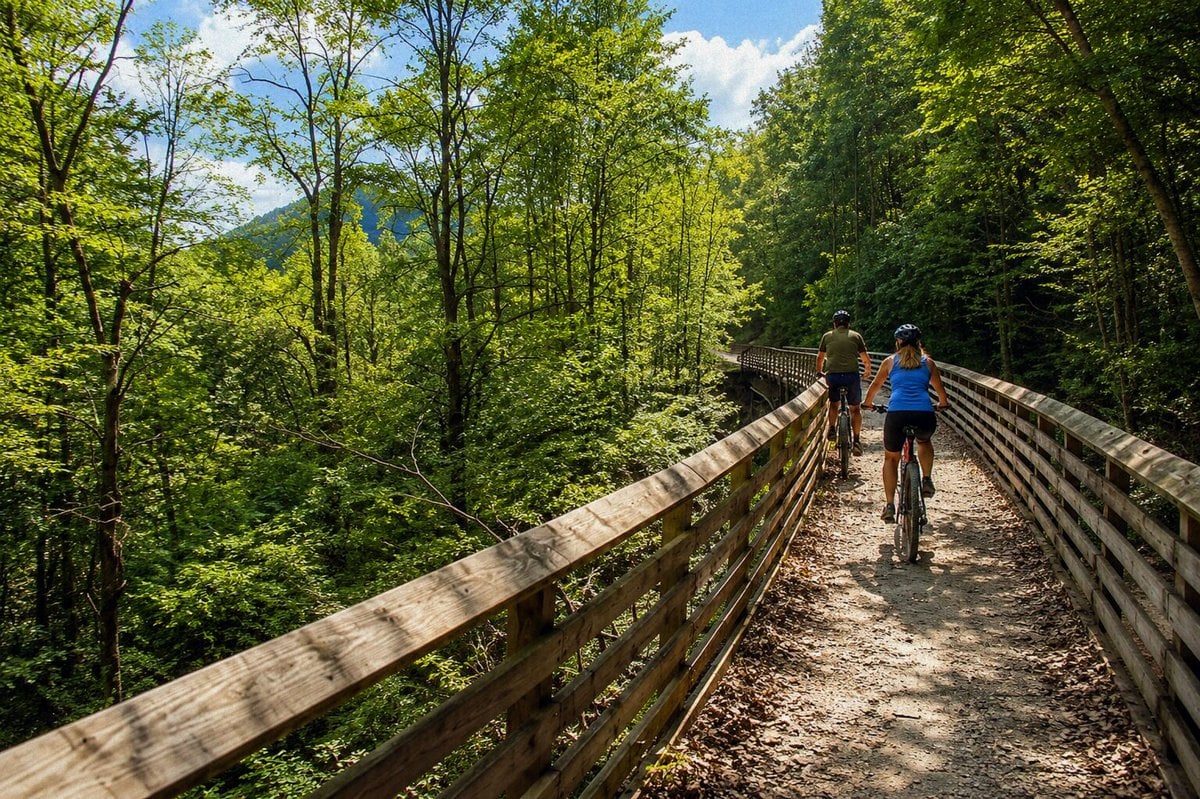
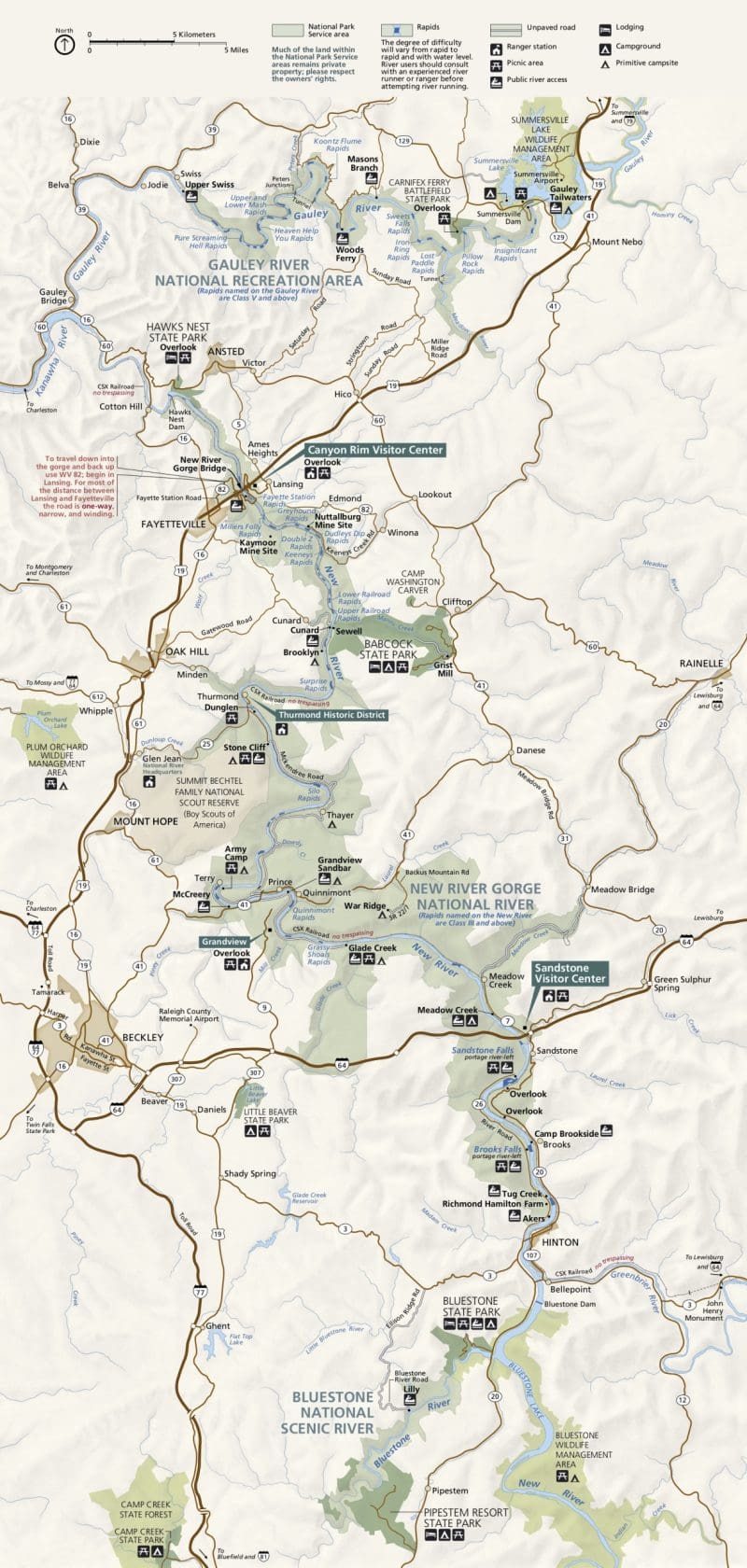
GLEN JEAN, W.Va. — Hidden beneath the forests of New River Gorge National Park and Preserve is one of the easiest ways to experience one of America’s newest national parks.
Unlike many of the gorge’s steep, rugged trails, the Rend Trail follows the nearly level grade of a former railroad line. Families, cyclists, older hikers, photographers, and anyone seeking a leisurely walk have long been drawn to its quiet forests, historic railroad trestles, and the gentle course of Arbuckle Creek.
Soon, it will become even more welcoming.
Beginning Aug. 3, the National Park Service will close the 3.2-mile trail to begin an $11.8 million rehabilitation that will transform it into the park’s first fully accessible earthen-surface trail. When the project is complete, visitors will find restored historic railroad bridges, improved trail surfaces, new visitor amenities, and a route designed to accommodate people who previously could not experience the trail independently.
Although the work will temporarily close one of the park’s favorite walks through late 2027, Acting Superintendent Eric LaPrice said the investment will preserve both the trail’s history and its future.
“Once completed, this trail is going to be a great addition to the park’s recreational offerings,” LaPrice said. “It will offer the public a fully accessible trail and reconnect the park with a gateway community, providing additional national and recreational opportunities to park visitors and residents.”
The rehabilitation is funded through the Great American Outdoors Act Legacy Restoration Fund, created to address decades of deferred maintenance throughout America’s national parks.
A different way to experience the New River Gorge
Many visitors know New River Gorge National Park and Preserve for its soaring cliffs, world-class whitewater rafting and challenging mountain trails. The Rend Trail offers something entirely different.

Following the route of a former Chesapeake & Ohio Railway branch line, the trail winds gently through mature hardwood forests, crosses historic steel trestles and follows Arbuckle Creek through a landscape where nature and Appalachian history coexist.
Without the steep climbs found on many of the park’s signature hikes, the trail has become a favorite among families with young children, beginning hikers, photographers, birdwatchers and visitors who simply want to slow down and enjoy the scenery.
Every season brings a different experience. Spring wildflowers brighten the forest floor, summer offers cool shade beneath towering trees, autumn paints the valley in brilliant color and winter reveals long views of the surrounding mountains and the historic railroad’s engineering.
The trail also offers glimpses into the region’s past. Historic railroad structures remain scattered along the corridor, while nearby communities such as Thurmond, Rend and Minden tell the story of the coal industry that once shaped the New River Gorge.
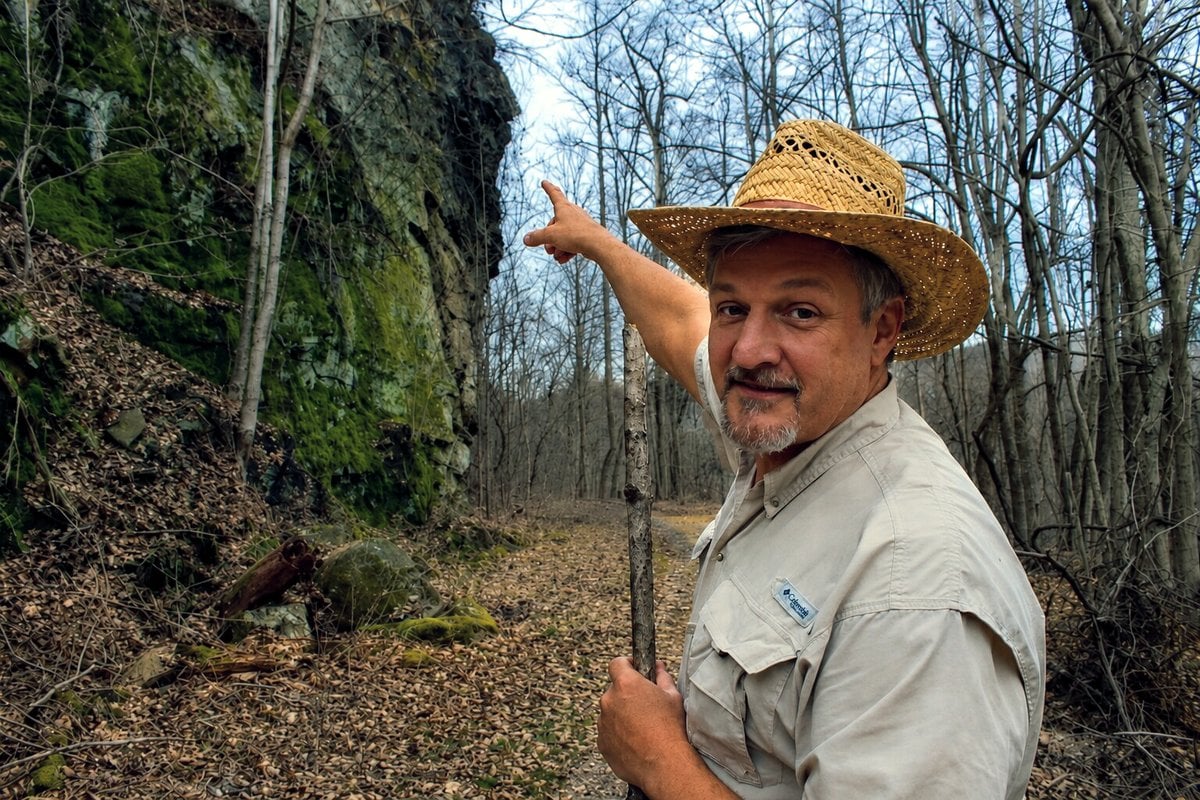
Along the route, hikers also pass McKinley Rock, a sandstone cliff tied to one of the area’s best-known legends. According to local tradition, railroad workers blasting the cliff in 1901 noticed what appeared to be the profile of President William McKinley, only to learn later that day that the president had been shot. Whether coincidence or folklore, the story has remained part of the trail’s character for generations.
Opening the trail to more visitors
The rehabilitation project is about more than repairing aging infrastructure.
Among its most significant improvements is the construction of an accessible route around the trail’s massive Big Rock, replacing a stairway that has long limited access for many visitors. Crews will also rehabilitate five historic railroad trestles, resurface the entire trail, and build a new parking area, restroom, picnic area, and scenic overlook at the Minden Trailhead.
Levi Moore, an outdoor recreation guide, believes the accessibility improvements will have the greatest long-term impact.
Moore, who spent several years using a wheelchair and now leads youth outdoor recreation programs, said expanding access will allow more people to experience one of the national park’s most distinctive trails.
“Any time any organization or authority wants to become more compliant with ADA standards, I’m always going to be 100 percent for that,” Moore said.
He is particularly interested in how engineers design the accessible route around Big Rock while maintaining the gradual slopes required for wheelchair users.
Moore also believes reopening the trail will reconnect nearby communities with one of southern West Virginia’s most significant outdoor destinations.
“I think it’s long past due that the Park Service did something with that trail,” he said. “It gives that part of the county, so Minden and Upper Oak Hill there, access to the national park that they really didn’t have before.”
For years, deteriorating conditions on several historic railroad trestles prevented visitors from hiking the trail from end to end, limiting access from either trailhead.
Preserving a walk through history
The Rend Trail occupies more than an abandoned railroad bed. It preserves a corridor that helped shape the New River coalfields in the late nineteenth and early twentieth centuries.
The five railroad trestles scheduled for restoration carried trains linking coal camps to the outside world. Preserving them helps protect an important chapter of Appalachian history and ensures visitors can continue to experience it firsthand.
Construction is expected to continue through fall or winter 2027.
For hikers, the temporary closure will require patience. When the trail reopens, it will offer something increasingly rare in America’s national parks: a place where visitors of nearly every age and ability can experience the beauty, history, and quiet character of the New River Gorge together.
If you can spend millions of dollars on a trail through the woods y not spend it on something that would actually benefit the people of wva some business that would put money into the pockets of the hard working people of wva
David, you always have interesting and time relevant articles. Hope you are well; can see that you are still engaged in preserving so much of West Virginia. Your expertise and positive attitude are so needed. rebecca
I think that’s a bull hockey. I’ve been doing that trail since the 80s doesn’t take 16 months …you could have it done in two months everything in the park service does takes too long and I think there’s a lot of money laundering that goes on… You only hire certain people and give certain people opportunities…just like they said at Cunard … shut it down two different times for two years in a row …six months at a time and didn’t even do what they said they were going to do ..that was during the Biden administration… I went down there every almost on a weekly basis and hiked the trail above it ..the workers there couldn’t even speak English… then when Trump came into office, they had regular contractors redo it .. said they were going to redo the bathrooms and all they did was waste $17 million and only fixed a part of the road that had fallen in ..that they made worse by blasting it out. I live right at the top of the hill I used to take my horse down to Cunard back in the early 80s even before there was a road and before those old cars that went down the side of the road where still there ..and I would take my kids when I taught at Mount Nebo to the Rend trail which was the Mary Ingle Draper Trail……. and who’s going to police these trails ..state and local police are not even allowed on national Park property… and the national Park system needs to get away from the woke ideology…They bring people in here from out of state. They can’t even walk half a mile. You can tell that by looking at them.
Kathryn, I worked along side the contractor who did the job at Cunard. I can promise you that every one of the guys spoke English, they probably just didn’t want to talk to you. Also, the same contractor who started the job finished the job. I don’t know who told you the bathrooms were to be redone but that was never in the deal. The contract was to fix the section of road that was blowing out and that’s what was done. There’s another section further down towards the river access that’s up for bid now and they will likely be getting that section as well.