
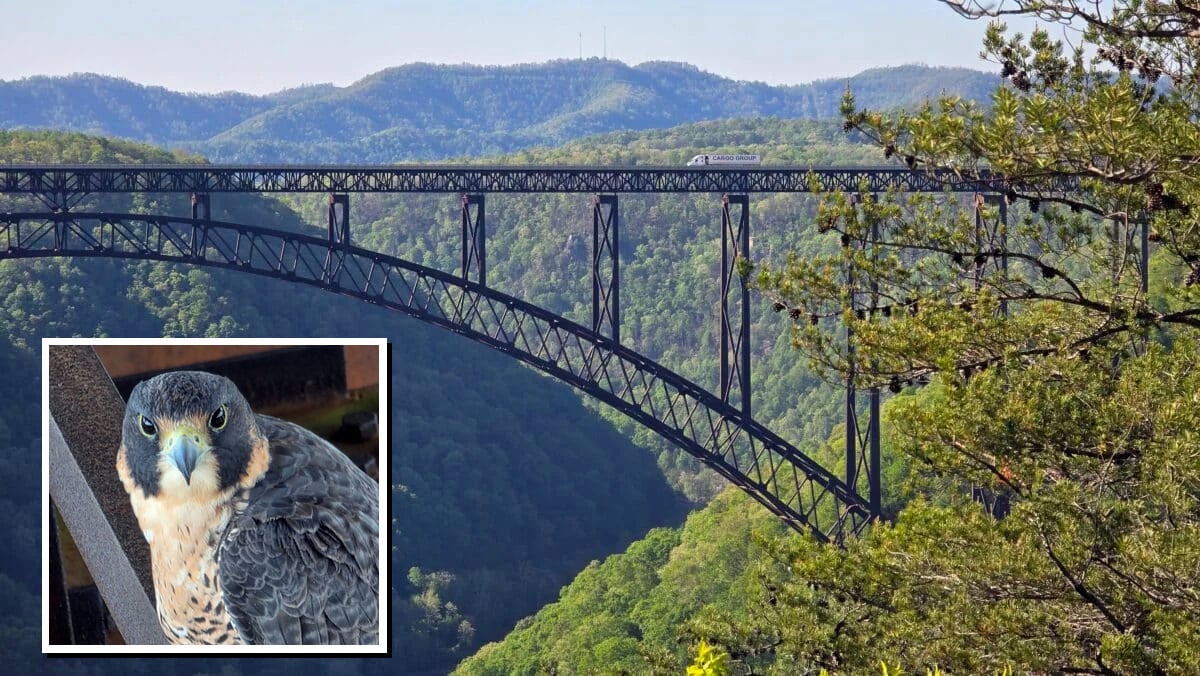
LANSING, W.Va. — Two unbanded peregrine falcons have been confirmed at the New River Gorge Bridge, an encouraging development nearly two decades after conservationists began an ambitious effort to restore the species to the central Appalachians.
Bridge Walk guides, who lead tours along the catwalk beneath the landmark span, observed the two birds together Monday after tracking peregrine activity around the bridge since late May.
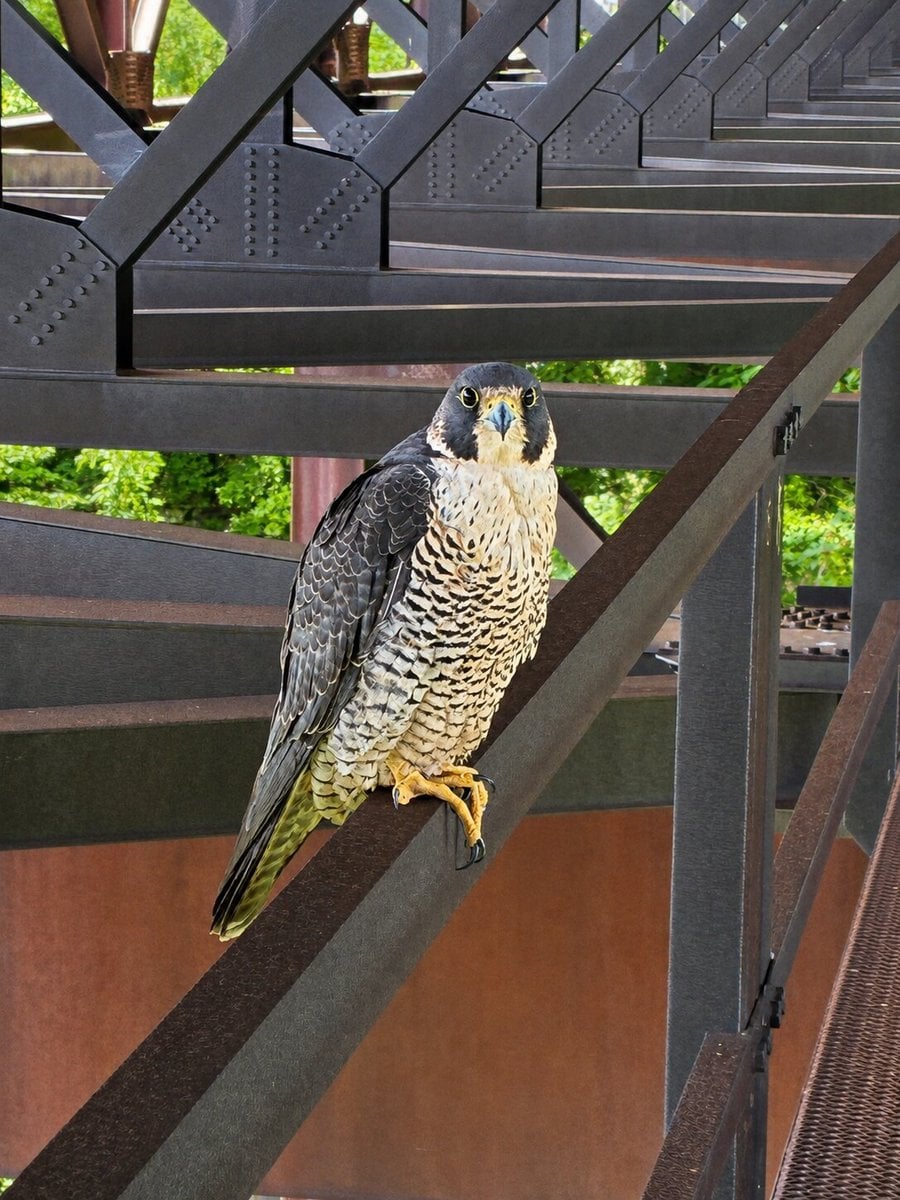
The absence of bands is significant, according to Wendy Perrone, executive director of Three Rivers Avian Center, which participated in the years-long peregrine restoration project in the New River Gorge. Birds released through that program were fitted with identifying bands, while the peregrines now being observed at the bridge are wild-bred, Perrone said.
For Bridge Walk General Manager Julie Jones, Monday’s sighting confirmed what guides had increasingly suspected.
“We’re just so excited to see them coming back on this level,” Jones said. “This is huge.”
Guides first noticed dead pigeons around the bridge in late May, raising hopes that a peregrine might be responsible. They soon began seeing a falcon at a distance, and in early June one guide witnessed a peregrine take a pigeon in flight.
The bird remained around the bridge through June and into early July before disappearing, Jones said. More recently, Bridge Walk guide and former park ranger Sarah Prior became convinced that the peregrine being observed was a different bird, although initial photographs made comparisons difficult.
Then Monday, guides saw two peregrines on the bridge at the same time.
“This is the first day that we’ve seen two birds on the bridge, and we are absolutely ecstatic,” Jones said.
New birds continue a national conservation success story
The peregrines at the New River Gorge Bridge are part of one of the nation’s most notable wildlife recoveries, Perrone said.
Peregrine falcons had disappeared from the eastern United States by 1970, after populations collapsed during the widespread use of DDT and other organochlorine pesticides. DDT caused the birds to produce thin-shelled eggs that frequently broke during incubation, according to the U.S. Fish and Wildlife Service.
The peregrine was federally listed as endangered in 1970. Restrictions on DDT, federal protections, and extensive restoration programs eventually allowed the population to recover, and the species was removed from the federal endangered species list in 1999.
The New River Gorge became part of that larger recovery effort as conservationists sought to re-establish peregrines in a portion of their former Appalachian range.
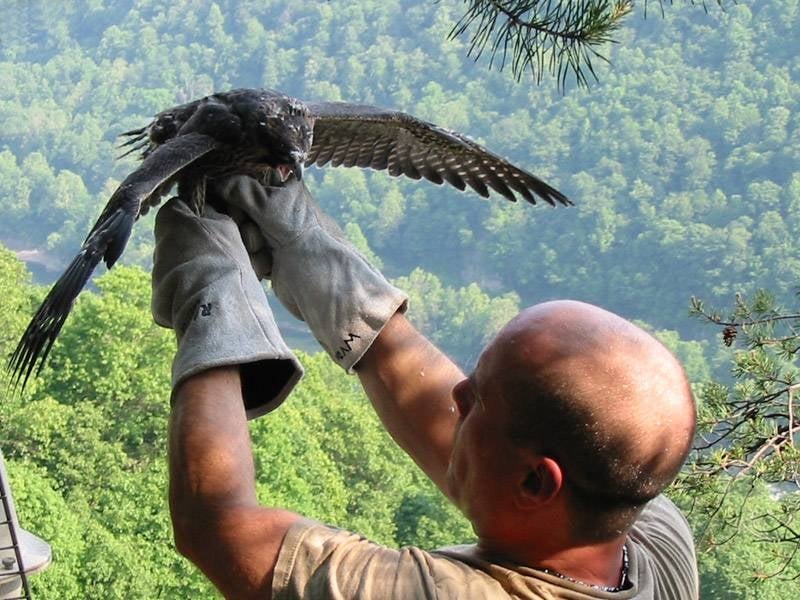
From 2006 through 2011, the National Park Service, Three Rivers Avian Center, and their partners released more than 120 young peregrine falcons into the New River Gorge at sites near Lansing and Grandview. National Park Service records put the final number at 122 and describe the effort as the largest peregrine restoration project in the eastern United States by both numbers and success rates.
The birds used in the program were wild peregrines removed from dangerous situations elsewhere, including bridges, buildings, and other structures. They were fitted with identifying bands from the U.S. Fish and Wildlife Service and from the states they came from, then spent time in special enclosures known as hack boxes before their release.

“The idea was to try to re-establish peregrine falcons into the southern Appalachia region because they just hadn’t spread out into the Southern Appalachians,” Perrone said.
One released falcon made the bridge his home
One of the early males brought into the restoration program came from the Betsy Ross Bridge area between Pennsylvania and New Jersey and later took up residence at the New River Gorge Bridge. He attracted a wild female, and the pair produced young.
One of their male offspring was injured in a 2015 collision and found at the bottom of the bridge. The bird survived and became Dori, an ambassador peregrine at Three Rivers Avian Center.
For Perrone, the continued presence of peregrines at the bridge illustrates what coordinated wildlife restoration can accomplish.
“Peregrine falcons are an indicator of success when it comes to what it takes for everybody to pitch in and get a wild species back to its original amounts,” she said.
Restoring peregrines nationally required cooperation among federal and state wildlife agencies, universities, conservation organizations, and others. By the time federal wildlife officials announced the species’ recovery, more than 6,000 falcons had been reintroduced into the wild nationwide.
Why peregrines favor the New River Gorge
The gorge provides many of the features peregrines need, Perrone said, including cliffs and cavities for nesting and shelter, a waterway that attracts potential prey, and an abundance of birds to hunt. Peregrines also readily use human structures, including bridge abutments and other parts of bridges that can provide some of the same advantages as natural cliffs.
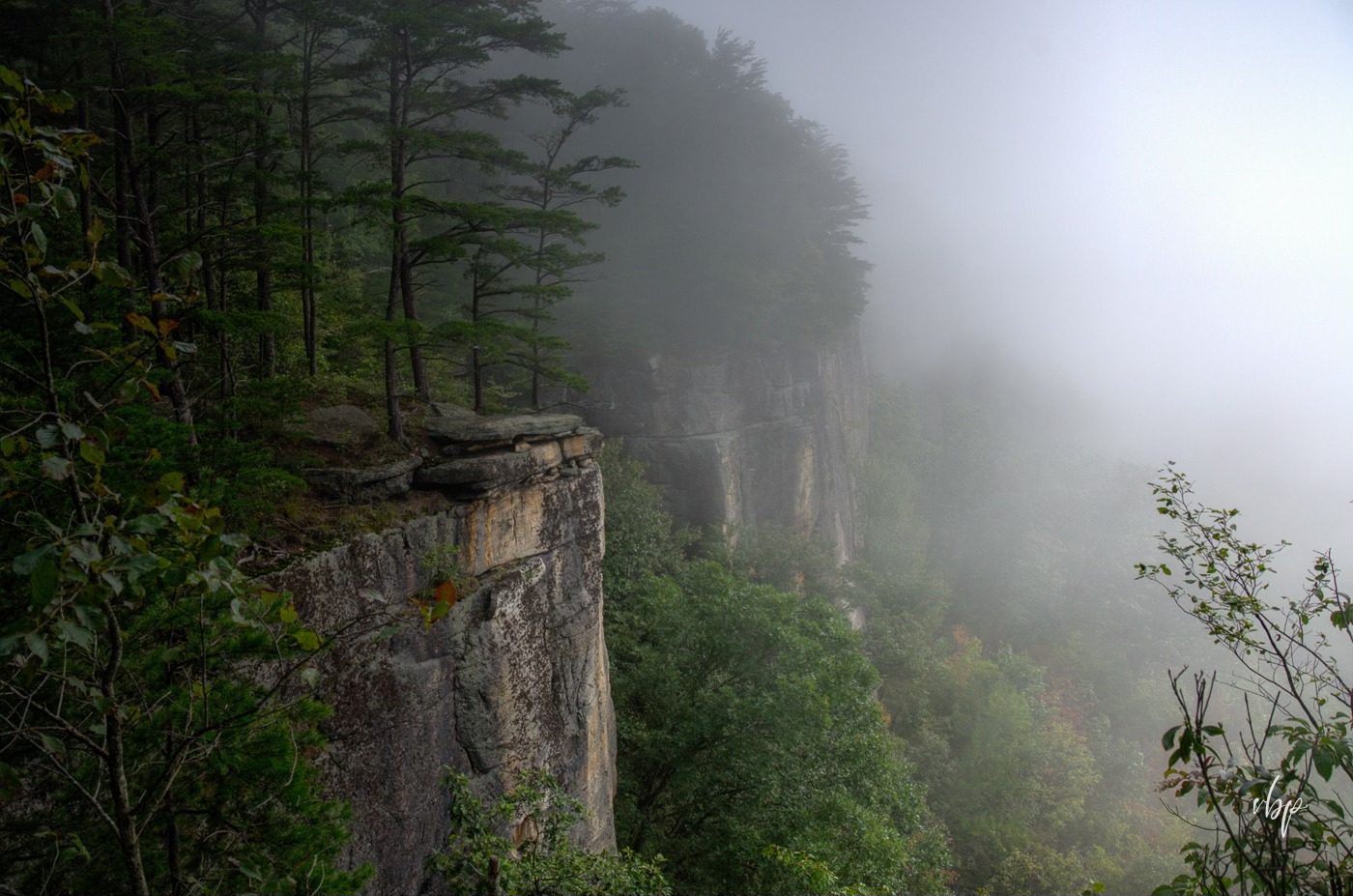
“It is perfect, you know, peregrine place,” Perrone said.
Peregrines primarily prey on other birds and are exceptionally fast aerial predators. The U.S. Fish and Wildlife Service says they can reach about 200 mph while diving after prey, making them among the fastest animals on Earth.
Perrone suspects individual peregrines have succeeded one another at the New River Gorge Bridge as older birds disappeared and new mates arrived, though she emphasized that she has no data to establish that history with certainty. She believes the desirable habitat could explain why peregrines have continued to occupy the area through successive generations.
“It has been ongoing now since, gosh, 2007 or ’08, I think, is when they first took up residence there,” Perrone said. “It’s been just handoff to handoff to handoff, and it’s wonderful to see.”
Bridge guides get a rare view of the falcons
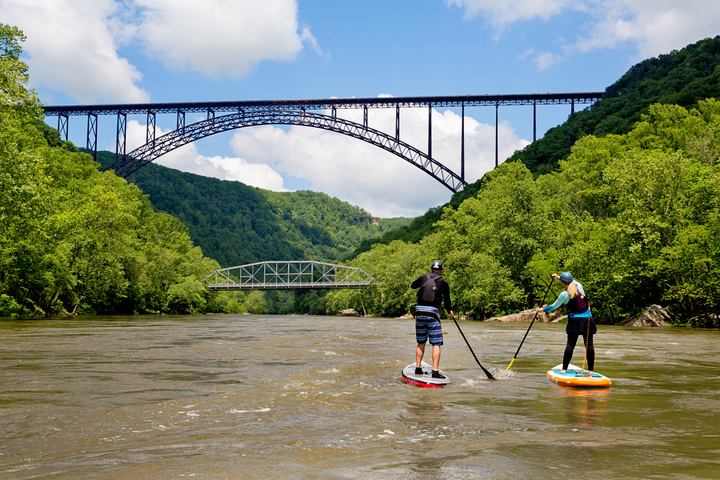
Bridge Walk guides are uniquely positioned to observe birds because their tours follow the maintenance catwalk beneath the New River Gorge Bridge, roughly 851 feet above the New River. From there, visitors can see the gorge’s cliffs, railroad, whitewater, and wildlife from beneath one of West Virginia’s best-known landmarks.
Jones said employees are careful not to interfere with the peregrines. She previously consulted experts familiar with the species to ensure Bridge Walk’s activities did not disturb the birds, and guides give them space when they encounter them.
The attraction operates year-round, and Jones said the minimum age is 8. Unlike some of the more strenuous adventure activities associated with the New River Gorge, Bridge Walk can accommodate a broad range of visitors, including multigenerational families.
The two peregrines have now added another wildlife encounter to that experience, though several questions remain. It has not been established whether the birds are a male and female, and there is no evidence yet that they intend to nest at the bridge.
Both birds are unbanded. Years after conservationists stopped releasing banded peregrines into the New River Gorge, wild-bred falcons continue to occupy the bridge and gorge that helped anchor one of the East’s largest peregrine restoration efforts.
For Perrone, their presence is another encouraging chapter in a conservation story that has unfolded there for nearly two decades.
Dear Mr. Sibray:
Thank you so very much for writing this article and I truly enjoy reading everything on this extremely outstanding website. As a native West Virginian and living in a chemical valley in the Charleston area, I have always had many deep concerns about the beautiful wildlife, environment,and everything. I have made numerous trips to New River Gorge and other beautiful places throughout West Virginia, I’m extremely proud of all of the beauty that West Virginia has. It makes me extremely happy when people work hard to preserve it .
Although I now live in Arden, North Carolina another beautiful mountainous community, my heart will always be in the beauty places in West Virginia.
I’m also a Veteran’s Advocate and have been one for 35 years and I used to travel throughout the rural areas and assist Veterans and their families. You can read more about me by searching Lisa Groves Veterans at Google.com.
Again thank you so very much for all you do and I’m looking forward to reading many more articles.
Today I saw a peregrine falcon just below Pinnacle Rock in Mercer county. Brief, it was moving along.