
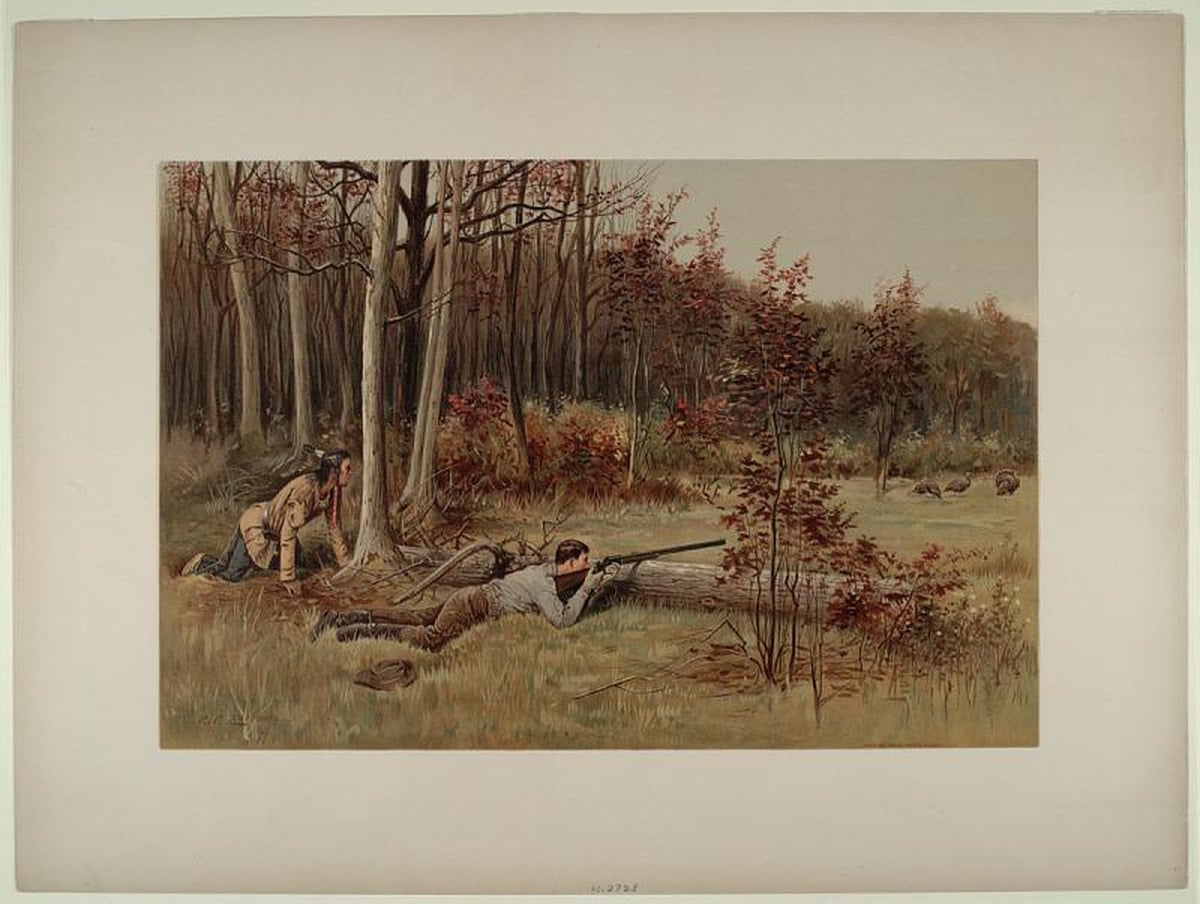
CHARLESTON, W.Va. — One of America’s oldest hunting traditions returns to Appalachian forests Saturday, Oct. 10, when West Virginia opens its fall wild turkey season in all 55 counties, continuing a pursuit that has survived centuries of settlement, deforestation, and the bird’s near-disappearance.

Long before European colonists arrived in North America, Indigenous peoples hunted wild turkeys for food and used their feathers and bones for tools, ornaments, and other purposes. The bird later became an important food source for settlers moving into the Appalachian interior and generations of rural Americans who depended on the forests for meat.
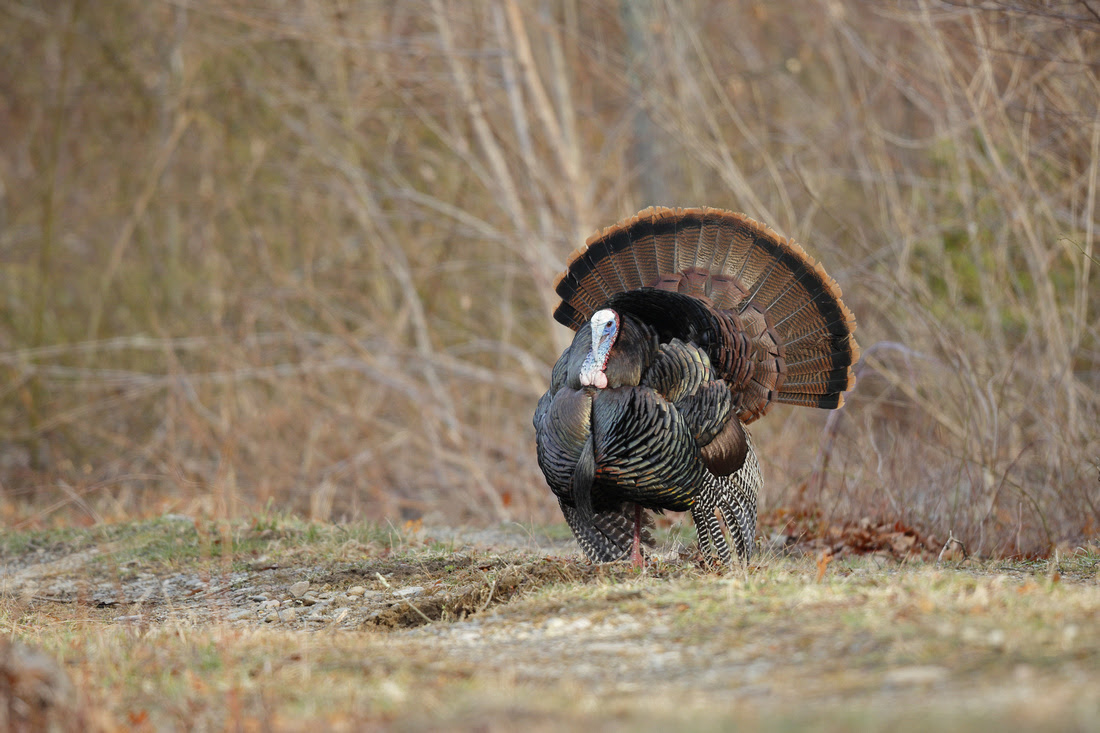
Today, wild turkey hunting is associated with one of the nation’s most successful wildlife restoration efforts. After populations collapsed during the 19th and early 20th centuries, hunting regulations, forest regeneration, and programs to relocate surviving wild birds helped restore the species across much of its original range.
For West Virginia hunters, the annual fall season preserves a tradition that combines forest knowledge, the challenge of pursuing one of North America’s wariest game birds, and the opportunity to provide a wild turkey for the Thanksgiving table.
Brett McMillion, director of the W.Va. Division of Natural Resources, emphasized the holiday tradition of presenting a wild turkey for the celebration.
“We encourage hunters to take the opportunity to reconnect with the outdoors and pursue one of West Virginia’s most elusive game birds,” McMillion said.
“There’s nothing like bagging your own wild turkey for Thanksgiving dinner. It’s a wonderful tradition to share with family and friends, and we remind everyone to stay safe, follow season regulations, and make the most of West Virginia’s unmatched autumn woods.”
A bird that helped feed early America
The eastern wild turkey, the subspecies native to West Virginia, inhabited the hardwood forests of eastern North America thousands of years before the United States was established.
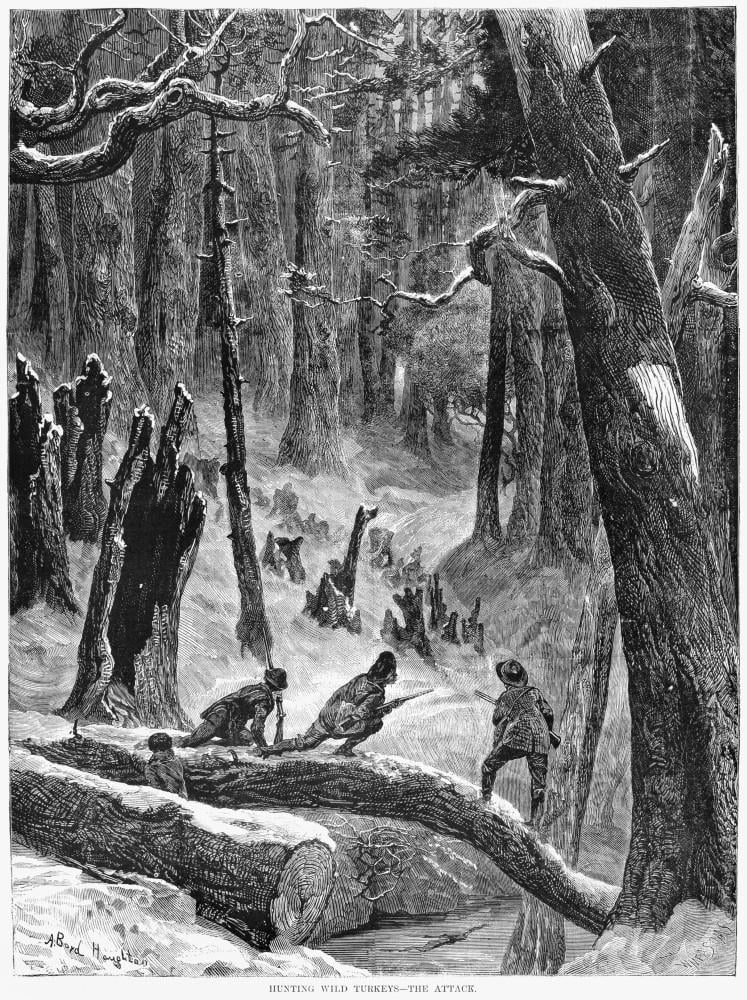
Archaeological evidence shows that Indigenous communities hunted wild turkeys and used their feathers and bones for many purposes. Elsewhere in North America, Indigenous peoples domesticated turkeys long before European contact.
Turkeys domesticated in ancient Mexico eventually reached Europe through Spanish exploration and trade. Descendants of those birds later returned to North America with European settlers.
Wild turkeys, meanwhile, remained an important food source for settlers moving into the Appalachian Mountains, where extensive forests provided suitable habitat.
The birds feed on acorns, beechnuts, berries, seeds, insects, and other natural foods. Their ability to travel considerable distances on foot and to fly into trees to roost helps them survive in forested landscapes.
Unlike domesticated turkeys raised commercially for meat, wild turkeys are strong fliers with exceptionally keen eyesight. Their ability to detect movement and quickly escape danger makes them challenging quarry even for experienced hunters.
Their place in American culture extends beyond hunting. Benjamin Franklin famously praised the turkey’s courage in a 1784 letter criticizing the bald eagle as a national symbol. Although the letter inspired the enduring belief that Franklin wanted the turkey adopted as the national bird, he never formally proposed replacing the eagle.
How Americans nearly lost the wild turkey
Despite its former abundance, the wild turkey experienced severe population declines as American settlement expanded.
Commercial hunting, poorly regulated harvests, and forest clearing for agriculture and development reduced its numbers throughout the 19th and early 20th centuries.
By the 1930s, conservation histories estimate that fewer than 30,000 wild turkeys remained in the United States. The species had disappeared from large portions of its former range.
Early restoration efforts often involved releasing captive-raised turkeys, but these attempts frequently failed because the birds lacked the survival skills needed to establish wild populations.
Wildlife agencies eventually achieved better results by capturing surviving wild turkeys and relocating them to suitable forests where the species had disappeared.
The development of cannon nets and other capture methods allowed biologists to move wild birds more effectively. Meanwhile, forests were regenerating across parts of the eastern United States as former agricultural lands reverted to woodland.
Conservation funding played an essential role
The federal Pittman-Robertson Act of 1937 established a system through which excise taxes on firearms and ammunition support state wildlife conservation programs. Hunting license revenues provided additional funding for habitat management, research, and restoration.
These combined efforts helped wild turkey populations recover to several million birds nationally, although populations have subsequently declined in some regions.
West Virginia contributed to the restoration beyond its borders. In 1956, six wild turkeys from West Virginia and four from Kentucky were released in Ohio as part of that state’s effort to reestablish the species. Wild turkeys from West Virginia also contributed to restoration efforts in Illinois beginning in 1959.
The restoration became a prominent example of cooperation among hunters, wildlife agencies, conservation organizations, and landowners.
Yet wildlife biologists caution that the recovery does not guarantee the bird’s future. Populations have declined in portions of the eastern and southern United States, renewing research into nesting success, habitat quality, and the survival of young birds.
Why fall turkey hunting is different
Spring turkey hunting is best known for male birds gobbling to attract mates. Hunters often imitate hen calls to attract a gobbler within range.
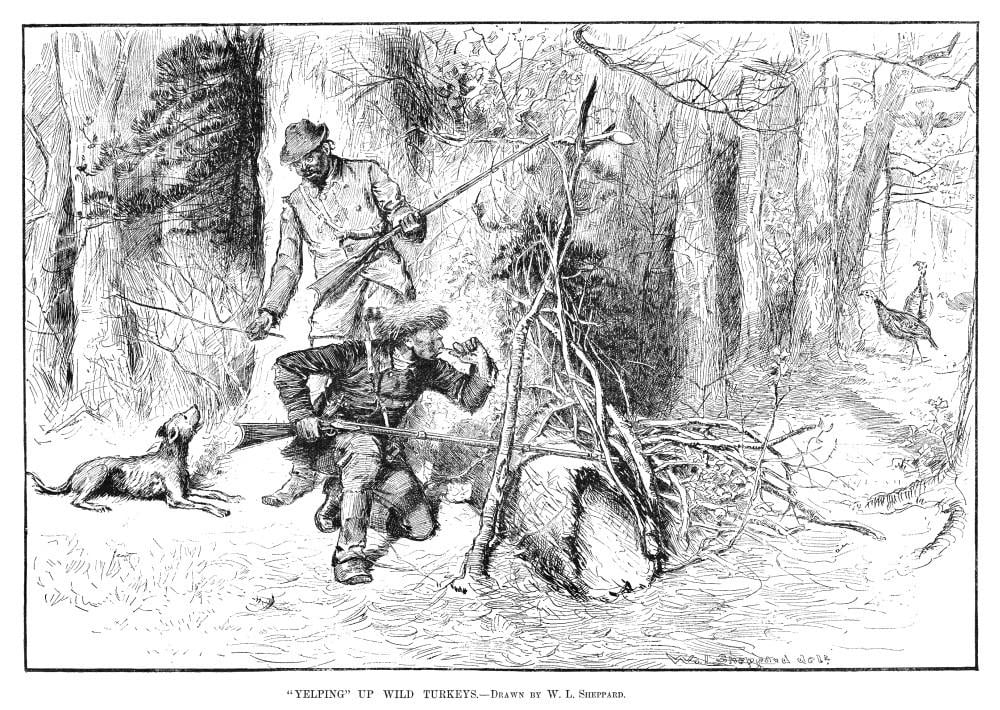
Fall hunting requires a different understanding of turkey behavior.
By October, the breeding season has ended, and wild turkeys spend much of their time traveling and feeding in flocks. Hunters must locate the birds, identify feeding areas, and understand how groups move through the forest.
In West Virginia, that often means searching hardwood ridges where acorns, beechnuts, and other natural foods become important in autumn.

The availability of these foods can influence where turkeys gather. Productive oak ridges may repeatedly attract birds, while a shortage of mast can force flocks to travel farther to find food.
Turkey calling also has a long history in America. Traditional calls have been made from wood, slate, and even turkey wing bones. Modern hunters use a variety of friction and mouth calls to imitate the clucks, yelps, and other vocalizations turkeys use to communicate.
Fall hunters sometimes use calls to attract birds separated from their flocks, taking advantage of their tendency to regroup.
Unlike spring hunting, which typically focuses on adult male turkeys, West Virginia’s fall season allows hunters to harvest one bird of either sex.
The challenge is considerable. Wild turkeys can detect movement at great distances, and their keen eyesight makes concealment especially important.
For hunters accustomed to pursuing gobblers in spring, autumn offers a different experience, emphasizing the birds’ feeding habits, flock behavior, and movements through the forest.
West Virginia’s fall turkey harvest declined sharply in 2025
The state’s most recent fall harvest figures remind us that wild turkey populations and hunting success can fluctuate considerably.
West Virginia hunters harvested 537 wild turkeys in the 2025 fall season, a 52.5 percent decrease from the 1,130 birds harvested in 2024, according to state biologists.
The 2025 total was also 38.1 percent below the five-year average and 49.9 percent below the 10-year average.
The agency attributed the lower harvest, in part, to rainy spring and early summer conditions that may have reduced survival among young turkeys. Abundant acorns and other hard mast also likely made birds harder to locate because food was widely available.
Although division staff observed more broods than the five-year average, the number of young birds per hen was the lowest recorded in five years.
The agency cautioned that harvest totals reflect several factors, including hunter participation, reproductive success, and food availability, rather than providing a direct count of the state’s wild turkey population.
West Virginia’s 2026 fall turkey season
The fall season opens Saturday, Oct. 10, in all 55 West Virginia counties, with additional hunting opportunities in selected counties.
| Season dates | Counties |
|---|---|
| Oct. 10–18 | All 55 counties |
| Oct. 26–Nov. 1 | 16 counties receive an additional week |
| Oct. 26–Nov. 15 | 14 counties receive three additional weeks |
The remaining 25 counties close after Oct. 18. The two later periods are alternatives for different county groups, not consecutive seasons in the same counties.
Hunters may harvest one turkey of either sex during the fall season using a bow, crossbow, or legal firearm, including .22 caliber or larger air rifles.
Hunting hours extend from 30 minutes before sunrise until 30 minutes after sunset. Electronic calls and bait are prohibited.
Hunters age 15 and older generally must possess a valid hunting license and identification, subject to applicable exemptions. Authorized agents and WVHunt.com offer licenses.
Hunters should review the 2026–2027 West Virginia Hunting and Trapping Regulations Summary, particularly because season lengths vary by county.
An American tradition with an uncertain future
The wild turkey’s history reflects both the environmental costs of American expansion and the promise of organized wildlife conservation.
For thousands of years, people hunted the bird for food. Its decline followed the transformation of the continent’s forests, while its recovery required decades of wildlife management, habitat restoration, and financial support from hunters and other conservation interests.
Today, declining populations in some regions have raised new questions about how to sustain that achievement.
The challenge is no longer simply returning wild turkeys to places where they disappeared. It is understanding what healthy populations need to survive as forests, land use, and environmental conditions continue to change.
For West Virginia hunters entering the woods this October, the season offers a connection to a tradition older than the nation itself. Whether they return with a Thanksgiving bird or only the experience of the hunt, their opportunity exists in part because earlier generations worked to restore a species Americans once came close to losing.
The future of that tradition will depend on continuing the conservation work that brought the wild turkey back.