
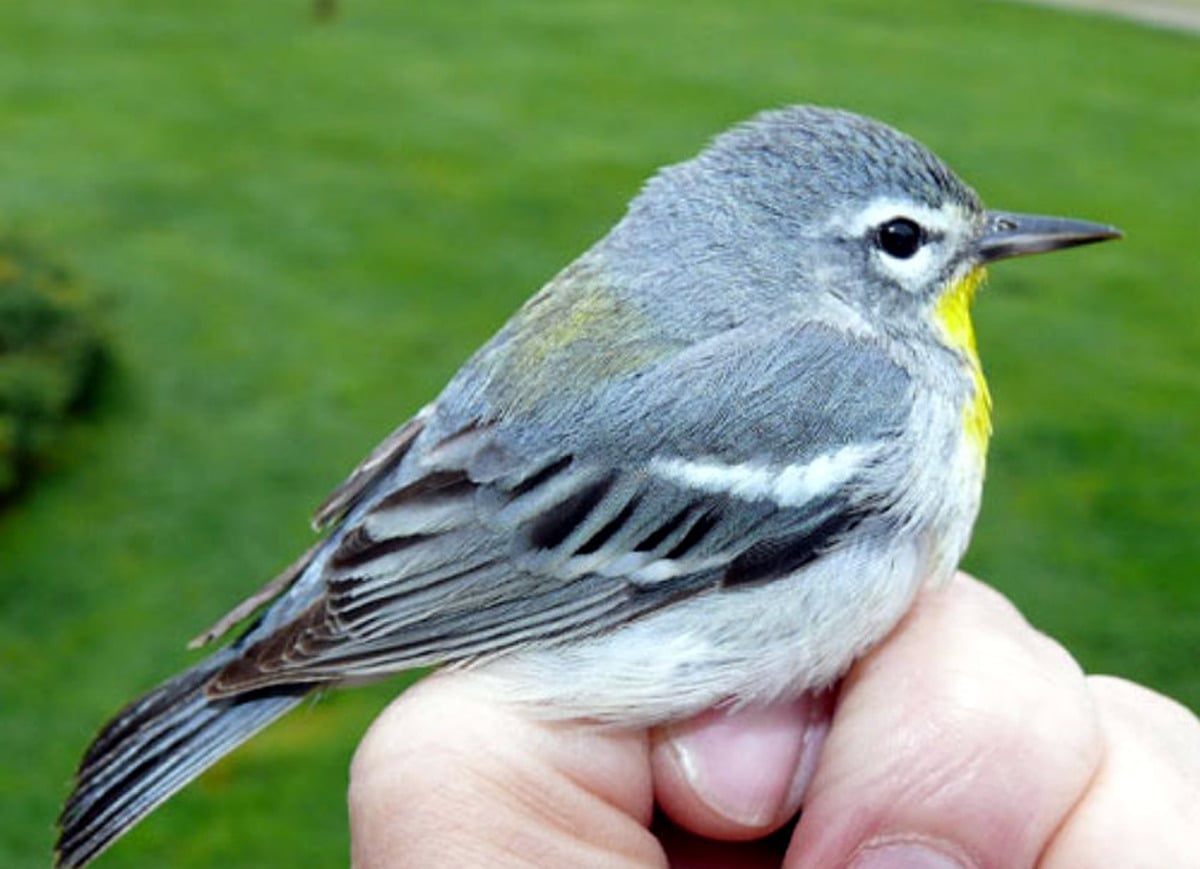
DANIELS, W.Va. — In the spring of 1975, two women visiting Little Beaver State Park in Raleigh County spotted an unusual songbird that would soon convince dozens of experienced birdwatchers they had rediscovered one of North America’s rarest birds.
The bird appeared to be Sutton’s Warbler, first discovered in West Virginia’s eastern panhandle in 1939 and long considered one of the most elusive birds in American ornithology.
Members of the Brooks Bird Club captured the bird in a mist net, examined and photographed it, and released it. An account of the discovery appeared in the national ornithological journal American Birds.
But months later, the journal published a correction. After examining photographs, several ornithologists determined that the bird was actually a yellow-throated warbler.
The journal’s editors acknowledged that the apparent agreement of approximately 60 observers, including highly experienced birdwatchers, had given the identification credibility it did not deserve.
An extraordinary discovery at Little Beaver
Ann Shreve of Charleston and Connie Katholi of South Charleston first reported the bird, according to Jim Comstock’s 1976 West Virginia Heritage Encyclopedia.
The women were visiting Little Beaver State Park during the Brooks Bird Club’s annual foray, a gathering of naturalists who studied wildlife in different regions of West Virginia. The 1975 foray was headquartered at the Raleigh County 4-H Camp near Daniels.
The bird’s unusual song attracted attention. It resembled the northern parula’s song but included a repeated phrase associated with Sutton’s Warbler.
In a 2017 account published by the West Virginia Highlands Conservancy, John McFerrin described how additional birdwatchers were summoned to investigate.
The group captured the bird in a mist net, allowing them to examine it closely. Photographers took photos, and the bird was released after being banded.
The Brooks Bird Club’s history of its first 75 years also documents the encounter.
Comstock reported that the club described the discovery as an ornithological find of national significance.
Leland S. DeVore published the identification in an article titled Sutton’s Warbler in West Virginia, appearing in the 1975 volume of American Birds.
Scientists overturn the identification
In December 1975, American Birds published a formal correction stating that the identification was apparently mistaken.
Several ornithologists had examined photographs of the captured bird and concluded that its physical characteristics were those of a yellow-throated warbler, despite its superficial resemblance to Sutton’s Warbler.

Its unusual song remained noteworthy. The editors reported that its vocalizations and responses to recorded bird songs raised questions about possible hybridization between yellow-throated warblers and northern parulas.
The correction also acknowledged that the original report had been rushed into publication.
The editors expressed regret that so many observers’ agreement had lent the identification unwarranted credibility. They also clarified that the published report had created the mistaken impression that its author had personally participated in the original observation.
The correction did not challenge the fact that an unusual bird had been captured and examined in Raleigh County. It established that the photographic evidence did not support the identification as Sutton’s Warbler.
The mystery began in West Virginia in 1939
The excitement surrounding the 1975 encounter reflected the unusual history of Sutton’s Warbler.
In 1939, ornithologist Karl W. Haller collected two unfamiliar warblers in West Virginia’s Eastern Panhandle.
The first, a male, was collected May 30 near Martinsburg in Berkeley County. Researchers collected the second, a female, on June 1 near Shepherdstown in Jefferson County.
The birds resembled yellow-throated warblers but showed characteristics associated with northern parulas, including greenish back coloration. Their songs also differed from those of typical yellow-throated warblers.
Haller described the birds in 1940 as a previously unknown species, Dendroica potomac, naming it Sutton’s Warbler in honor of George Miksch Sutton, a West Virginia-born ornithologist and bird illustrator.
The announcement drew national attention because discovering a new bird species in the eastern United States was considered extraordinary.
Sutton himself questioned whether the birds represented a separate species, suggesting that they might be hybrids between northern parulas and yellow-throated warblers.
The Brooks Bird Club documented the discovery and subsequent scientific discussion in The Redstart, the Club’s journal.
Birdwatchers spent decades searching
The original discovery prompted Brooks Bird Club members to organize searches for additional examples.
A group known as the Sutton’s Seekers returned to the Eastern Panhandle, where Haller had collected the original specimens.
Other birds resembling Sutton’s Warbler were reported during the following decades, although no established breeding population was identified.
The birds’ rarity complicated attempts to identify them. Ornithologists had few opportunities to study living examples, and differences in plumage or song could make identification uncertain.
By 1975, Sutton’s Warbler had become a familiar name among West Virginia’s serious birdwatchers, even though few had ever encountered a bird believed to be one.
That history explains why the Little Beaver discovery attracted so much attention and why observers were eager to establish its identity.
What scientists know about Sutton’s Warbler today
Sutton’s Warbler is now generally regarded as a rare hybrid between the northern parula (Setophaga americana) and the yellow-throated warbler (Setophaga dominica).
Both species breed in eastern North America, including West Virginia.
Hybrids can inherit physical characteristics from both parent species, producing combinations of plumage and other traits that differ from typical examples of either bird.

In 2012, researchers Nicholas M. Anich, Jack A. Swelstad and Brian Pierce published The First Report of Sutton’s Warbler in Wisconsin, documenting an unusual warbler observed in Wisconsin in May 2011.
Their study reviewed the historical record and cited an earlier compilation of 15 sightings between 1939 and 1980, including seven in West Virginia.
The researchers supported the interpretation that birds resembling Sutton’s Warbler represent hybrids rather than members of a separate species.
However, researchers identified the 1975 Raleigh County bird as a yellow-throated warbler after examining the photographs. Its unusual song prompted speculation about hybridization, but the correction did not establish that it was a hybrid.
A discovery corrected by science
Founded in 1932, the Brooks Bird Club has played an important role in documenting West Virginia’s birdlife through field observations, scientific publications and annual forays.
The 1975 encounter remains part of that history, although its original identification was overturned.
Comstock’s encyclopedia, published the following year, preserved the excitement surrounding the discovery but did not reflect the correction issued by American Birds in December 1975.
The photographs taken during the Raleigh County foray ultimately allowed ornithologists to reject the identification that dozens of observers had accepted.
The journal’s correction identified the bird as a yellow-throated warbler, but its unusual song remained a subject of scientific interest.