
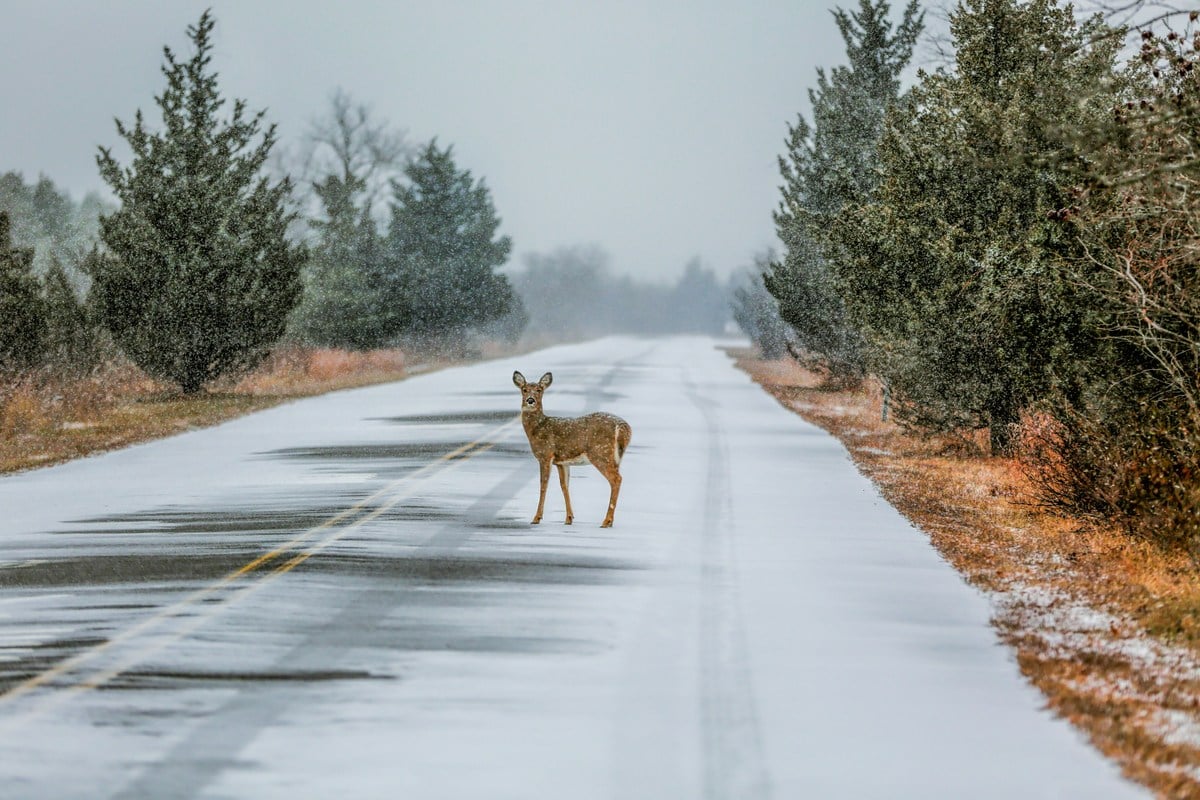
CHARLESTON, W.Va. — West Virginia motorists face the nation’s highest risk of striking an animal while driving, according to new insurance data released as the state enters its most dangerous deer-collision season.

“Driving through West Virginia this time of year is like driving through a petting zoo,” said David Sibray, publisher of West Virginia Explorer. “I drive all 55 counties year-round, and this time of year in particular I keep a sharp eye out.”
West Virginia drivers face a one-in-46 chance of an animal-related collision, compared with a national average of one in 145, according to State Farm’s latest annual report. The state has held the nation’s highest-risk ranking for more than a decade.
November is the most dangerous month nationally, followed by October and December. The increased risk coincides with the autumn breeding season for white-tailed deer, when animals move more frequently and are more likely to cross highways.
State Farm estimates that more than 1.6 million animal-related vehicle claims occurred nationwide between July 1, 2025, and June 30, 2026. The insurer paid approximately $1.9 billion in associated claims costs during that period.
Deer account for the largest share of animal collisions, although the study also includes other wildlife and domestic animals. Some animal-related claims involve damage unrelated to collisions, such as rodents chewing vehicle wiring.
West Virginia’s likelihood improved from one in 40 in the preceding reporting period, but it remains substantially higher than in any other state. Montana ranks second at one in 54, followed by Wisconsin at one in 62, Pennsylvania at one in 64, and Michigan at one in 68.
Why autumn is especially dangerous
The W.Va. Division of Natural Resources in Charleston warns that the state’s mountainous terrain, winding highways, and narrow roads can make it difficult for drivers to spot animals before they enter traffic.
Sharp curves and hills limit visibility, especially in the early morning and evening, when deer are most active.
The danger increases during the breeding season, commonly called the rut. Bucks travel more widely in search of does, and deer may cross roads without regard for approaching vehicles.
November is generally the peak breeding period for white-tailed deer in West Virginia.
Motorists should also be aware that deer frequently travel in groups. When one crosses a highway, others may follow.
These conditions contribute to the hazards motorists encounter, although State Farm’s research does not establish precisely why West Virginia ranks above every other state.
What to do if you hit a deer in West Virginia
A collision with a deer can badly damage a vehicle, even when its occupants escape injury.
State Farm recommends moving the vehicle out of traffic, if it can be done safely, and turning on the hazard lights. Motorists should avoid approaching a wounded animal, which may kick or charge when frightened.
Once safely off the roadway, drivers should photograph the damage and surrounding conditions. Photos of the vehicle, roadway, and accident scene can help document an insurance claim.
Drivers should also check for leaking fluids, damaged tires, broken headlights, loose body panels, and other mechanical problems before continuing their trip.
A vehicle that appears drivable may have sustained damage to its radiator, steering, or other essential components. When its condition is uncertain, towing is the safer option.
West Virginia law requires motorists to immediately notify law enforcement when a crash results in injury, death, or apparent property damage of $1,000 or more.
Under West Virginia Code §17C-4-6, drivers must notify municipal police if the crash occurs within a municipality. Elsewhere, drivers must notify the county sheriff’s office or the nearest West Virginia State Police office.
The requirement applies to qualifying crashes even when no other vehicle is involved.
Motorists who encounter a dead animal obstructing a state highway can also request its removal through the West Virginia Division of Highways at 1-833-WVROADS.

Does insurance cover hitting a deer?
Damage from directly striking a deer is generally covered under the comprehensive portion of an automobile insurance policy.
Comprehensive insurance typically covers animal strikes, theft, fire, and certain other losses that do not involve collisions with vehicles or roadside objects.
Motorists carrying only liability insurance generally have no coverage for damage to their own vehicles from striking deer.
Those with comprehensive coverage ordinarily must pay their deductible before the insurer covers the remaining eligible repair costs.
A different situation arises when a driver swerves to avoid an animal and instead strikes a tree, guardrail, or another vehicle. Such damage may fall under collision coverage rather than comprehensive coverage.
The distinction can affect both the deductible and how the insurer handles the claim.
Drivers should notify their insurance companies promptly, provide photographs, and retain records of towing, repairs, and other expenses. They should also determine whether their policies include rental-car reimbursement while their vehicles are being repaired.
A comprehensive claim does not automatically result in higher insurance premiums. Any increase depends on the insurer, the policy, and applicable state rules.
What happens if your vehicle is totaled?
Deer collisions can cause extensive front-end damage, sometimes making repairs cost more than the vehicle is worth.
When an insurer declares a vehicle a total loss, the settlement generally reflects its value immediately before the accident, subject to the policy’s terms and deductible, though West Virginia law sets requirements for determining that value.
Under West Virginia Code §33-6-33, insurance companies must use the most recent version of an official used-car guide approved by the state Insurance Commissioner to determine a vehicle’s minimum value in a total-loss settlement.
The law also requires an additional amount equal to the applicable consumer sales tax specified in the statute.
A separate provision, West Virginia Code §17A-4-10, defines a total-loss vehicle for specified salvage-title purposes as one sustaining damage equivalent to at least 75 percent of its market value, or meeting the statute’s flood-damage definition.
That threshold governs a particular legal classification and should not be interpreted as the only circumstance in which an insurer may settle a vehicle claim as a total loss.
Motorists who believe their vehicles have been undervalued can request an explanation of the insurer’s calculations.
The valuation should accurately reflect the vehicle’s make, model, mileage, equipment and pre-accident condition. Comparable vehicles advertised for sale may provide useful context, although asking prices do not necessarily establish market value.
Drivers should review the valuation and any deductions before accepting a final settlement.
Where to turn if an insurance claim is disputed
West Virginia motorists who encounter claim delays, denials, or disagreements over settlement amounts may contact the W.Va. Office of the Insurance Commissioner.
Its Property and Casualty Consumer Services Division reviews complaints involving automobile insurance and investigates whether insurers have complied with applicable laws and regulations. You can reach the division at 304-720-8580 or toll-free at 888-879-9842.
Although the agency can investigate insurance practices, it cannot represent consumers as an attorney or decide every dispute involving vehicle value or liability.
How to avoid a deer collision
State Farm advises motorists to reduce speed in areas where animals frequently cross highways, especially between dusk and dawn.
Drivers should watch the roadside for movement and use high beams when appropriate, as long as they do not interfere with oncoming traffic.
If a deer enters the roadway, motorists should brake firmly and, when possible, stay in their lane. Swerving can send a vehicle into oncoming traffic, a tree, or a roadside embankment.
The consequences can extend well beyond vehicle damage. According to figures from the Insurance Institute for Highway Safety cited by State Farm, 210 people died nationwide in motor vehicle crashes involving animals in 2024.
State Farm recommends wearing a seat belt on every trip and maintaining sufficient speed and stopping distance to react when wildlife appears unexpectedly.