
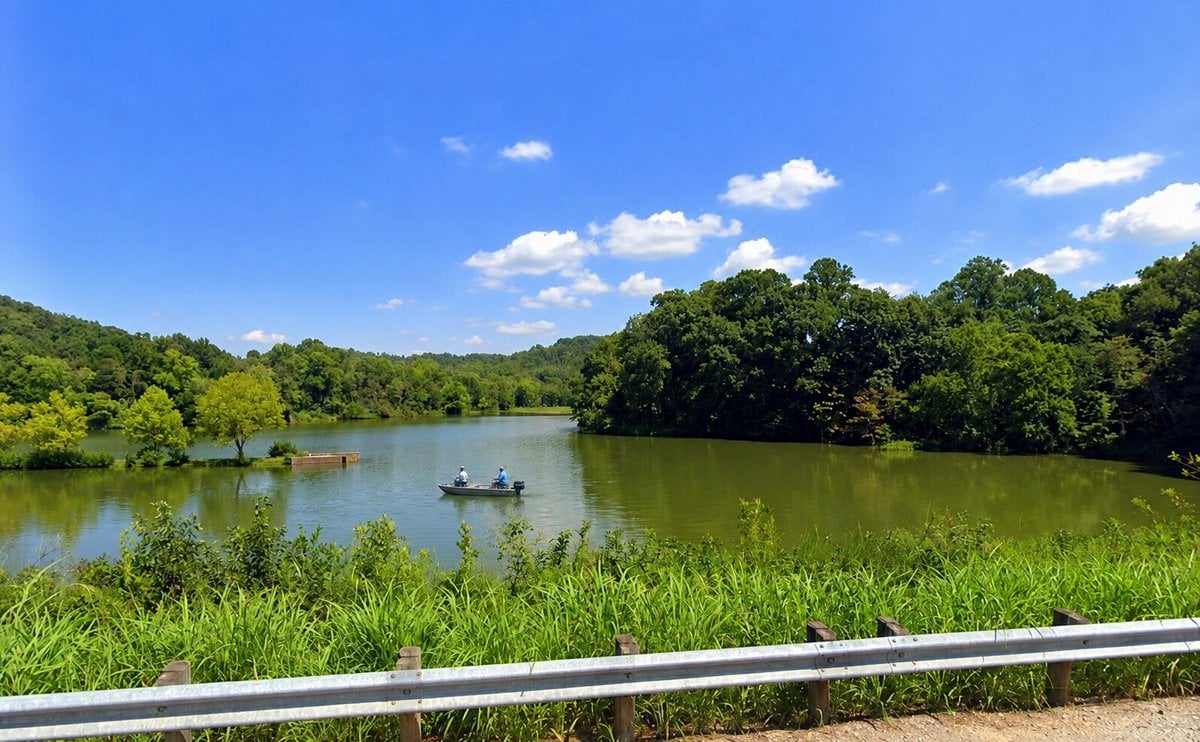
RAVENSWOOD, W.Va. — A 60-year-old West Virginia fishing lake will be drained and largely disappear under a state plan to remove an aging dam and restore the stream and wetlands that once occupied the valley before it was flooded.

The W.Va. Division of Natural Resources and the W.Va. Department of Environmental Protection announced Thursday that Turkey Run Lake in Jackson County will be returned to a free-flowing stream and wetland complex. The decision follows more than two years of debate over the lake’s future, including an earlier attempt to advance the project that then-Gov. Jim Justice made amid local concerns.
Crews are expected to begin dewatering the 15-acre lake later this summer, according to the agencies, with the larger restoration project scheduled for completion by the end of 2027. The project also includes a smaller fishing pond and wildlife-viewing trails.
The decision will fundamentally change a recreation area familiar to generations of residents and anglers around Ravenswood. According to division records, the earthen dam was completed in 1964, and Turkey Run Lake opened to fishing in 1966.
State officials say the dam no longer complies with the West Virginia Dam Control and Safety Act and is considered potentially unsafe during high-precipitation events. Keeping the existing lake would have required a major reconstruction project that the division estimated at approximately $30 million last year.
Instead, the state chose to remove the dam and reestablish Turkey Run through the valley.
“The project follows a detailed engineering and environmental review of Turkey Run Lake dam, which no longer meets modern safety standards and would require extensive reconstruction to remain in service,” officials with the division and department said in Thursday’s announcement.
The agencies said they considered multiple alternatives before determining that restoring the natural stream corridor would provide the greatest long-term benefit for the community, watershed, and wildlife.
State considered $30 million alternative to save lake
The decision announced Thursday resolves a question the DNR formally posed to the public in 2025.
At an April 2025 public meeting in Ravenswood, the agency presented two alternatives for Turkey Run Lake. One would have retained the lake by reinforcing the existing dam embankment and constructing a bridge capable of handling storm flow.
The DNR estimated that alternative at $30 million and said construction could disrupt nearby traffic and homes for several years.
The other alternative called for removing the dam and restoring a more natural stream system while creating additional stream and wetland habitat, a smaller fishing pond, wildlife-viewing areas, and trails.
DNR Director Brett McMillion said before the 2025 meeting that public input was important to the agency’s decision.
“Listening to the concerns and insights of the public strengthens our decision-making process as we work to safeguard our wildlife resources and the people who rely on them,” McMillion said at the time.
Local reaction documented during the public-comment period showed that at least some residents strongly preferred to retain the lake.

Zack Brown of the DNR told WSAZ-TV following the April 2025 meeting that local residents were particularly interested in keeping Turkey Run Lake and its fishing opportunities. He said people had grown up with the lake and considered it an important part of the community.
Ravenswood Mayor Josh Miller also publicly advocated exploring ways to preserve the lake. In an April 2025 interview with WCHS-TV, Miller described Turkey Run as important to recreational tourism and encouraged residents to participate in the state’s public process.
Anglers interviewed by the station similarly said they wanted to keep the lake, noting it attracted fishermen from the Ravenswood area as well as Ohio and Parkersburg.
Gov. Justice halted earlier Turkey Run project in 2024
The debate over Turkey Run Lake predates the 2025 public meeting.
Plans to remove the dam and restore the lake to a stream and wetland complex surfaced publicly in 2024 through a U.S. Army Corps of Engineers notice seeking comments on the proposed project.
The proposal raised concerns in Ravenswood. Mayor Miller asked the Corps of Engineers for a public hearing, according to contemporary local reporting.
On July 19, 2024, Justice directed the department and division to pause the project.
“Our priority is to make sure we are doing what is right in this situation,” Justice said at the time. “I want our agencies to take all the time they need to make sure the project benefits both the communities of our state and our natural resources.”
The DEP subsequently suspended work on the proposal while the state conducted additional review and stakeholder engagement.
The issue returned publicly the following spring, when the division presented the dam-rehabilitation option alongside the stream-restoration alternative and opened another period for public comment.
Thursday’s announcement settles that long-running debate in favor of removal.
Lake was created by damming Turkey Run
The restoration will also reverse a landscape change made more than six decades ago.
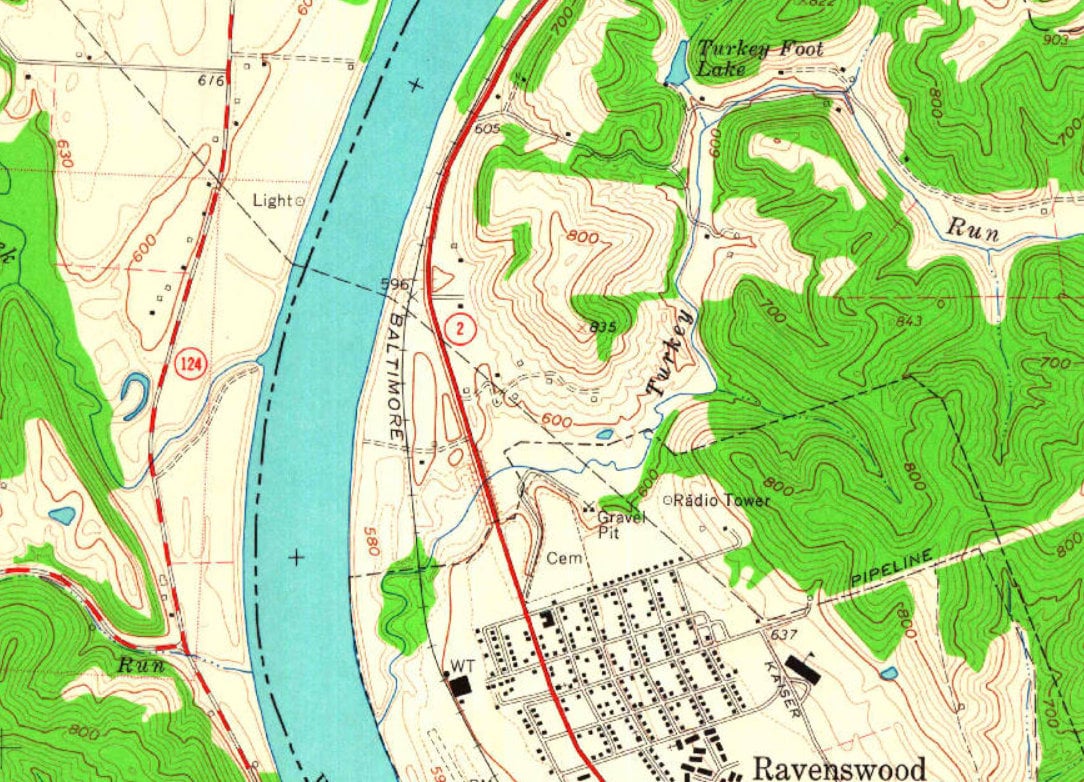
Turkey Run Lake occupies the Turkey Run valley just before the stream reaches the Ohio River near Ravenswood. A DEP water-quality study describes a watershed of approximately 2,147 acres, entirely within Jackson County, with land use dominated by forests and hay or pasture.
The 15-acre impoundment was created when the dam was built in 1964 and opened to fishing two years later.
Older DEP records indicate that Turkey Run Lake was relatively shallow. A state study based on earlier surveys reported an average depth of about four feet and a maximum depth of about nine feet.
The dam itself is substantially larger than the small lake might suggest. Regional hazard-mitigation records describe it as an earthen structure approximately 33 feet high and 1,000 feet long.
The same regional records classify Turkey Run Lake Dam as a high-hazard structure. Hazard classifications refer to the potential consequences of a dam failure rather than the dam’s current physical condition.
The DNR has been more specific about the immediate problem, stating in 2025 that Turkey Run Dam did not meet current provisions of the state Dam Control and Safety Act and was considered potentially unsafe during high-precipitation events.
WCHS reported in 2025 that nearby W.Va. 68 could be at risk because of the dam, while no homes were identified as being within the hazard area.
Popular lake remains part of state fishing program
The decision also marks the eventual loss of a long-established fishing destination.
According to division information, Turkey Run Lake has supported largemouth bass, bluegill, channel catfish, and crappie, as well as stocked trout. Recreational facilities have included a boat ramp and an accessible fishing pier.
The lake remained part of West Virginia’s active trout-stocking program even as its future was debated.
According to the agency’s stocking records, DNR hatchery crews stocked Turkey Run Lake during the week of Jan. 5, 2026, meaning trout were still being placed in the lake only months before Thursday’s decision to proceed with dewatering.
The state did not say in its announcement how it will handle fish remaining in Turkey Run Lake during dewatering. Officials say fishing opportunities will remain at the site, but Thursday’s announcement does not specify the size or location of the planned pond or the species that would eventually be managed there.
Turkey Run Lake has long-standing water-quality issues
The lake also has a history of environmental impairment that predates the current dam-safety debate.
DEP documents show that Turkey Run Lake was included on West Virginia’s 1998 list of impaired waters. A subsequent Total Maximum Daily Load study — a regulatory process used to determine how much pollution a water body can receive while meeting water-quality standards — identified problems involving nutrients, siltation, aluminum and iron.
The watershed itself is predominantly rural, according to the DEP study, and the agency evaluated multiple potential sources contributing sediment and other pollutants to the lake.
Federal records also document invasive aquatic vegetation in Turkey Run Lake.
The U.S. Geological Survey’s Nonindigenous Aquatic Species database records hydrilla as established at Turkey Run Lake in 2015. Hydrilla is a highly invasive submerged aquatic plant that can form dense growth in lakes and other waterways.
The state did not cite either the lake’s historical water-quality impairment or hydrilla as reasons for selecting dam removal in Thursday’s announcement. Officials instead emphasized dam safety, habitat improvement, natural hydrology and long-term watershed resilience.
Mitigation program will pay for restoration
West Virginia’s In Lieu Fee Program, administered by DEP, will fund the selected restoration project.
The program is part of the regulatory system governing impacts to streams and wetlands. Permittees whose projects cause unavoidable impacts to aquatic resources can meet certain federal mitigation obligations by paying fees that are directed toward qualifying restoration, enhancement, or preservation projects.
At Turkey Run, those funds will be used to remove the aging dam, restore natural hydrology, and create a stream-and-wetland complex that can satisfy federal mitigation requirements, according to the department and division.
The agencies did not disclose the total projected cost of the restoration in Thursday’s announcement. They also did not specify how much stream will be restored or how many acres of wetlands will be created or restored.
A lake becomes a stream again
Once completed, the project will leave the Turkey Run valley looking substantially different from the landscape residents have known since the 1960s.
Instead of a 15-acre impoundment extending upstream from the dam, the state envisions a free-flowing Turkey Run surrounded by associated wetlands and wildlife habitat. New trails are intended to provide access for wildlife viewing and other recreation.
DNR and DEP officials said they will also work with local partners to identify additional improvements that support public access and community use. The agencies said they will issue updates as construction progresses and notify the public of changes affecting recreational access.
The project is expected to be completed by the end of 2027.
For Ravenswood and Jackson County, however, the transformation will be more than a dam-safety project. A lake that has existed for most of the lifetimes of many area residents — and that was still being stocked with trout this year — will give way to the stream valley that preceded it.
After more than two years of public debate over which landscape should remain, West Virginia has chosen the stream.
If I’m understanding this correctly the dam could fail & be a flood issue? Correct?
You take the dam out & it goes back to being a stream how much of a flood issue is that?
It’s a fake reason is why.
The real reason is much simpler, we don’t have the money, material or know how to replace the dam with a up to date one.
The real question everyone should be asking themselves is why a dam was built at all… people don’t just randomly dam stuff up, there was a causality.
Sad we spent so much time in all area of the lake when growing up in Ravenswood. We fished, hunted and ice skated on the lake when safe in winter. This will remove a recreation area the supported our area when growing up in Ravenswood.
It’s a shame to lose one of the best fishing spots in the County.
If you live in Ravenswood it’s just one more thing you have to drive somewhere else to enjoy.
Making the lake bigger.
I can remember a former Jackson county conservation officer telling me they shocked and released a state record bass that resided in the lake. It will be a great loss .
If the lake is anywhere from 4 ft to 9ft deep and the dam is 30 ft or so high and 1000 ft long that in itself should tell you the dam ain’t going anywhere. The DNR wants to drain it because it’s probably out of their way to check it regularly
If the lake is anywhere from 4 ft to 9ft deep and the dam is 30 ft or so high and 1000 ft long that in itself should tell you the dam ain’t going anywhere. The DNR wants to drain it because it’s probably out of their way to check it regularly