
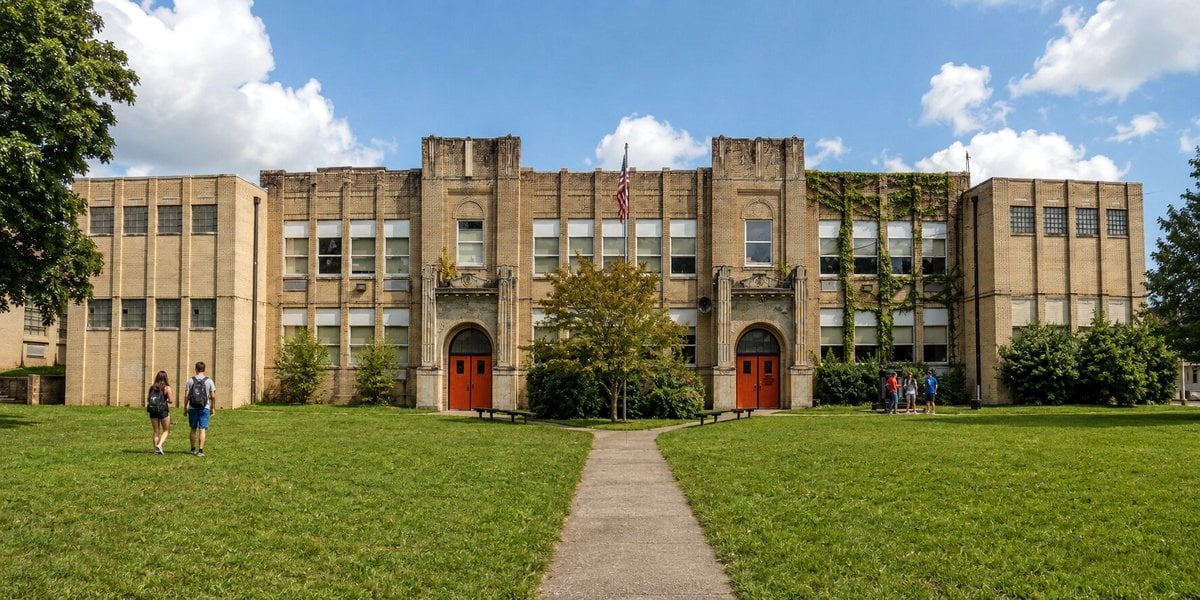
FORT GAY, W.Va. — A West Virginia high school that closed 13 years ago is being converted into apartments, offices and community space, giving a new purpose to a landmark that has stood in this small Wayne County town since 1931.
Eight affordable apartments on the second floor of the former Fort Gay High School are nearing completion, while the first floor will include commercial, municipal, public and workforce-development space.
The redevelopment is also receiving a $50,000 grant from the Preservation Alliance of West Virginia to rehabilitate the first-floor exterior, including historically appropriate replacement windows and repairs to damaged limestone window sills, glass block and brickwork.
For preservation advocates, however, the project is about more than saving one old building, according to Danielle Parker, the alliance’s executive director.
“When you’re talking about rural communities, the school buildings are, in a lot of cases, some of the grandest pieces of architecture,” Parker said. “Losing these sites leaves a huge hole in the area, and it’s really hard to develop new projects in some of these more rural communities.”
A school finds another purpose
The former high school had been vacant since its permanent closure in 2013. Coalfield Development Corporation has since acquired the property and is working to return it to productive use while preserving the historic building.
The eight apartments nearing completion upstairs are part of that effort. The broader redevelopment is intended to create space where people can live, conduct business, and access community and municipal services.
Construction has also provided paid, on-the-job training, allowing workers to develop building skills while participating in the rehabilitation.

Parker said the Fort Gay project stood out among applicants for the alliance’s Fund for Historic Schools Grant.
“This project scored highly. It was the highest scorer of all the applications that we received,” Parker said.
She said the proposal reflected the program’s purpose: finding viable new uses for decommissioned schools in rural communities where large-scale new development can be difficult to attract.
Coalfield Development already had a redevelopment plan underway, she said, giving the alliance a chance to advance a larger project rather than simply stabilize an unused building.
Closed schools can leave enormous holes
The Fort Gay project also illustrates a problem facing communities elsewhere in West Virginia as schools close and large buildings are left behind.
Former schools can be particularly difficult to reuse. They are often among the largest structures in small towns, and redeveloping them can require millions of dollars and multiple sources of financing.
“You need to have folks that really know how to do financing and put capital stacks together because the projects are usually multi-million,” Parker said.

Historic rehabilitation tax credits and other incentives are often needed to make such projects possible, she said.
But Parker said the buildings can also be unusually important to the places around them. Schools were often built in central locations and became some of the most prominent pieces of architecture in their communities.
That makes the consequences of losing them especially visible in rural towns, where relatively little new development may be taking their place.
The Fort Gay grant is being awarded through the Preservation Alliance’s Fund for Historic Schools Grant program, supported by a Paul Bruhn Historic Revitalization Grant from the National Park Service and the U.S. Department of the Interior. The program aims to encourage economic development by rehabilitating historic school buildings in rural West Virginia communities with high levels of poverty.
In Fort Gay, the $50,000 award represents only a portion of the investment required to return the former school to use. It will focus on the first floor, while work on the apartments upstairs moves toward completion.
For Parker, success will ultimately be measured less by the rehabilitation itself than by whether people once again have a reason to enter the building.
“I just hope that it’s a place where people are using it and they feel safe, having good experiences there,” Parker said. “It’s a place that people can gather and get their business done and live.”
“I think that’s really why we do this. We just want to have healthy places to live.”
This is the way grand old buildings like that should be re-purposed.
I agree. All these closed buildings should be evaluated with re-purposed if possible. In Fairmont, WV, Miller School now houses seniors! So many empty malls across America.
I feel this is a wonderful project! Especially after losing our original high school, which was a beautiful old building. Now we have already lost the one that was considered the new one, when I was in school, after flooding. At least we still have a combination school in our end of the county.